Hello! Welcome to the final lesson in our module on Strategic Foresight & Failure Analysis.
In our last session, we built a powerful tool for seeing the invisible structures that drive system behavior: the Causal Loop Diagram (CLD). You learned how to model a trust-collapse scenario, revealing the vicious, reinforcing feedback loops that can quickly spiral out of control.
Today, we will connect that structural map to the world of decision-making. We'll examine how specific choices made by product leaders and designers act as the trigger for these devastating cascades. Your learning outcome is to analyze the key decisions in a trust-collapse scenario in terms of their first and second-order consequences. This skill bridges the gap between understanding a system and intervening in it effectively, a core competency for a systems architect.
1. Beyond the Immediate: Introducing Second-Order Thinking
When we make a decision, we usually focus on the immediate, intended result. This is first-order thinking. It's fast, intuitive, and often necessary. However, it's rarely sufficient.
Every action creates a ripple effect, a chain of consequences that unfolds over time. Second-order thinking is the deliberate practice of asking, "And then what?" It's about anticipating the downstream effects, the unintended side effects, and the long-term reactions that are not immediately obvious.
The following video introduces this concept brilliantly, contrasting short-term gratification with long-term strategic thinking.
Long-Term Thinking, 2nd Order Consequences & Effect Horizons
This video from Sam Ovens explains the core ideas of second-order consequences and how a failure to consider them is at the root of many personal and business failures. Pay close attention to the distinction between short-term and long-term thinking.
Please watch two segments: From the beginning to 05:22 to understand the fundamental concept. From 10:06 to 11:41 for a clear definition of second-order consequences.
As the video explains, most people stop at the first-order consequence. The ability to see the second, third, and Nth-order effects is what separates strategic thinkers from purely reactive ones. In your mechanical engineering studies, you may have encountered similar principles in control systems, where a small input can lead to oscillating or exponentially unstable behavior over time due to feedback. The same applies to product and business systems.
To solidify this, let's look at a text that breaks down the concept with clear business examples.
Second-Order Thinking: How Hidden Effects Shape Winners
This article, 'Second-Order Thinking: How Hidden Effects Shape Winners', provides a structured definition and several illustrative examples that will be very relevant to your work.
Please read from the beginning of the article down to the end of the 'Illustrative examples' section. Focus on the definitions of first-order and second-order thinking and how the examples (like the 'resume optimizer gone wrong') show a first-order 'win' becoming a second-order 'loss'.
2. Mapping Consequences with Your CLD
So, how do we systematically trace these consequences? The Causal Loop Diagram you learned to build in the last lesson is the perfect tool. It is, in essence, a map of potential first, second, and third-order consequences.
Let's revisit the ConnectSphere scenario from last lesson's exercise:
A leading social media platform, "ConnectSphere," rolls out a new AI-powered content moderation system. The goal is to reduce harmful content. However, within weeks, prominent users complain that their posts are being unfairly removed. A narrative emerges online that the AI is politically biased and acts like an overzealous censor.
Let's analyze the core decision using the "And then what?" framework.
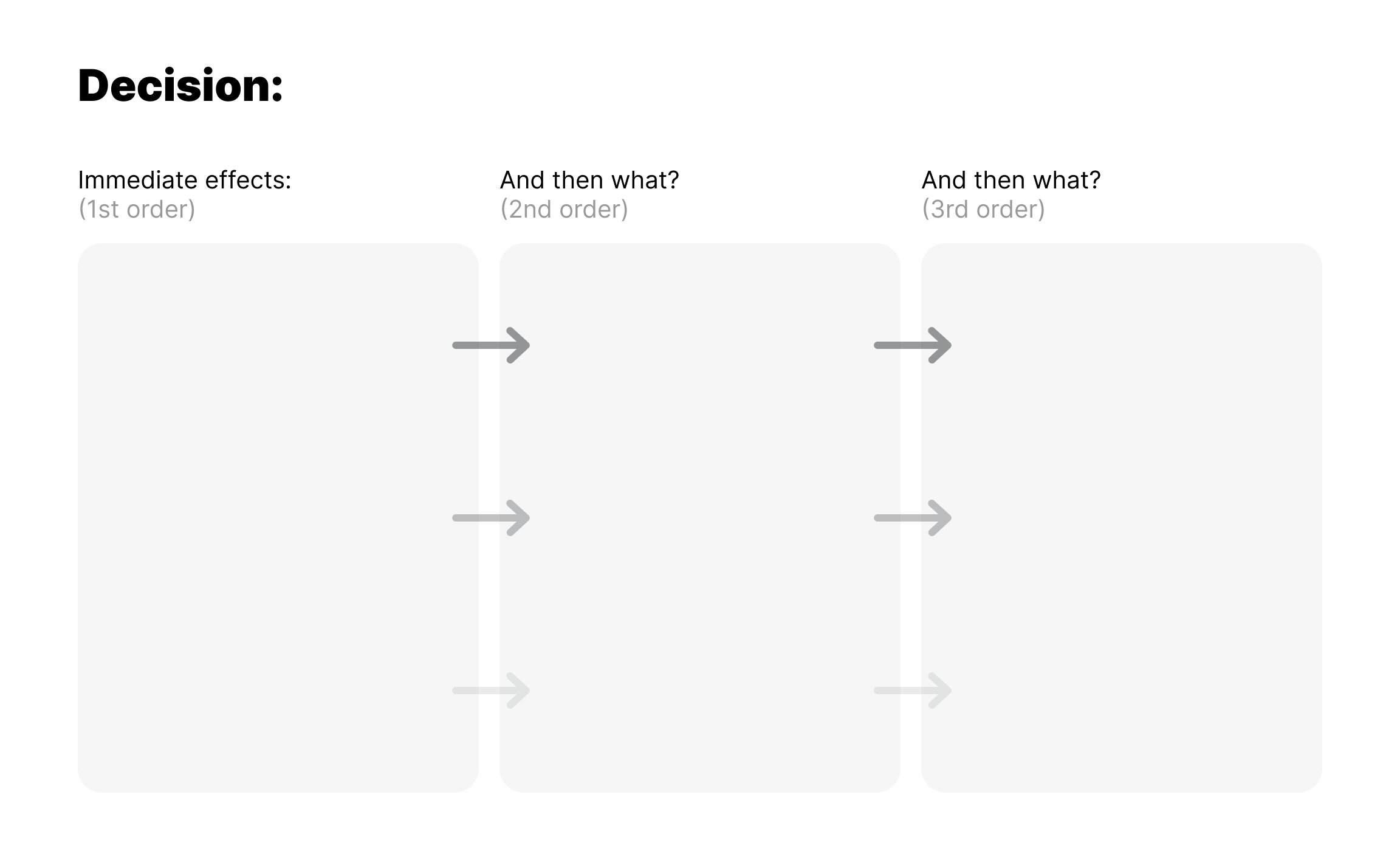
Decision: Launch the new AI content moderation system.
| Immediate Effects (1st Order) | And then what? (2nd Order) | And then what? (3rd Order) |
|---|---|---|
Intended: Harmful Content decreases. |
Unintended: False positives increase, leading to a rise in Perceived Censorship. |
Negative Media/Social Buzz increases, which causes User Trust in Platform to decrease. |
Intended: Human Moderation Cost decreases. |
Unintended: Users feel their voice is unfairly silenced. | A reinforcing loop kicks in: Negative Buzz causes more users to leave, reducing User Engagement and ad revenue. |
| Unintended: A few high-profile users have posts incorrectly removed. | The narrative of "AI censorship" spreads, fueling the #ConnectSphereIsOverParty hashtag. |
The platform is now in a reactive crisis mode, further eroding trust as they try to "fix" the problem they created. |
Your CLD from the last lesson should look very similar to this chain of events. The second and third-order consequences are the variables and links that make up the "distrust doom loop." The first-order decision was the spark that lit the fuse on this pre-existing systemic structure.
3. Case Study: The Algorithmic Displacement of Trust
Now let's apply this analysis to a deep, real-world scenario that has shaped the modern internet. Many social media platforms made a key architectural decision years ago: to algorithmically optimize feeds for user engagement.
This seems like a rational, first-order decision. But what were the second-order consequences? The following academic essay, "Algorithmic Displacement of Social Trust," presents a powerful argument that this single decision is at the root of many problems we see today, from the spread of misinformation to the erosion of shared reality.
This is a more challenging text, but it contains a critical insight for any system architect. We will focus only on the core arguments.
Algorithmic Displacement of Social Trust
This essay argues that the real problem with social media algorithms isn't just the 'bad content' they sometimes show (a first-order problem), but their displacement of the reliable social processes we use to determine truth (a devastating second-order consequence).
This reading is broken into two parts. Please read them in order: Part 1: The Core Argument. Read the section titled 'Problematic Algorithmic Amplification.' Focus on the authors' distinction between problematic content as a symptom and the underlying algorithmic process as the disease. This is the essence of first vs. second-order thinking. Part 2: The Evidence. Now, read the section titled 'The Case of Epistemic Processes.' This section explains how algorithms optimized for engagement end up undermining trustworthy knowledge. Pay close attention to the examples of how platforms like Twitter (now X) penalize external links and attribution—practices that are essential for building trust in traditional media.
Your Analysis
After completing the reading, take a few minutes to reflect on these questions. You don't need to write long answers; the goal is to synthesize the information.
- The Decision: What was the primary business goal that led platforms to design their algorithms to maximize user engagement?
- First-Order Consequence (The "Win"): What was the immediate, positive business outcome of this decision?
- Second-Order Consequence (The "Loss"): According to the article, what trustworthy social "processes" were displaced or damaged by this decision? How did optimizing for engagement lead to the amplification of unreliable, controversial, or false information?
- Connecting to CLDs: How does this analysis explain the "distrust doom loop"? How does a system designed for engagement inevitably create the conditions for a trust collapse?
This analysis reveals a classic pattern: a decision that is highly successful by first-order metrics (like time-on-site or ad revenue) can simultaneously plant the seeds of its own long-term destruction by creating negative second-order effects (like eroding user trust and degrading the information ecosystem).
Conclusion
In this module, we have moved from identifying immediate risks to mapping deep systemic structures and analyzing the long-term consequences of key decisions.
Key Takeaways:
- First-order thinking solves the immediate problem. Second-order thinking builds a durable system.
- The key question of a strategic architect is always, "And then what?"
- A Causal Loop Diagram serves as a map to trace the path from a first-order decision to its cascading second and third-order consequences.
- Many trust-collapse scenarios are not accidents but the predictable, long-term result of decisions that prioritized short-term, first-order wins while ignoring disastrous second-order effects.
Next Lesson Preview
You have now completed Phase 1 of the Architect Track on Systems Thinking. You've learned to see products not as static objects, but as dynamic systems with feedback loops, delays, and hidden consequences.
In our next lesson, we will begin Phase 2: Economic Modeling. We'll start with the learning outcome: "Model the cost structure of a SaaS feature in a spreadsheet." We will see how these economic models often drive the very first-order decisions we've been analyzing, providing another critical lens for understanding and designing robust systems.