Hello! Welcome to the next phase of your journey toward becoming a systems architect.
In the previous module, we concluded by exploring Donella Meadows' hierarchy of leverage points. You learned that the most powerful interventions in a system—like changing its goals or rules—are often the least obvious. However, a high-leverage intervention can have powerful and unexpected consequences. Acting on a system without foreseeing these consequences is like steering a large ship with a powerful rudder but without looking at the horizon.
This lesson marks the beginning of our module on Strategic Foresight & Failure Analysis. We will start by building a foundational mental model for anticipating the future. Your learning outcome for today is to be able to distinguish first-order (immediate) from second-order (long-term) consequences of a product decision.
This skill is the bedrock of strategic thinking. It helps you move from simply solving today's problems to designing products and systems that are resilient, sustainable, and successful in the long run.
1. First-Order vs. Second-Order Thinking
At its core, the distinction is simple.
- First-order thinking is fast and superficial. It focuses on solving an immediate problem by considering only the direct result of a decision. "I am hungry, so I will eat this candy bar." The first-order consequence is that your hunger is satisfied.
- Second-order thinking is more deliberate. It asks, "And then what?" It explores the ripple effects of a decision over time. "I will eat this candy bar. And then what? I will get a sugar rush, followed by a crash. And then what? If I do this every day, I will gain weight and my health will decline."
Most people and organizations operate on first-order thinking because it's easier and provides immediate feedback. True strategic advantage, however, comes from mastering second-order thinking.
To see this concept in action, let's watch a short video that uses a historical and a business example to illustrate the point.
THE GREAT MENTAL MODELS by Shane Parrish | Core Message
This clip from the Productivity Game channel provides a concise introduction to second-order thinking, explaining why you must think beyond the immediate outcome you desire.
Please watch from 04:55 to 06:20. Notice how it contrasts the desired immediate outcome with the disastrous unintended consequences that followed.
2. Consequences in Product and Technology
This mental model is not just for historical analysis or personal habits; it is critical in technology and product design. Your background in mechanical engineering has likely exposed you to the idea that a change in one part of a physical system can have cascading effects elsewhere. Digital systems are no different.
Let's look at a well-known example from the tech world.
Why Systems Thinking Is the Most Powerful Tech Skill
In this clip from 'Why Systems Thinking Is the Most Powerful Tech Skill' by Tiff In Tech, a real-world example from Facebook illustrates how optimizing for a seemingly positive first-order outcome led to a significant negative second-order consequence.
Watch from 01:27 to 01:41. This is a very brief but powerful example.
Facebook's decision is a classic case:
- Decision: Change the algorithm to boost "meaningful interaction."
- First-Order Consequence: Engagement with certain types of content (often emotionally charged) increased. This metric looked good.
- Second-Order Consequence: The system amplified outrage and disagreement, contributing to increased political polarization.
Here are a few more examples common in product development:
- Offering Deep Discounts:
- 1st-Order: Boost short-term sales and acquire new users.
- 2nd-Order: Attracts price-sensitive customers with low loyalty, anchors your product's value at a lower price, and damages your brand's premium perception.
- Cutting the R&D Budget:
- 1st-Order: Meet quarterly profit targets and improve short-term financials.
- 2nd-Order: A decline in product innovation, loss of top engineering talent to competitors, and a diminished market position within 2-3 years.
- Adding a Feature to Maximize Daily Active Users:
- 1st-Order: A 10% lift in engagement.
- 2nd-Order: Increased server load (higher costs), user burnout from excessive notifications, and a brand reputation for being "addictive" rather than "useful."
As a UI/UX designer, you are constantly making decisions that have ripple effects. The layout, copy, and interaction patterns you design are interventions in a system. Thinking about the second-order effects of these decisions is what elevates your work from execution to architecture.
3. A Practical Framework for Product Decisions
Knowing the concept is one thing; applying it is another. The following reading provides an excellent, actionable framework for applying second-order thinking in a product management and design context.
This article, 'Second Order Thinking' by Ranit Sanyal, is written specifically for product builders. It provides a clear definition, a step-by-step framework, and multiple real-world scenarios that demonstrate the difference between first and second-order thinking.
Please read the article from the beginning down to the section titled 'The Second Order Consequences Map'. Focus on the step-by-step framework (Ask 'And then what?' 5 times) and the excellent 'Real Product Decisions Through Second Order Lens' scenarios.
The framework from the article gives you a repeatable process:
- Map the immediate effect: What is the obvious, direct result?
- Ask "And then what?" repeatedly: Chain the consequences together to see where they lead.
- Consider multiple stakeholders: How does this affect users, internal teams, business metrics, and competitors?
- Look for feedback loops: Does this create a virtuous (positive) or vicious (negative) cycle that will compound over time?
- Pressure test with time horizons: How does this play out after 1 week? 1 month? 1 year?
This structured approach helps you move beyond your initial assumptions and uncover the hidden dynamics of your decision.
4. Visualizing the Chain Reaction
Decisions don't create consequences in a straight line; they create an interconnected web of effects. A single choice can impact finances, customer perception, and team morale, and these impacts can then influence each other.
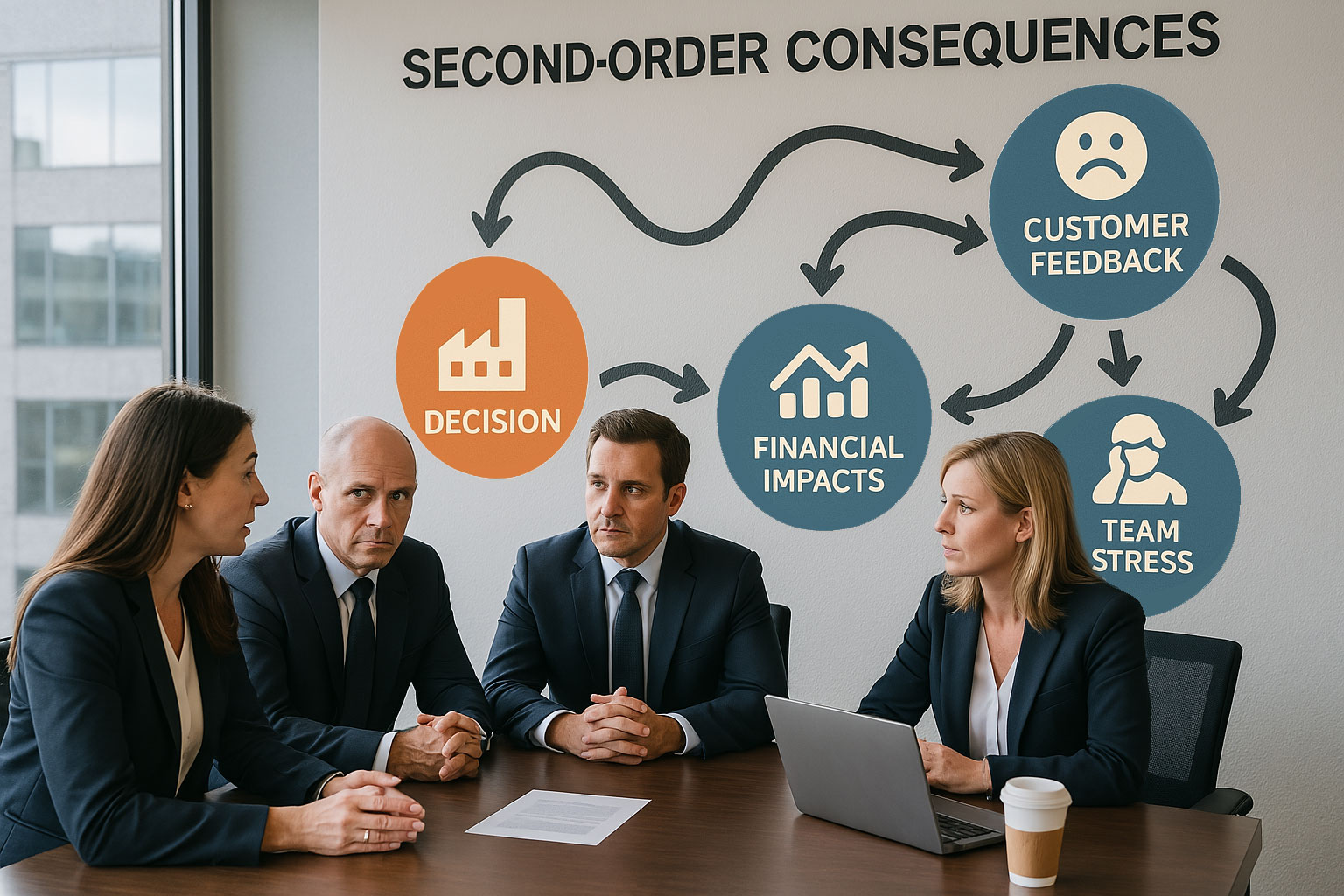
This image captures the essence of systems thinking. A change in one area ripples outwards. The "Team Stress" caused by a decision could lead to burnout, which impacts product quality, which then generates negative "Customer Feedback," which in turn creates negative "Financial Impacts." This is a vicious feedback loop—a key second-order effect to anticipate.
5. Putting It into Practice
Let's try a quick exercise. Consider the following scenario:
A popular fintech app that helps users budget and save wants to increase daily engagement. The product team decides to add a gamification layer. Users will now earn points and badges for daily logins, completing budget categories, and making transactions through the app.
Based on what you've just learned, take a moment to think about this decision.
- What is the obvious first-order consequence the team is hoping for?
- Now, ask "And then what?" Brainstorm at least three potential second-order consequences (they can be positive, negative, or neutral).
. . .
Here's one possible analysis:
-
First-Order Consequence: User engagement metrics (like daily active users and session time) will likely increase in the short term as users start chasing points and badges.
-
Potential Second-Order Consequences:
- Behavioral Distortion: Users may start optimizing for points rather than sound financial behavior. For example, they might make many small, unnecessary transactions to earn a badge, defeating the app's core purpose of helping them save money. This is a classic example of Goodhart's Law, which we'll cover soon.
- User Segmentation and Churn: Serious users who rely on the app for its clean, professional budgeting tools may feel the app has become "childish" or distracting. They might churn in favor of a more utility-focused competitor.
- Extrinsic Motivation Burnout: The initial fun of collecting badges wears off. Because the user's motivation has shifted from intrinsic (feeling good about managing money) to extrinsic (getting points), they lose interest in the app altogether when the novelty fades. Engagement plummets below its original baseline.
As you can see, a decision that looks like an easy win from a first-order perspective can introduce significant long-term risks to the product's value and sustainability.
Conclusion
Today, you've added a crucial mental model to your architect's toolkit. By learning to look past the immediate and obvious, you can start to anticipate, shape, and mitigate the long-term ripple effects of your decisions.
Key Takeaways:
- First-order thinking addresses the immediate result of an action. It's fast, reactive, and often misleading.
- Second-order thinking asks "And then what?" to explore the delayed, indirect, and often counter-intuitive consequences of a decision over time.
- Decisions that look good in the short term (e.g., boosting a single metric) can create disastrous second-order effects (e.g., destroying user trust, creating perverse incentives).
- Using a framework—mapping effects, considering all stakeholders, and testing across time horizons—can make second-order thinking a systematic and repeatable practice.
Next Lesson Preview:
You've now learned the concept of distinguishing immediate from long-term effects. In our next lesson, we will make this more concrete. We will practice how to map the potential 6-month and 3-year impacts of a new feature introduction, applying today's thinking to specific time horizons to build a strategic foresight capability.