Hello again! Welcome to your next lesson in the Strategic Foresight & Failure Analysis module.
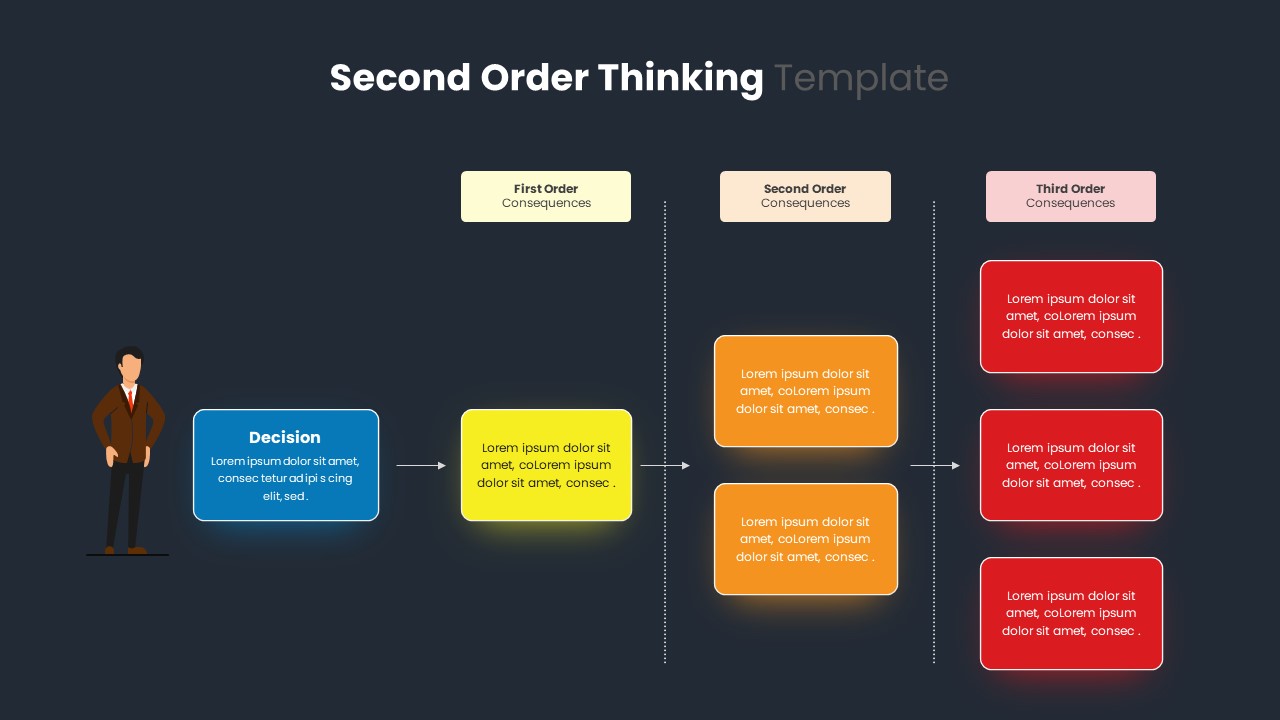
In our previous session, we established the critical difference between first-order (immediate) and second-order (long-term) consequences. You learned to use the simple but powerful question, "And then what?", to start tracing the ripple effects of a decision.
Today, we will build directly on that foundation by adding structure and specific time horizons to our analysis. It’s one thing to know that long-term consequences exist; it’s another to systematically map them out. Your learning outcome is to be able to map the potential 6-month and 3-year impacts of a new feature introduction. This skill moves you from being a designer who implements features to an architect who anticipates the future.
1. Thinking Across Time Horizons
Thinking about the future is difficult because it's abstract. A powerful technique to make it concrete is to force yourself to consider specific time scales. What does the impact of your decision look like in a week? Six months? Three years? Ten years?
This forces you to move beyond immediate gratification and consider the delayed, often hidden, consequences that emerge over time. In fact, the time lag is a defining characteristic of second-order effects.
Let's start with a video that clearly breaks down how a single decision can lead to first, second, and even third-order consequences, illustrating how these effects ripple outward over time.
The Power of Framework Thinking for Executives (Mental Models in Business)
This video, 'The Power of Framework Thinking for Executives' by Kara Ronin, provides a great business example of mapping out the chain of consequences for a decision. It clearly distinguishes between first, second, and third-order effects.
Please watch from 08:43 to 11:45. Pay close attention to how the example of leadership training creates both positive and negative consequences at each stage of the chain.
As the video demonstrates, a single decision creates a branching tree of possibilities. The further you go down the chain, the more you are thinking about longer-term, second- and third-order effects.
2. A Framework for Mapping Long-Term Impact
To make this process systematic, we can use a structured framework. A great article from Upgrowth introduces the C-E-S Framework: Consequences, Ecosystem, and Scenario Timeline. The "Scenario Timeline" component is exactly what we need for today's outcome.
Second-Order Thinking: How Hidden Effects Shape Winners
The article 'Second-Order Thinking: How Hidden Effects Shape Winners' is an excellent resource that explains why looking at long-term effects is a key differentiator for successful businesses. It introduces a practical framework for doing so.
Please read two sections from this article: Start at 'First-order versus second-order thinking' and read down to 'Illustrative examples'. Focus on the definition of second-order effects as 'hidden consequences that emerge over time'. Then, read the section 'c. Scenario timeline: think across time horizons'. This section provides the exact framework we'll be using.
The key idea from the reading is to deliberately project the impacts of a decision across different time scales:
- Immediate (days/weeks): This is where you see the first-order effects. What are the initial metrics, user reactions, and system responses?
- Medium Term (months): Here, the initial second-order effects begin to surface. How has user behavior started to shift? How are competitors reacting? Are there new operational strains on your team? This corresponds to our 6-month impact analysis.
- Long Term (years): Deeper, systemic second-order effects become clear. Has the feature changed your market position? Has it eroded or enhanced your brand? Has it created dependencies that are now hard to reverse? This is our 3-year impact analysis.
The case studies of Netflix's pivot to streaming or Chegg's failure to anticipate ChatGPT, also mentioned in the article, are perfect examples of how decisions play out over a multi-year horizon.
3. Asking the Right Questions for Long-Term Foresight
To effectively map impacts at 6 months and 3 years, you need to ask probing questions that go beyond surface-level metrics. You're not just predicting numbers; you're predicting behaviors, expectations, and systemic shifts.
The following article offers a powerful set of questions tailored for exactly this kind of deep thinking, especially relevant in the context of AI and digital products.
Second-Order Thinking Made Useful: A Product Strategy Framework ...
This Medium article, 'Second-Order Thinking Made Useful,' provides a framework specifically for assessing the cognitive and behavioral impacts of new technology.
Please read the sections 'What Is Second-Order Thinking?' and '4. Ask Second-Order Questions!'. The questions in part 4 are especially valuable prompts for our exercise.
These questions are fantastic tools for your analysis:
- What are we training users not to do?
- What happens if this becomes the default?
- What feedback loop are we reinforcing?
- Is this a stepping stone or a crutch?
These questions force you to think about the user and the system not just as they are today, but what they will become as a result of your feature.
4. Practical Exercise: Mapping the Impact of an AI Feature
Let's put this into practice. Given your interests in UI/UX, AI, and fintech, consider the following scenario.
Scenario:
A popular fintech app, "FinBalance," helps users manage their budgets and savings goals. The product team decides to launch a major new feature: "AI Autopilot."
This feature uses AI to automatically:
- Analyze a user's spending habits and identify "excess" cash.
- Move that cash into a high-yield savings account.
- Based on the user's stated risk tolerance, automatically invest a portion of that savings into a pre-defined portfolio of ETFs.
The user can set it and forget it. The primary goal is to increase user retention by delivering tangible financial growth with zero effort.
Your Task:
Map the potential impacts of the "AI Autopilot" feature over 6 months and 3 years. Use the framework and questions we've discussed.
A. Immediate Impact (First 30-60 days)
- What are the likely first-order consequences? (Think about user adoption, key metrics like 'assets under management', and initial user feedback).
B. Medium-Term Impact (6-12 months)
- And then what? What second-order effects start to appear?
- Prompt Question: What are you training users not to do anymore?
- Prompt Question: How might a segment of your users react negatively to this level of automation?
- Prompt Question: How might your customer support team's workload change?
C. Long-Term Impact (3+ years)
- And then what? What deeper, systemic effects might have taken hold?
- Prompt Question: What happens if "AI Autopilot" becomes the default, expected way of managing money for your user base? How does this change your brand and market position?
- Prompt Question: What happens during a major market downturn? How does the feature's behavior (and the users' lack of financial literacy) create a catastrophic failure scenario for the user and for FinBalance's reputation?
- Prompt Question: How might competitors and regulators have responded by this point?
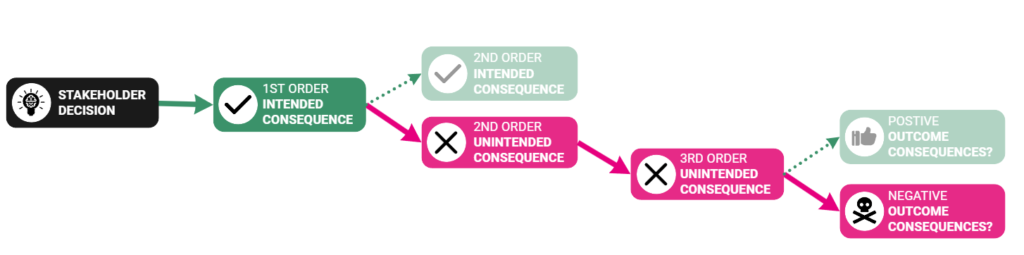
Take about 15-20 minutes to outline your thoughts for each time horizon. Think in terms of a branching tree of consequences—some positive, some negative, some intended, and some unintended.
5. An Example Analysis
Here is a sample of how one might begin to analyze the scenario.
-
Immediate (30 days):
- First-Order: High engagement from early adopters. A small but growing amount of money flows into the Autopilot system. Positive press about "the future of finance." The "total savings automated" metric looks great on dashboards.
-
Medium-Term (6 months):
- Second-Order (Positive): A cohort of users sees tangible growth in their savings/investments and becomes highly loyal, increasing LTV.
- Second-Order (Negative): Users become financially illiterate; they don't understand why their money is moving or what it's invested in. This creates a "black box" problem. Customer support is flooded with questions about why the AI made a certain move. Some users, particularly those who enjoyed the control of manual budgeting, churn because the app feels too opaque now.
-
Long-Term (3 years):
- Third-Order (Systemic Risk): A major stock market crash occurs. The AI Autopilot, following its rules, continues to invest or sells at a loss, wiping out significant value for users who never understood the risk they were opted into. This leads to mass user revolt, lawsuits, and regulatory investigation. FinBalance's brand is permanently damaged as being "reckless" with user money.
- Third-Order (Market Shift): Competitors have either copied the feature (making it table stakes) or successfully marketed against it, branding themselves as the "transparent, human-in-the-loop" alternative for savvy users. The entire market's perception of financial automation has been shaped by the success or failure of features like Autopilot.
This exercise shows how a feature that seems like a clear win on day one can contain the seeds of its own—and the company's—destruction if its long-term, second-order effects are not considered.
Conclusion
Today, you've transformed a conceptual understanding of second-order thinking into a practical, strategic skill. By applying specific time horizons—6 months and 3 years—you can force a more rigorous and imaginative analysis of a feature's true impact.
Key Takeaways:
- Second-order effects are consequences that emerge with a time lag. Mapping impacts over 6 months and 3 years is a structured way to anticipate them.
- Asking probing questions about behavior ("What are we training users not to do?") and system dynamics ("What happens if this becomes the default?") is crucial for long-term foresight.
- A feature's immediate success can be misleading. The most significant risks and opportunities often lie in the second- and third-order effects that play out over years.
Next Lesson Preview:
You can now map out the potential future consequences of a decision. But what if you want to be more proactive in preventing disaster? In the next lesson, we will learn to apply inversion thinking to identify potential catastrophic failure modes for a product. Instead of just asking "What will happen?", we will start by assuming failure and working backward to see how we might get there.