Hello! Welcome to the next lesson in our module on Strategic Foresight & Failure Analysis.
In the previous lesson, we focused on looking forward, mapping the potential 6-month and 3-year impacts of a product decision. You learned to ask "And then what?" to trace the ripple effects of a new feature. This is a crucial skill for anticipating the future.
Today, we're going to flip that approach on its head. Instead of just trying to predict success or map out consequences, we will actively hunt for failure. This powerful mental model is called inversion. Just as a mechanical engineer might stress-test a physical component to find its breaking point, a systems architect must stress-test a product idea to find its potential modes of collapse.
Your learning outcome for this lesson is to apply inversion thinking to identify potential catastrophic failure modes for a product.
1. What is Inversion Thinking?
At its core, inversion is a problem-solving technique where you identify what you want to avoid and then work backward. Instead of asking, "How can we make this project a success?", you ask, "What would guarantee this project's total and complete failure?".
By starting with failure, you uncover risks, blind spots, and flawed assumptions that are often invisible when you only think in a forward direction.
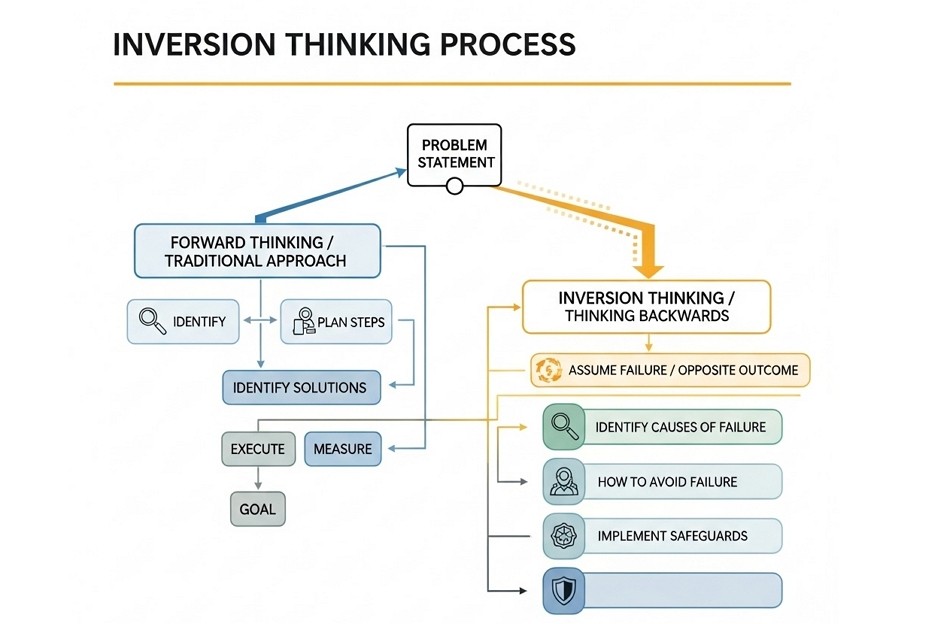
To see just how powerful this shift in perspective can be, let's look at a classic historical example.
Get Ahead of 99% of People by Thinking Backwards (Inversion Explained)
This segment from the video 'Get Ahead of 99% of People by Thinking Backwards' by Value Catcher tells the famous story of Abraham Wald and the WWII planes. It's a perfect illustration of how focusing on failure (the planes that didn't return) can lead to life-saving insights that forward-thinking missed.
Please watch from 00:33 to 02:03. Pay close attention to how the obvious, forward-thinking solution was wrong, and how inverting the problem revealed the correct, counter-intuitive answer.
Wald's insight came from considering the missing data—the planes that failed to return. This is the essence of inversion: systematically considering the negative outcome to make better decisions about achieving the positive one.
2. From Inversion to Pre-Mortem: A Practical Tool
So, how do we apply this in a product design context? We use a technique called a pre-mortem. A post-mortem happens after a project has failed to figure out what went wrong. A pre-mortem happens before a project even starts, by imagining it has already failed spectacularly.
This proactive pessimism helps you bypass natural optimism bias and identify catastrophic risks when they are still cheap and easy to fix.
Let's watch another clip that explains the concept.
Get Ahead of 99% of People by Thinking Backwards (Inversion Explained)
This clip, also from 'Get Ahead of 99% of People by Thinking Backwards', introduces the 'failure premortem' as a direct business application of inversion. It frames it as a 'kill the company' exercise, which is a memorable way to think about it.
Please watch from 05:19 to 06:04. This section provides a concise overview of how to conduct a failure pre-mortem.
The process is simple but profound:
- Imagine your project has completely failed.
- Work backward to generate all the possible reasons for that failure.
- Use that list of failure modes to strengthen your plan.
3. An "Inversion Pass": A Structured Approach
To make this even more concrete, we can use a structured framework. Given your engineering background, you'll likely appreciate a systematic checklist for identifying failure modes across different domains. The following article provides an excellent template for what it calls an "inversion pass."
The article 'Invert, always invert' from The Engineering Manager provides a detailed template for applying inversion thinking in a technical context. Its 'Inversion questions' are a fantastic, practical tool for our exercise.
Please read the sections titled 'Doing an inversion pass' and 'Inversion questions'. Focus on the seven categories of questions provided—they form a powerful checklist for identifying different types of failure modes.
The questions in that article give you a powerful lens through which to view your product:
- Catastrophic failure: What breaks the whole system?
- Silent degradation: What fails slowly without tripping alarms?
- Rollback: Can we undo this if it goes wrong?
- Load and scale: What happens when usage is 10x our assumption?
- Dependency failures: What if a service we rely on breaks?
- Human error: How could our own team break this?
- Data integrity and security: How could data be corrupted, lost, or exposed?
This structured approach moves inversion from a purely philosophical exercise to a repeatable engineering and design practice.
4. Practical Exercise: Pre-Mortem of an AI Feature
Now it's your turn to apply this. Let's use a scenario that combines your interests in SaaS, AI, and UX design.
Scenario:
A B2B SaaS company that provides project management tools, "TaskFlow," is launching a new premium feature called "AI Smart Scheduler."
- What it does: The feature automatically analyzes all project tasks and assigns them to team members.
- How it works: It uses AI to consider each team member's documented skills, current workload, availability calendars, and historical performance on similar tasks.
- The promise: It claims to optimize project timelines, ensure fair workload distribution, and free up project managers from the manual drudgery of task assignment.
Your Task:
Conduct a mini "inversion pass" on the "AI Smart Scheduler" feature.
-
Assume Catastrophic Failure: Imagine it is 6 months after launch. The feature is being emergency-disabled. Customers are furious, and several large accounts have canceled their subscriptions specifically because of it. It has been an unmitigated disaster.
-
Identify Failure Modes: Now, work backward. Using the "Inversion questions" from the article as your guide, list at least five potential reasons why the feature failed so catastrophically. Try to come up with at least one reason for each of the following categories:
- Catastrophic Failure: What single point of failure could have led to projects being derailed?
- Silent Degradation: How could the AI have failed slowly and caused damage before anyone noticed?
- User Experience & Human Factors: How could the design and interaction with the feature itself have led to its failure, even if the AI was technically "correct"?
Take about 15 minutes to brainstorm and write down your list of failure modes. Think about the system, the users (both managers and team members), and the data.
5. Example Failure Modes
Here are a few examples of the kinds of failure modes you might identify for the "AI Smart Scheduler":
- Catastrophic Failure: The AI assigns a mission-critical, high-complexity task to a junior employee who is then overwhelmed and fails, causing a major project deadline to be missed and damaging the client relationship.
- Silent Degradation: The AI's training data contains a subtle bias. Over months, it consistently assigns high-visibility "growth" tasks to men and tedious "maintenance" tasks to women on the team, leading to a toxic team culture, employee attrition, and a potential HR crisis.
- User Experience Failure: Project managers feel their authority and expertise are being undermined. They lose a sense of control and ownership over their projects. They start "fighting" the AI by manually re-assigning tasks, creating conflicting sources of truth and chaos within the team. The AI becomes a source of friction rather than a solution.
- Data Integrity Failure: The AI relies on employees' self-reported skills. Some employees exaggerate their skills to get better tasks, while others are too modest. The AI takes this bad data as truth and makes poor assignments, leading to a "garbage in, garbage out" problem that erodes all trust in the system.
Notice how these failures are not just simple bugs. They are systemic issues that arise from the interaction of technology, human behavior, and organizational context. This is why inversion is so vital for systems architecture.
Conclusion
Today, you've added a powerful tool for strategic foresight to your arsenal. While second-order thinking helps you map out potential futures, inversion thinking gives you a structured way to find and eliminate the worst possible futures.
Key Takeaways:
- Inversion is the practice of working backward from a negative outcome to identify risks and failure modes.
- A pre-mortem is a practical exercise where you imagine a project has already failed in order to uncover the reasons why.
- Using a structured checklist of inversion questions (covering catastrophic failure, silent degradation, human error, etc.) makes the analysis more rigorous and comprehensive.
- The goal of inversion isn't to be pessimistic; it's to be proactively realistic, stress-testing your ideas to make them more robust.
Next Lesson Preview:
In this lesson, you learned to identify catastrophic failure modes. In our next session, we'll take it a step further. You will learn to conduct a pre-mortem analysis to proactively identify risks for a new feature launch. This involves not just listing failures but also formalizing them as risks and beginning to think about how to address them, which will lead us directly into designing mitigation strategies.