Hello! Welcome back to our journey in designing robust decision systems.
In our last few lessons, we've focused on diagnostics. You've learned to map systems with causal loop diagrams and, crucially, to identify how those systems can fail through archetypes like 'Limits to Growth' and 'Tragedy of the Commons'. We've learned to spot the potential for collapse.
Today, we move from diagnosis to treatment. Knowing that a system is prone to failure is one thing; knowing how to fix it effectively is another. This lesson introduces one of the most powerful concepts in systems thinking: leverage points. The learning outcome is to be able to identify and rank potential leverage points for intervention in a system diagram. You'll learn that not all interventions are created equal and discover where to focus your efforts for maximum impact.
1. The Counter-Intuitive Nature of Leverage
A leverage point is a place within a complex system where a small, focused change can produce a large, lasting effect. The challenge is that these points are often not obvious. Our intuition tends to draw us to the most visible symptoms of a problem, leading us to intervene at low-leverage points. We put a lot of effort into "fixing" things with very little systemic result.
A helpful way to visualize this is the "iceberg model," which shows that the visible "events" of a system are just the tip of a much larger structure of patterns, underlying structures, and mental models.
To get a clear picture of this concept, let's watch a short video.
This video from the Systems Innovation Network introduces the concept of leverage points using the iceberg model. It effectively explains why our instinct to react to immediate events often fails to create real change, and why deeper interventions are more powerful.
Please watch from the beginning until 04:19. Pay close attention to the four levels—Events, Patterns, Structure, and Mental Models—and how they correspond to different levels of intervention: reacting, anticipating, designing, and transforming.
As the video explains, reacting to events is the lowest form of leverage. True systems change comes from altering the underlying structures and, most powerfully, the mental models (or paradigms) that create those structures in the first place.
2. The Hierarchy of Leverage Points
The most influential work on this topic comes from the late Donella Meadows, a pioneering systems scientist. She identified and ranked 12 distinct leverage points in order of increasing effectiveness. Understanding this hierarchy is fundamental to thinking like a systems architect.
The following video provides an excellent and comprehensive summary of Meadows' 12 leverage points. It's a dense overview, so the goal here is not to memorize all 12 points, but to grasp the different types of interventions and the logic behind their ranking.
Thinking in Systems, Ch. 6: Leverage Points in Systems
This video by Ashley Hodgson is a guided tour through Donella Meadows' famous framework. It presents the 12 leverage points in reverse order, from most effective to least effective, giving you a clear sense of the hierarchy.
Watch the full video. As you watch, notice how the interventions shift from tangible, physical things (like infrastructure and numbers) at the low-leverage end, to intangible but powerful things (like rules, goals, and paradigms) at the high-leverage end. We will refer back to this hierarchy throughout the course.
For clarity, here is Donella Meadows' list, presented in her original order of increasing effectiveness. I've grouped them into three broad categories that align with the iceberg model.
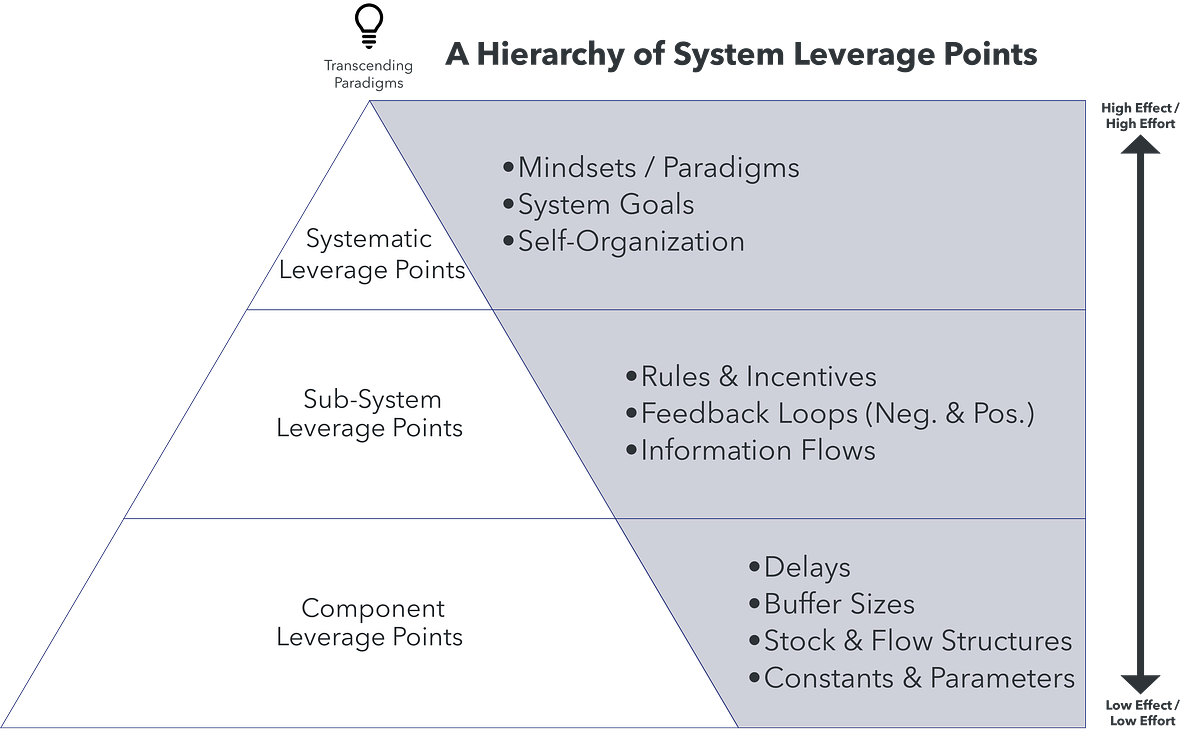
Low Leverage: The Physical System
- 12. Constants, parameters, numbers: Tweaking numerical values (e.g., changing prices, tax rates, or in UX, the specific hex code of a color). These are easy to change but rarely alter the system's overall behavior.
- 11. Buffers: The size of stabilizing stocks (e.g., inventory in a warehouse, cash reserves in a bank). Larger buffers can increase stability, but are often costly or difficult to change.
- 10. Stock-and-flow structures: The physical layout of a system (e.g., road networks, a product's information architecture). Very influential but also very difficult and expensive to change once built.
- 9. Delays: The length of time before feedback has an effect. Shortening or lengthening delays can have major effects, but they are often inherent to the system.
Medium Leverage: Information & Control
- 8. Balancing (negative) feedback loops: The strength of self-correcting loops. Strengthening these makes a system more resilient (e.g., strong anti-trust laws, clear user feedback channels).
- 7. Reinforcing (positive) feedback loops: The gain of self-reinforcing loops. Slowing down runaway loops is a powerful way to prevent collapse (e.g., progressive taxes to slow a "rich get richer" loop).
- 6. Information flows: The structure of who has access to what information. Introducing a new, relevant information flow can dramatically change behavior (e.g., making electricity meters visible in homes).
High Leverage: The Intangibles
- 5. Rules of the system: Incentives, punishments, and constraints (e.g., laws, terms of service, the rules of a marketplace). Power over the rules is real power.
- 4. Self-organization: The power of a system to add, change, or evolve its own structure. Fostering this ability leads to incredible resilience.
- 3. The goal of the system: The ultimate purpose or aim of the system. Changing the overall goal changes every part of the system below it.
- 2. The paradigm of the system: The shared mindset or deep-seated beliefs out of which the system arises. Changing the paradigm can transform a system entirely.
- 1. The power to transcend paradigms: The ability to see that no paradigm is "true" and to flexibly choose the one that is most helpful.
This list is based on Meadows' seminal article, "Leverage Points: Places to Intervene in a System" (resource_id: [LINK](https://donellameadows.org/archives/leverage-points-places-to-intervene-in-a-system/)), which is highly recommended for a deeper understanding.
3. A Designer's Guide to Leverage Points
Meadows' framework is universal, but how does it apply directly to your work as a UI/UX designer and aspiring systems architect? The next resource translates these 12 points into a more concise, five-level model specifically for design.
This article, 'Designing at leverage points,' provides a practical bridge from systems theory to design practice. It re-frames Meadows' hierarchy into categories that are immediately recognizable in product development.
Please read the article from the beginning up to and including the list of bullet points that begins with 'Break down and categorize...'. Focus on the 5-level design hierarchy and how it maps to activities you're familiar with, like interface design, UI flow diagramming, and information architecture.
This adapted model is extremely useful for a designer:
- Parameters and representations (Low Leverage): The look and feel—aesthetics, copy, layout. This is classic UI design.
- Flows and feedback loops (Medium-Low Leverage): User journeys, microinteractions, and patterns designed to influence behavior (like Nir Eyal's Hook Model). This is classic UX design.
- Structure, meaning, and availability of information (Medium Leverage): Information architecture and content strategy—what information is shown, what it's called, and who sees it.
- Goals of the system (High Leverage): The definition of success—the KPIs, metrics, and user problems you are solving (like Jobs to Be Done).
- Principles and values of the greater context (Highest Leverage): The mission of the company, the ethics of the market, the societal context.
By framing your work this way, you can more clearly assess the potential impact of your design decisions. A change to a button color (Level 1) is not the same as introducing a new information flow that increases user trust (Level 3), or contributing to a shift in a product's core success metric (Level 4).
4. Identifying and Ranking Leverage Points: An Example
Let's apply this thinking to a causal loop diagram. The diagram below models the complex system of social media use and its effect on mental well-being. It also proposes several potential interventions—these are our leverage points.
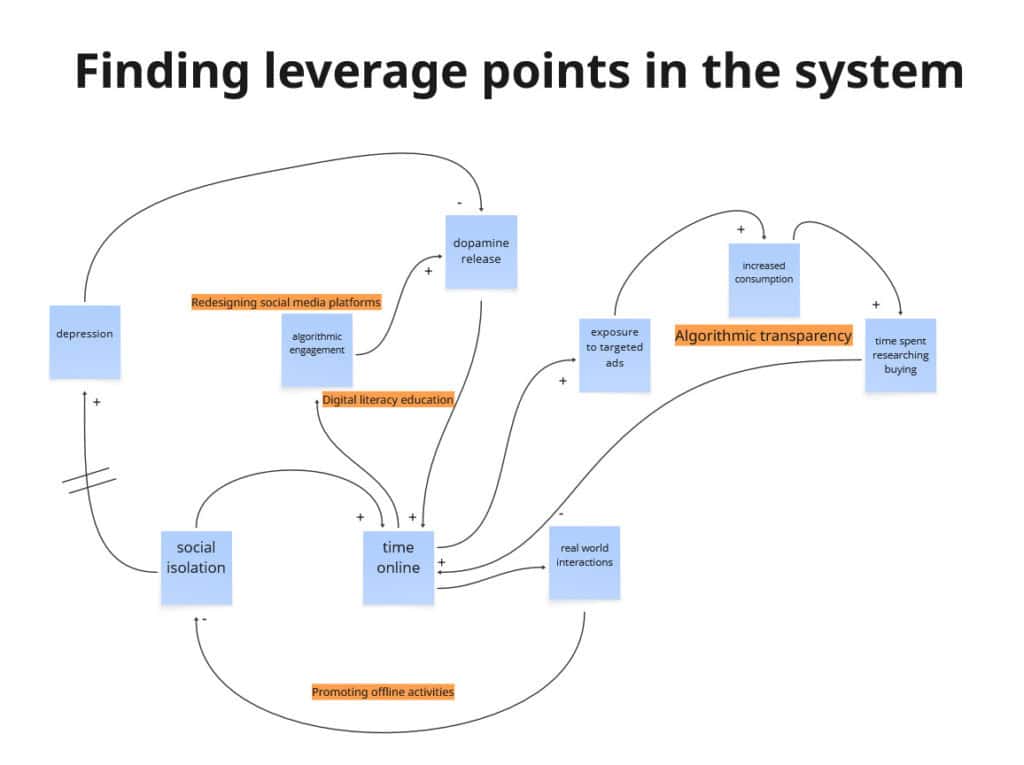
Let's identify and rank the interventions shown in the diagram:
- Promoting offline activities: This is an attempt to weaken the reinforcing loop where 'Time online' leads to 'More engagement'. This is an intervention on a feedback loop (Meadows #7, Design #2). This has medium leverage.
- Digital literacy education: This intervention aims to change user behavior and understanding. It can be seen as changing the rules of engagement from the user's side (Meadows #5) or even shifting their paradigm about social media (Meadows #2). This has high leverage.
- Algorithmic transparency: This directly addresses the structure of information flows (Meadows #6, Design #3). By revealing how the algorithm works, you empower users and change the dynamics of the system. This has high leverage.
- Redesigning social media platforms: This is a broad term, but if it implies changing the platform's core goal from 'maximizing engagement' to 'promoting meaningful connections', it is a very high leverage point (Meadows #3, Design #4). All other elements, from the algorithm to the UI, would have to be reconfigured to serve this new goal.
As you can see, interventions like changing the platform's goal or educating users about the system are far more powerful than simply trying to peel them away from the screen for a few hours.
Conclusion
You now have a powerful framework for moving beyond simply analyzing systems to strategically changing them. Understanding where and how to intervene is a critical skill for anyone designing complex products.
Key Takeaways:
- Leverage points are places in a system where small, well-focused interventions can produce significant, lasting change.
- These points exist in a hierarchy of effectiveness. Interventions at higher levels (like changing goals or paradigms) are more powerful than those at lower levels (like tweaking numbers).
- Our intuition often draws us to low-leverage, symptomatic fixes. Effective system design requires looking deeper to find the structural, rule-based, or goal-oriented leverage points.
- As a designer, you have the ability to influence systems at multiple levels, from low-leverage UI parameters to high-leverage information flows and system goals.
Next Lesson Preview:
Now that we know where to intervene in a system, our next task is to understand the consequences of those interventions over time. A powerful intervention can have unexpected side effects. In our next lesson, we will begin our module on Strategic Foresight by learning to distinguish first-order (immediate) from second-order (long-term) consequences of a product decision.