Hello! Welcome back.
In our last lesson, we explored the mechanics of C++ templates, establishing that they are blueprints the compiler uses to generate code on-demand. You learned how this instantiation process works for both functions and classes and how to control it across multiple files using extern template. This "under the hood" view is the foundation for today's topic.
Our goal for this lesson is to analyze the trade-offs of template use, including potential for code bloat and improved performance. We will investigate the two sides of the template coin: the compile-time costs they can incur and the significant runtime performance benefits they can unlock. For a systems programmer, understanding this balance is not just academic—it's essential for writing code that is both efficient and maintainable.
The "Cost" of Templates: Code Bloat and Compile Times
The power of templates—generating specific code for each type—is also the source of their primary costs. Let's break them down.
1. Code Bloat: The Price of Specialization
As you learned, when you use a template like std::vector<int> and std::vector<double>, the compiler doesn't use a single generic std::vector. It generates two separate, complete class definitions with all their member functions, one for int and one for double.
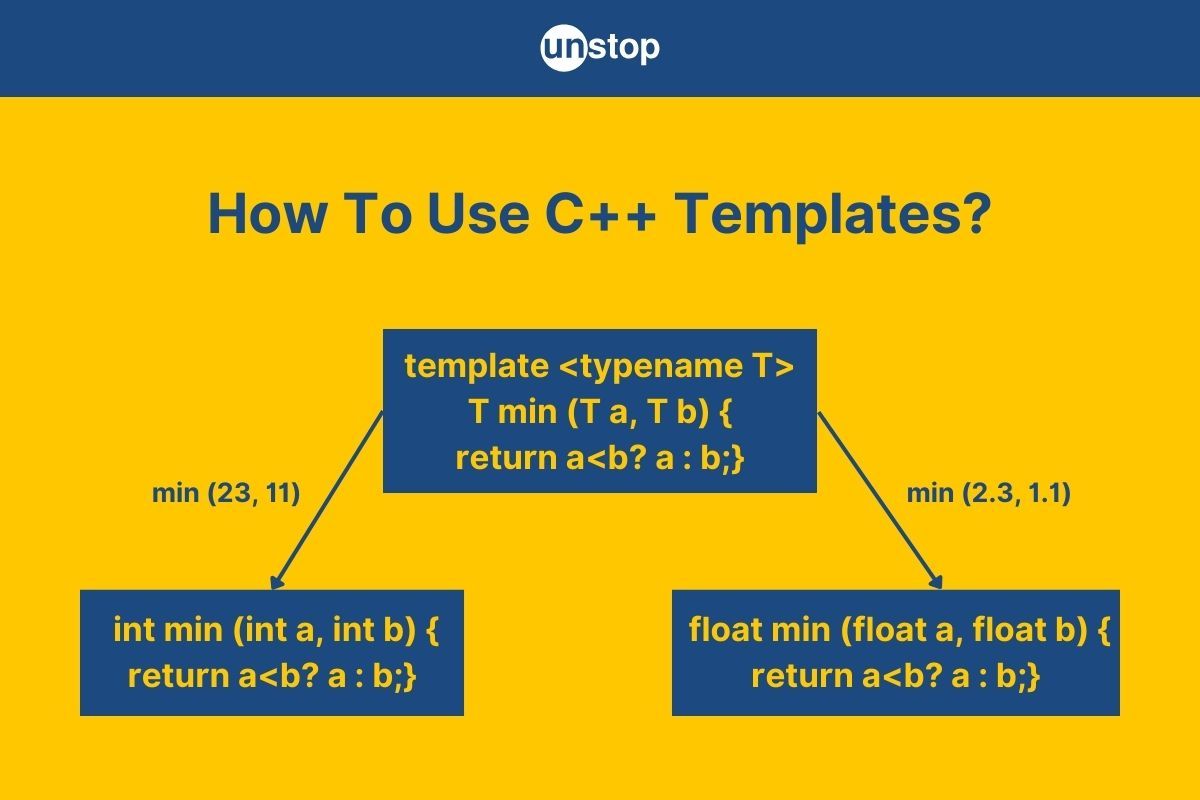
This leads to code bloat, which is an increase in the final size of your executable binary. Each instantiation contributes its machine code to the final program.
The video "Templates under the hood" we saw previously explains this phenomenon well. Let's revisit the core idea of how specializations end up in the binary.
Briefly re-watch the segment from 01:44 to 03:56. The key takeaway is seeing how using a template with three different types results in three distinct function symbols in the object file, as shown with objdump. This is the direct cause of code bloat.
While the linker can merge identical instantiations (e.g., if std::vector<int> is used in multiple .cpp files), it cannot merge std::vector<int> and std::vector<double>. They are fundamentally different types with potentially different sizes and behaviors.
2. Increased Compile and Link Times
The second major cost is time.
- Longer Compile Times: The compiler does more work. It has to parse the template, substitute the arguments, and generate the code for each instantiation. This process is more computationally expensive than compiling a non-template function.
- Header-Only Nature: Template definitions must typically reside in header files so the compiler has the full blueprint available to instantiate them. This means that a change in a popular template header can trigger a recompilation of every source file that includes it, slowing down incremental builds.
Using Modern C++ to Eliminate Virtual Functions - Jonathan Gopel - CppCon 2022
In this clip from a CppCon talk on replacing virtual functions, the speaker explicitly lists the downsides of a heavily template-based approach. This provides a concise, expert summary of the costs.
Watch the section from 29:26 to 32:22. Pay close attention to the speaker's list of downsides: Increased translation unit size. Potential increase in binary size (code bloat). Increased compile time and memory usage. Added code complexity.
Test your understanding!
Imagine you are working on an embedded system with very limited ROM (storage for the program). You have two options for implementing a generic list container:
- A template-based
List<T>which you use forList<int>,List<char>, andList<SensorData>. - A single non-template
GenericListthat usesvoid*to store pointers to heap-allocated items and requires manual type-casting (a common C approach).
Which approach is more likely to result in a larger executable binary, and why?
Show answer
The template-based List<T> is more likely to result in a larger binary. The compiler will generate three separate versions of the List class and its member functions, one for each type (int, char, SensorData).
The void* approach, while less safe and potentially slower, will only have one version of the GenericList code in the binary. This is a classic trade-off between type safety/performance and binary size.
The "Benefit" of Templates: A "Zero-Cost" Abstraction
If templates have these costs, why are they the cornerstone of modern C++? Because they enable powerful optimizations that often lead to significantly faster code. The key idea is static polymorphism.
1. Static vs. Dynamic Polymorphism: Avoiding Runtime Overhead
You've seen dynamic polymorphism with virtual functions. When you call a virtual function on a base class pointer, the program must perform a runtime lookup:
- Dereference the object's
vptrto find thevtable. - Look up the correct function address in the
vtable. - Call the function through that address (an indirect function call).
This is a small but non-zero runtime cost. Templates offer static polymorphism, where the resolution happens at compile time.
CPP / C++ - Template Metaprogramming - Generic ...
This article provides a clear comparison of static polymorphism (templates) and dynamic polymorphism.
Read the section titled "C++ 'Duck-typing' or type-safe structural typing". It highlights the key advantage: templates eliminate the runtime overhead of virtual function calls, making the code more performant.
Since the compiler knows the exact type at compile time (e.g., it's compiling max<int>), it can directly call the correct function or, even better, inline it. Inlining replaces the function call with the body of the function itself, eliminating function call overhead entirely.
2. The Power of Inlining: A C vs. C++ Example
Your C background makes the comparison between C's qsort and C++'s std::sort particularly insightful.
qsort: Takes a function pointer for the comparison. The compiler typically cannot inline a call through a function pointer. Every comparison involves an indirect function call. It also needs the size of elements as a runtime argument, leading to genericmemcpyoperations.std::sort: Is a function template. The comparison logic (often a functor or lambda) is a template parameter. The compiler can generate a specialized version ofsortwith the comparison logic inlined directly into the sorting loop. It also knows the element type and size at compile time, allowing for highly optimized copy/move operations instead of generic memory copies.
C++ templates for performance?
The top answer on this StackOverflow question gives an excellent, detailed breakdown of why std::sort often outperforms qsort, directly attributing it to the optimizations enabled by templates.
Read the first two answers (by Steve Jessop and "Stack Overflow is garbage"). Focus on: How templates allow the comparator to be inlined in std::sort. How knowing the element type at compile-time allows for more efficient copying/swapping of elements. The crucial summary: templates are not inherently faster, but they are "as fast" as hand-written, specialized code while remaining generic.
3. Compile-Time Computations (Template Metaprogramming)
Templates can be used for more than just generic containers. They form a turing-complete sub-language that the compiler executes at compile-time. This is Template Metaprogramming (TMP). By performing calculations during compilation, you can reduce or eliminate work that would otherwise be done at runtime.
A classic example is calculating a factorial.
// TMP version
template <int N>
struct Factorial {
    // The value is computed during compilation
    static const int value = N * Factorial<N - 1>::value;
};

template <>
struct Factorial<0> {
    static const int value = 1;
};

int main() {
    // The compiler replaces Factorial<5>::value with the constant 120.
    // No calculation happens at runtime.
    int fact_5 = Factorial<5>::value;
}
This is a simple case, but the principle scales to complex scenarios. An advanced technique called Expression Templates is used in high-performance scientific computing libraries. It allows code like Matrix C = A + B; to be transformed by the compiler into an optimized loop that calculates C(i,j) = A(i,j) + B(i,j) for each element, avoiding the creation of a temporary matrix for the result of A + B and improving cache usage.
While recursive TMP is powerful, modern C++ offers a cleaner way to achieve compile-time computations with constexpr functions, which you will find much more readable.
CPP / C++ - Template Metaprogramming - Generic ...
This article discusses constexpr as a modern alternative for compile-time computations, which shares the same performance motivation as traditional TMP.
Read the section "1.21.1 Overview" under "Compile-time computations with constexpr specifier". Notice the benefits: improved performance (since computations no longer happen at runtime) and elimination of hard-coded constants.
Making the Trade-off: A Balanced View
So, are templates good or bad? They are a tool, and the trade-off depends on your goals.
| Aspect | Pro (Performance) | Con (Cost) |
|---|---|---|
| Polymorphism | Static Polymorphism: No runtime overhead, enables inlining. | - |
| Binary Size | Can be smaller if inlining reduces code more than instantiation adds. | Code Bloat: Each instantiation creates new code, increasing binary size. |
| Execution Time | Faster: Inlining, compile-time computations, type-specific optimizations. | - |
| Compile Time | - | Slower: Compiler must generate code for each instantiation. |
| Development | Type-safe: Errors are caught at compile time. | Complex: Can lead to cryptic error messages and hard-to-read code (especially TMP). |
As a C++ systems developer, you don't avoid templates. You learn to use them wisely.
- For general-purpose applications, the performance benefits of templates (especially in the STL) far outweigh the costs.
- For resource-constrained systems (embedded, IoT), you must be mindful of code bloat. Profiling your binary size is crucial. You might choose to use
extern templatemore aggressively or even avoid templates for certain types if the bloat is unacceptable. - For high-performance computing, you will actively leverage templates and TMP to squeeze every ounce of performance out of the hardware.
Conclusion
We've now analyzed the practical consequences of C++'s template instantiation mechanism. You're equipped to think critically about when and how to use templates, balancing their costs and benefits.
Key Takeaways:
- Templates Trade Compile Time for Run Time: They often increase compile times and binary size in exchange for faster, more optimized runtime code.
- Performance Comes from Static Knowledge: Because the compiler knows the types when instantiating a template, it can inline functions and perform type-specific optimizations that are impossible with runtime polymorphism (
virtualfunctions) or C-style generics (void*). - Code Bloat is Real: Every unique template instantiation (
MyClass<A>,MyClass<B>) generates new code, which can lead to larger executables. This is a critical consideration in memory-constrained environments. - Context is Key: The "right" choice depends on your project's constraints. What is a "zero-cost abstraction" on a desktop application might be an unacceptable memory cost on a microcontroller.
What's Next?
We've seen how templates provide a one-size-fits-all blueprint. But what if you need a specialized blueprint for one specific type? For example, a generic sort is fine, but maybe you have a super-optimized way to sort a vector of booleans.
In our next lesson, you will learn to apply template specialization to provide optimized implementations for specific types. This will give you another powerful tool to control the code generation process and fine-tune performance.