Hello! Welcome back to our journey into C++ internals.
In the last lesson, we analyzed the trade-offs of templates, concluding that they exchange longer compile times and potential code bloat for significant runtime performance gains. This performance boost comes from the compiler's ability to generate type-specific code, enabling optimizations like inlining that are impossible with C-style void* generics or even C++ virtual functions.
But what happens when the generic "blueprint" isn't optimal for a particular type? For example, a generic sorting algorithm is great, but what if you have a highly specialized way to sort a list of pointers? You wouldn't want to abandon the generic template for all other types, but you also don't want to miss the optimization opportunity.
This is where today's topic comes in. Our learning goal is to apply template specialization to provide optimized implementations for specific types. You will learn how to instruct the compiler to substitute your custom, hand-tuned implementation for a specific type (or category of types) while still using the generic template for everything else. This gives you fine-grained control over the code generation process, a crucial skill for systems programming.
Full Template Specialization: The One-Off Implementation
Full specialization is the most straightforward kind. You provide a complete, alternative template implementation for one single, concrete type. The compiler will use your specialized version whenever it encounters that exact type, and the primary (generic) template for all others.
The syntax involves declaring the specialization with template<>.
Let's look at a common use case: implementing a "type trait," a simple class template used to query properties of a type at compile time.
How to use CLASS TEMPLATES, type traits, partial and full class template specialization
The concept of type traits is one of the most powerful applications of template specialization. This video provides a brilliant and simple explanation of how to build a basic is_integral trait from scratch.
Watch the segment from 11:05 to 12:57. Pay close attention to the two-step process: Create a primary template that provides a default value (e.g., false). Create full specializations for each type that should have a different value (e.g., int, char, etc. get true).
As you saw, the implementation of is_integral follows a simple pattern:
-
The Primary Template (The Default Case):
template<typename T>
struct is_integral {
    static constexpr bool value = false;
};
By default, any given type
Tis not considered an integer. -
Full Specializations (The Exceptions):
template<> // An empty template<> signifies a full specialization
struct is_integral<int> {
    static constexpr bool value = true;
};

template<>
struct is_integral<char> {
    static constexpr bool value = true;
};

template<>
struct is_integral<bool> {
    static constexpr bool value = true;
};

// ...and so on for short, long, unsigned int, etc.
For each type we do consider an integer, we provide a full specialization that overrides the
valuemember to betrue. When the compiler seesis_integral<int>::value, it finds the exact match for<int>and uses it. When it seesis_integral<double>::value, no exact match is found, so it falls back to the primary template, resulting infalse.
This technique is fundamental to template metaprogramming and is used extensively throughout the C++ Standard Library in the <type_traits> header.
A Cautionary Tale: std::vector<bool>
Full specialization gives you the power to completely redefine a template's behavior for a specific type. However, this power comes with a great responsibility: the specialization should, as much as possible, conform to the interface and behavior of the primary template. The most famous example of where this went wrong is std::vector<bool>.
How to use CLASS TEMPLATES, type traits, partial and full class template specialization
The story of std::vector<bool> is a classic in C++. It's a full template specialization of std::vector for the bool type. This video explains why it was created and why it's now widely considered a mistake.
Watch the segment from 07:09 to 09:32. This is a perfect case study for understanding the consequences of specialization. Focus on how the internal optimization (packing bits) broke the external interface (you can no longer get a true bool&).
The key lesson from std::vector<bool> is that a specialization that changes the fundamental contract of the primary template can lead to surprising and buggy code. When you specialize, you are telling users of your code, "This looks and acts like the generic version, but it's optimized." If it doesn't act like the generic version, you've broken that promise.
Partial Template Specialization: Handling Categories of Types
Full specialization is great for single types, but what if you want to provide an optimized implementation for a whole category of types, like "all pointers" or "all std::vectors"? This is where partial specialization comes in.
With partial specialization, you provide a specialized template that is, itself, still a template.
The most intuitive example is creating an optimization. Let's consider a generic swap function. The generic version has to create a temporary object, which involves a copy constructor and two assignments—potentially expensive for large objects like vectors.
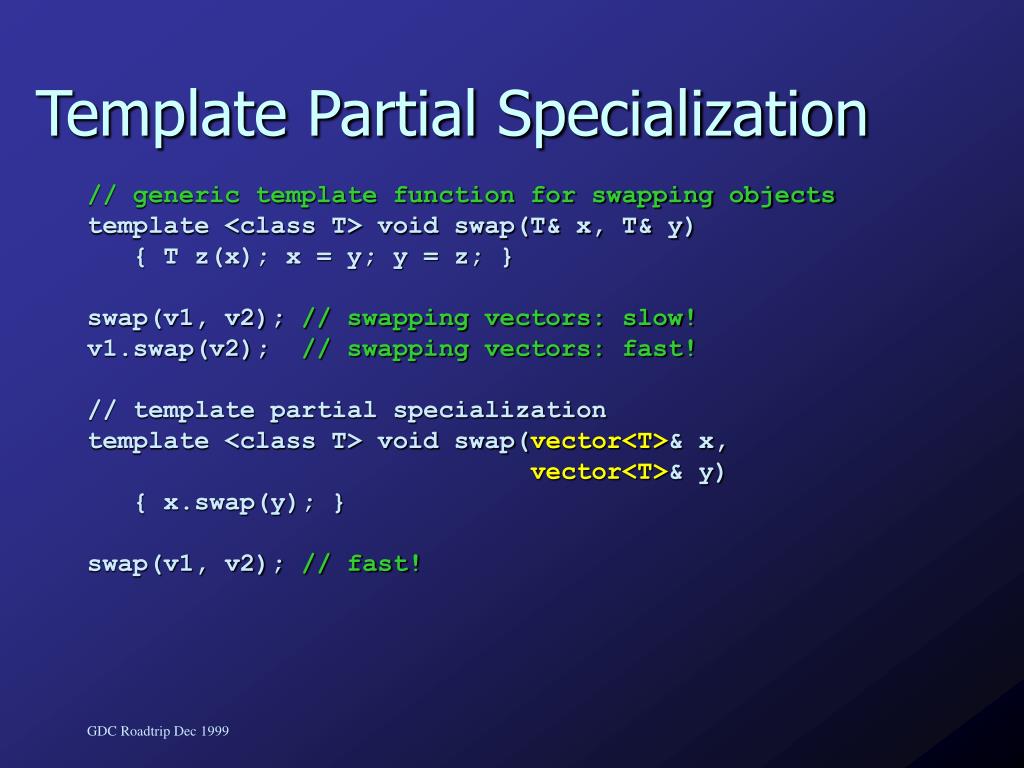
The syntax for the partially specialized swap would look like this:
// Primary template (works for any type T)
template <typename T>
void swap(T& a, T& b) {
    T temp = a;
    a = b;
    b = temp;
}

// Partial specialization for std::vector<T>
template <typename T> // Still a template, but more specific
void swap(std::vector<T>& a, std::vector<T>& b) { // Matches any std::vector
    a.swap(b); // Use the efficient member function
}
When the compiler sees swap(my_int1, my_int2), it uses the primary template. When it sees swap(my_vec1, my_vec2), it sees that the partial specialization swap(std::vector<T>&, std::vector<T>&) is a "better" match than the fully generic swap(T&, T&). The compiler always picks the most specialized template available.
Another common use is specializing for all pointer types. Let's build a type trait is_pointer.
// Primary template: by default, a type is not a pointer
template<typename T>
struct is_pointer {
    static constexpr bool value = false;
};

// Partial specialization for T*
// This will match any type that is a pointer
template<typename T>
struct is_pointer<T*> {
    static constexpr bool value = true;
};

// Usage:
// is_pointer<int>::value       -> false (uses primary template)
// is_pointer<int*>::value      -> true (uses partial specialization for T*)
// is_pointer<const char*>::value -> true (uses partial specialization for T*)
Test your understanding!
You are writing a generic pretty_print function. You want it to print the value for most types, but if the type is a pointer, you want it to print the memory address instead.
Which type of specialization would you use and why?
Show answer
You would use partial specialization.
You need to handle a category of types (all pointers, like int*, double*, MyClass*, etc.), not just one specific pointer type (like int*). A partial specialization template<typename T> void pretty_print(T* ptr) would match any pointer type and allow you to implement the address-printing logic there, while a primary template template<typename T> void pretty_print(T value) would handle all non-pointer types.
The Pitfalls of Specialization: Ambiguity and ODR
Template specialization is a powerful tool, but it requires care. Since you're influencing the compiler's code-generation choices, you can create situations that are complex or downright buggy. Given your interest in the low-level details, it's crucial to understand these risks.
C++Now 2019: JeanHeyd Meneide “The Plan for Tomorrow: Extension Points in C++ Applications”
This talk from CppNow delves into the real-world complexities of using template specialization as an extension mechanism in libraries. The speaker explains two major problems that can arise.
Watch the segment from 17:27 to 22:55. This is an advanced but vital section. Focus on understanding: Mutual Exclusion (Ambiguity): What happens when the compiler finds two specializations that are an equally good match for a type. ODR (One Definition Rule) Violations: The dangerous situation where different source files have different definitions for the same specialization, leading to the linker silently picking one and causing unpredictable runtime behavior. This is a classic C++ systems-level bug.
The issues raised in the video are not just theoretical.
- Ambiguity errors will stop your code from compiling, forcing you to resolve which specialization is truly "more" specialized.
- ODR violations are far more sinister. They compile and link without error. The program runs, but its behavior might depend on the link order or other seemingly unrelated factors because the linker chose one implementation of your specialized function while code from another translation unit was compiled expecting a different implementation. For a systems programmer, this is a nightmare scenario that requires advanced debugging tools to trace.
Conclusion
You now have the ability to override C++'s generic template mechanism to provide targeted, high-performance, or simply correct code for specific types.
Key Takeaways:
- Full Specialization (
template<>) provides a completely new implementation for a single, concrete type (e.g.,MyTemplate<int>). - Partial Specialization (
template<...> struct MyTemplate<T*>) provides an implementation for a category of types that still have template parameters (e.g., all pointers, all vectors). - The compiler resolves which version to use by finding the most specialized match for the given template arguments.
- Specialization is primarily used for optimization (providing a faster code path) and correctness (providing a working implementation where the generic one would fail).
- Type traits like
std::is_integralandstd::is_pointerare a canonical example of template specialization in action. - Specialization is powerful but introduces risks of ambiguity at compile-time and subtle ODR violations at link-time.
What's Next?
We've seen how specialization allows us to create entirely separate template definitions to handle different types. In recent C++ standards, a new tool has become popular for handling type-based differences within a single template: if constexpr.
In the next lesson, we will use if constexpr to perform compile-time branching within a template. You'll see how this can often lead to code that is simpler and easier to read than multiple specializations, while achieving the same goal of generating specialized code based on type properties.