Introduction
Welcome back! In our last lesson, we designed the commercial strategy for your customer migration, defining tailored offers and incentives for each of your customer waves. We now have a clear plan for who migrates, when they migrate, and the commercial incentives that motivate why they should migrate.
The final piece of this Go-To-Market puzzle is the how: How do we effectively communicate this entire plan to guide customers smoothly from your legacy platform to the new one? This lesson directly addresses the learning outcome: Develop a communication plan to guide customers through the migration journey.
Your extensive experience in product management and customer-facing roles has shown you that even the best product changes can fail without clear, value-driven communication. This lesson will provide a structured framework to apply that experience to the high-stakes environment of a platform migration, ensuring your customers feel guided, not forced.
Over the next 60 minutes, we will cover:
- Crafting the Core Migration Narrative: How to build the central story that explains the 'why' behind the change.
- The Anatomy of a Communication Plan: The key components that turn your strategy into an actionable plan.
- A Phased Communication Strategy: How to tailor your messaging across the pre-migration, migration, and post-launch phases.
By the end of this lesson, you will have a comprehensive playbook for communicating with customers at every stage of their migration journey.
Part 1: Crafting the Core Migration Narrative
Before you write a single email or plan a single webinar, you need a powerful, consistent, and customer-centric story. This narrative is the foundation of your entire communication plan. It must answer the fundamental questions your customers will have, starting with "What's in it for me?"
A great way to structure this is using a "Change Narrative" framework.
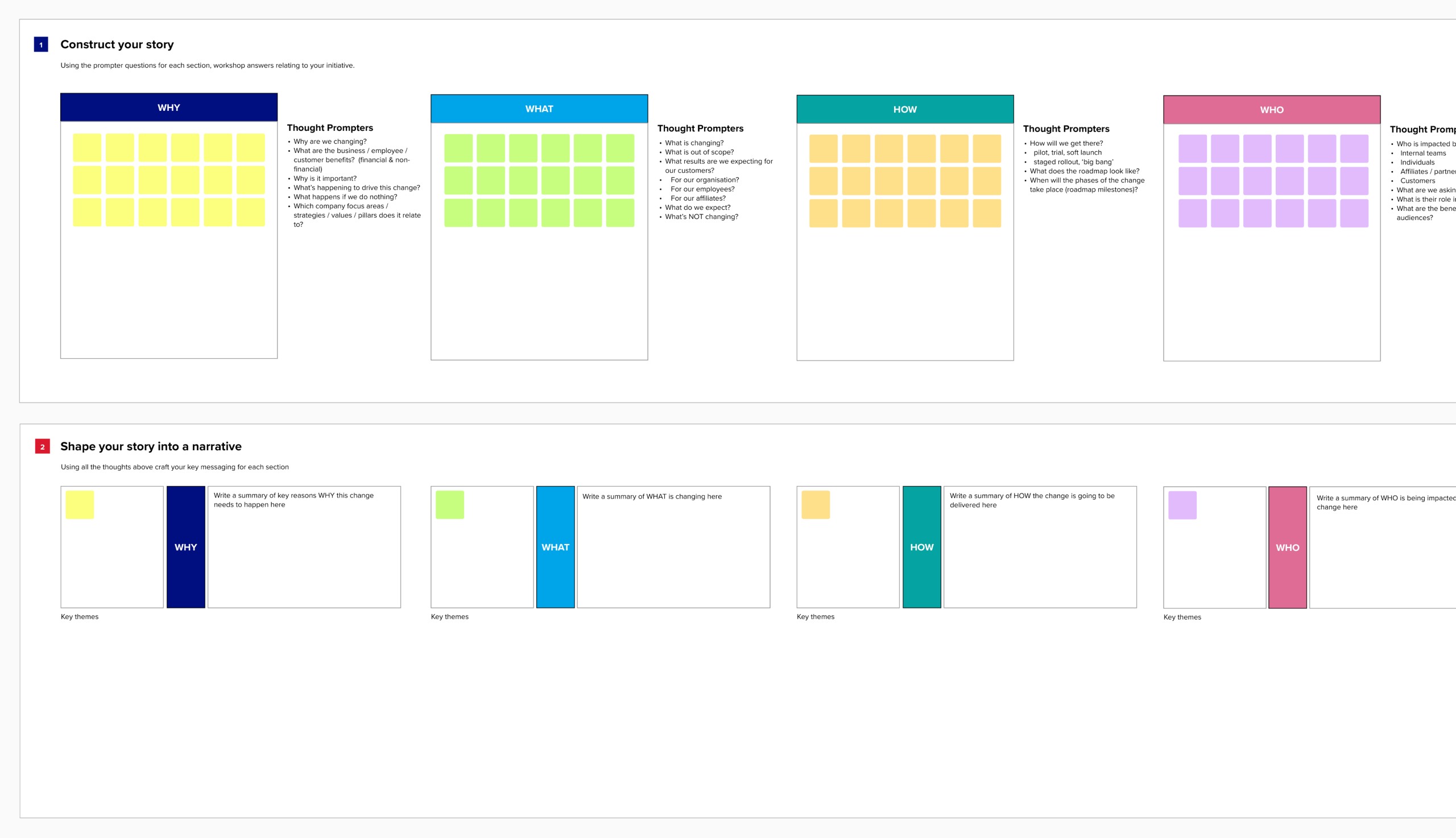
Let's break this down for your migration from a monolithic Loan Origination System (LOS) to the new microservices-based "Intelligent Lending Platform":
-
WHY are we changing? This is the most critical part. It must be framed in terms of customer value, not internal strategy. Instead of "we are moving to microservices," think:
- "To deliver new compliance features and lending capabilities to you faster."
- "To provide powerful new AI tools that reduce manual effort and improve decision accuracy."
- "To build a more flexible platform that can adapt to your future needs."
-
WHAT is changing? Be clear and specific about the impact on the customer.
- The Product: New features (e.g., AI Compliance Module), a new user interface, a modular structure.
- The Commercials: A new hybrid pricing model that aligns cost with value (as we designed in the last lesson).
- The Relationship: A more proactive partnership focused on driving business outcomes.
-
HOW will the change happen? This is where you build confidence and reduce anxiety.
- The Process: Explain the wave-based migration, the white-glove support, and the clear timeline.
- The Support: Detail the resources available—dedicated CSMs, training materials, knowledge base articles.
-
WHO will be involved? Clarify roles and responsibilities.
- The Customer's Team: Who needs to be involved from their side (IT, business users, project managers)?
- Your Team: Who are their points of contact (CSM, Technical Account Manager, Support Lead)?
To ground this narrative, it's vital to deeply understand your customer's world.
Tips Every Customer Success Manager In The SaaS Industry Should Know
This short video from PowerToFly emphasizes the importance of knowing your customer's business goals, challenges, and mission. This understanding is the raw material for building a compelling 'Why'.
Watch from 00:18 to 01:04. As you watch, think about how you would articulate the 'Why' for your new platform in the context of a customer's specific revenue goals or competitive challenges.
This customer-centric approach is the difference between a migration feeling like a disruption and an opportunity. A practical guide on migrating community software reinforces this exact point.
Community Software Migration Guide
Let's look at a guide from Higher Logic that outlines best practices for platform migrations. Note their emphasis on early, transparent, and member-focused communication.
Please read the 'Communicate' subsection under 'Stage 1: Pre-Platform Selection'. Then, jump to the section 'Challenges to Prepare For' and read point #4, 'Change Management'. Notice the recurring theme: frame the change as progress and communicate early and often.
With this narrative as your foundation, you can now build the tactical plan to deliver it.
Part 2: The Anatomy of a Customer Migration Communication Plan
A plan translates your narrative into a series of coordinated actions. The most effective way to manage this complexity is with a structured communication plan template.

Let's dissect the columns of this template and connect them to best practices for a B2B software migration.
1. Communication Goals
What specific action or change in understanding do you want to achieve? Don't just "inform"; aim for tangible outcomes.
- Bad Goal: Inform customers about the new platform.
- Good Goal: Generate 20 sign-ups for the Wave 1 pilot program.
- Good Goal: Reduce post-migration support tickets related to login issues by 50% through proactive education.
The ultimate goal is to improve the customer's business. To measure this, you need the right KPIs.
Driving Digital Channel Adoption
This article from Wipro on digital adoption provides a useful way to think about measuring the impact of your communication plan. It proposes two types of KPIs that are highly relevant.
Read the section 'How to measure impact of the digital adoption framework?'. Focus on the 'Vertical KPIs' and 'Journey KPIs'. Think about how you could apply these to measure the success of your migration communication (e.g., tracking the usage of a new AI module post-migration).
2. Communication Method
This is the channel you'll use. Your choice depends on the message's complexity and the audience. A multi-channel approach is essential. The Higher Logic guide provides an excellent list of options:
- Broad Reach: Webinars, blog posts, newsletters, teaser campaigns.
- Targeted: Segmented email campaigns, in-app messages.
- High-Touch: 1-on-1 meetings with CSMs, executive briefings.
- Self-Service: FAQs, knowledge base articles, visual guides, training videos.
3. Audience
Who, specifically, are you talking to?
- By Segment: The "Innovative Credit Union" from Wave 1 gets a different message than the "Risk-Averse National Bank" from Wave 4.
- By Persona: Within a customer, the Economic Buyer (CFO) cares about ROI, the Technical Lead (VP of IT) cares about security and integration, and the End User (Loan Officer) cares about ease of use and new features. Your messaging must be tailored to each.
4. Frequency
How often will you communicate? This should be a predictable cadence, not a random series of emails. For example: "You will receive a bi-weekly migration progress update every other Tuesday."
5. Owner
Who is accountable for creating and sending the communication? This ensures nothing falls through the cracks. This requires tight internal alignment.
Tips Every Customer Success Manager In The SaaS Industry Should Know
Let's revisit the PowerToFly video. This segment discusses the importance of internal collaboration between Sales, Support, and Product to present a unified front to the customer.
Watch from 01:04 to 02:05. This highlights why assigning clear ownership in your plan is crucial for a coordinated and seamless customer experience.
Part 3: A Phased Communication Strategy
Your communication plan must evolve as your customers move through the migration journey. We can map our communication activities to three distinct phases, using the structure from the Higher Logic migration guide.
Phase 1: Pre-Migration (Awareness & Excitement)
- Goal: Build awareness of the coming change, articulate the value proposition, and recruit early adopters.
- Tone: Visionary, exciting, benefit-oriented.
- Activities:
- Vision Webinars: Hosted by product leadership to paint a picture of the "Future of Lending."
- Teaser Campaigns: Emails and social media posts hinting at powerful new AI capabilities.
- CSM Outreach: Your Customer Success Managers conduct 1-on-1 strategy sessions to align the new platform's capabilities with the customer's specific goals (as mentioned in the PowerToFly video).
- Targeted "Pull" Communications: Send specific invitations to your Wave 1 "Friendlies" to join the "Co-Creation Partnership" you designed in the last lesson. This is a classic 'pull' strategy, creating an exclusive offer. (See resource LINK, sec 2).
Phase 2: During Migration (Guidance & Reassurance)
- Goal: Provide clarity, set expectations, minimize disruption, and build confidence.
- Tone: Clear, direct, supportive, and proactive.
- Activities:
- Detailed Migration Hub: A dedicated section on your website or knowledge base with timelines, FAQs, and training resources.
- Personalized Migration Plans: A document for each customer detailing their specific migration date, data cutover plan, and key contacts.
- Regular Status Updates: Automated emails and in-app banners announcing progress ("Your migration is 2 weeks away!").
- Internal Enablement: Crucially, provide your internal teams (Support, Sales, CSMs) with talking points, scripts, and FAQs so they can answer customer questions consistently. (See resource LINK, sec 2).
Phase 3: Post-Launch (Adoption & Advocacy)
- Goal: Drive usage of new features, gather feedback for continuous improvement, and turn successful customers into advocates.
- Tone: Celebratory, helpful, and engaging.
- Activities:
- "Welcome to the New Platform" Campaign: A series of emails that highlight key new features and provide "quick win" tips.
- Feedback Channels: Launch surveys, create an in-app feedback forum, and conduct listening sessions with key users. Your CSMs act as the "voice of the customer" to the product team.
- Celebrate Success: Once a customer achieves a key outcome (e.g., reduced loan processing time), work with them to create a case study or testimonial. This is how you create "purple" referenceable accounts.
Top 5 Activities of a Great SaaS Customer Success Manager
To understand the value of this post-launch phase, watch this clip from Dan Martell. He explains how CSMs 'escalate value' beyond initial success to create testimonials, referrals, and case studies—the ultimate output of a successful migration.
Watch from 07:20 to 11:24. Pay attention to the progression from a 'green' (successful) customer to a 'purple' (advocate) customer and the role of the CSM in gathering feedback for the product team. Your communication plan should facilitate this entire process.
Practical Application Exercise
Now it's time to put this all together. Your task is to start building the communication plan for your "Intelligent Lending Platform" migration.
Your Task (10 minutes):
Using the structure of the Project Communication Plan Template, fill out at least three rows, creating one communication for each phase of the migration.
- Pre-Migration: A webinar to announce the new platform to all customers.
- During Migration: An email to a specific customer segment (e.g., Wave 2 "Easy Wins") one week before their scheduled migration.
- Post-Launch: A survey sent to users who have been on the new platform for 30 days.
For each row, define the:
- Communication Goal
- Communication Method
- Audience
- Frequency
- Owner
Example Answer
| Communication Goal | Communication Method | Audience | Frequency | Owner |
|---|---|---|---|---|
| (Pre-Migration) Generate excitement and articulate the core value proposition of the new platform. Secure 100+ MQLs (Marketing Qualified Leads) for follow-up conversations. | Public Webinar: "The Future of Lending: Introducing the New Intelligent Lending Platform" | All existing customers (primary audience: Business & IT leaders). | One-time event, with recordings shared afterward. | VP of Product Marketing |
| (During Migration) Reassure the customer, confirm the final cutover time, and provide links to support resources to minimize day-1 anxiety and support calls. | Personalized Email | Primary contacts at all companies in "Wave 2 Migration Cohort". | Once, sent exactly 7 days before their scheduled migration date. | Customer Success Manager (using an automated template) |
| (Post-Launch) Gather feedback on the new UI and measure user satisfaction with the AI Compliance Module. Achieve a 20% survey response rate. | In-app Pop-up & Email Survey | All active users who have been migrated for 30+ days. | Once per user, triggered 30 days post-migration. | Product Manager (AI Features) |
Conclusion
Today, we have constructed a complete, strategic framework for guiding your customers through a complex platform migration. You've moved beyond simply informing customers of a change to strategically managing their entire experience.
Key Takeaways:
- Narrative is the Foundation: A successful communication plan starts with a compelling, customer-centric story that clearly answers "Why are we changing and what's in it for me?"
- Structure Creates Clarity: Using a formal communication plan (defining goals, audience, channels, frequency, and ownership) turns your strategy into an executable project.
- Phasing is Essential: Your messaging and goals must adapt to the customer's stage in the journey—from building excitement pre-migration, to providing guidance during, to driving adoption post-launch.
- Communication is a Two-Way Street: The best plans don't just broadcast information; they create channels for gathering feedback, which fuels both product improvement and customer advocacy.
Preview of the Next Lesson
Your communication plan sets clear expectations for the support customers will receive during their migration. But what happens when a user runs into a real issue at a critical moment? A great FAQ is not enough.
In our next lesson, we will address the learning outcome: "Outline a support model for customers during and after migration to the new platform." We will design the teams, processes, and tools needed to deliver on the promises your communication plan makes, ensuring your customers feel supported every step of the way.