Introduction
Welcome back! In our last lesson, you created a strategic, wave-based plan to segment your customer base for migration. We now have a clear sequence for who moves to the new platform and when. However, a plan is only as good as the motivation you create for people to follow it. This brings us to the crucial question: why should a customer undertake the effort to migrate?
This lesson directly addresses the learning outcome: Define migration offers, incentives, and pricing considerations for different customer segments. We will build the commercial strategy needed to compel each of your migration waves to move from the legacy monolithic product to your new, modular, AI-enhanced platform.
Given your background in finance and product management, you know that pricing is one of the most powerful levers in a business. It's not just a number; it's a signal of value. As we'll see, the shift to a microservices and AI architecture fundamentally changes how value is delivered, and therefore, how it must be priced.
Today, we will cover:
- The new pricing paradigm for AI and usage-based products.
- How to design a modern, hybrid pricing model for your new platform.
- How to craft specific migration offers and incentives tailored to each of your customer waves.
By the end of this lesson, you will be able to construct a complete commercial migration strategy that aligns price with value and motivates your entire customer base to embrace the future you are building.
Part 1: The New Pricing Paradigm for B2B SaaS
The move from a monolithic architecture to a modular, AI-driven one isn't just a technical change—it's a value change. The old world of simple per-user, per-month subscriptions often fails to capture the value of an AI that might automate the work of ten people, or a microservice that a customer uses intensely for just one hour a month.
This shift requires a new way of thinking about pricing. Let's explore why.
Pricing your AI product: Lessons from 400+ companies and 50 unicorns | Madhavan Ramanujam
To begin, let's watch a segment from a podcast with Madhavan Ramanujam, a leading expert on monetization. He explains why AI product pricing is fundamentally different from traditional SaaS and requires a new playbook.
Please watch the clip from 00:27:29 to 00:30:21. Pay close attention to the two key reasons AI pricing is different: cost dynamics and, more critically, value capture. Notice the point about tapping into labor budgets, not just software budgets.
As the video highlights, with AI, you can finally solve the attribution problem—you can directly link your product to a customer's business outcome (e.g., "reduced scrap by 5%"). This opens the door to Value-Based Pricing, the principle of setting a price based on the economic value your product provides to the customer.
A simple but powerful way to formalize this is the "Value Equation."
How To Price For B2B | Startup School
This short clip from Y Combinator's Startup School explains the 'Value Equation' in simple terms. It's a foundational concept for our work today.
Please watch from 01:01:13 to 04:19. The key idea is to work with your customer to quantify the value delivered and then price your product as a fraction of that value. This shifts the conversation from your costs to their ROI.
While the principle is simple, the implementation requires choosing the right pricing model to connect your price to the customer's value. The modern B2B SaaS landscape has evolved far beyond simple subscriptions.
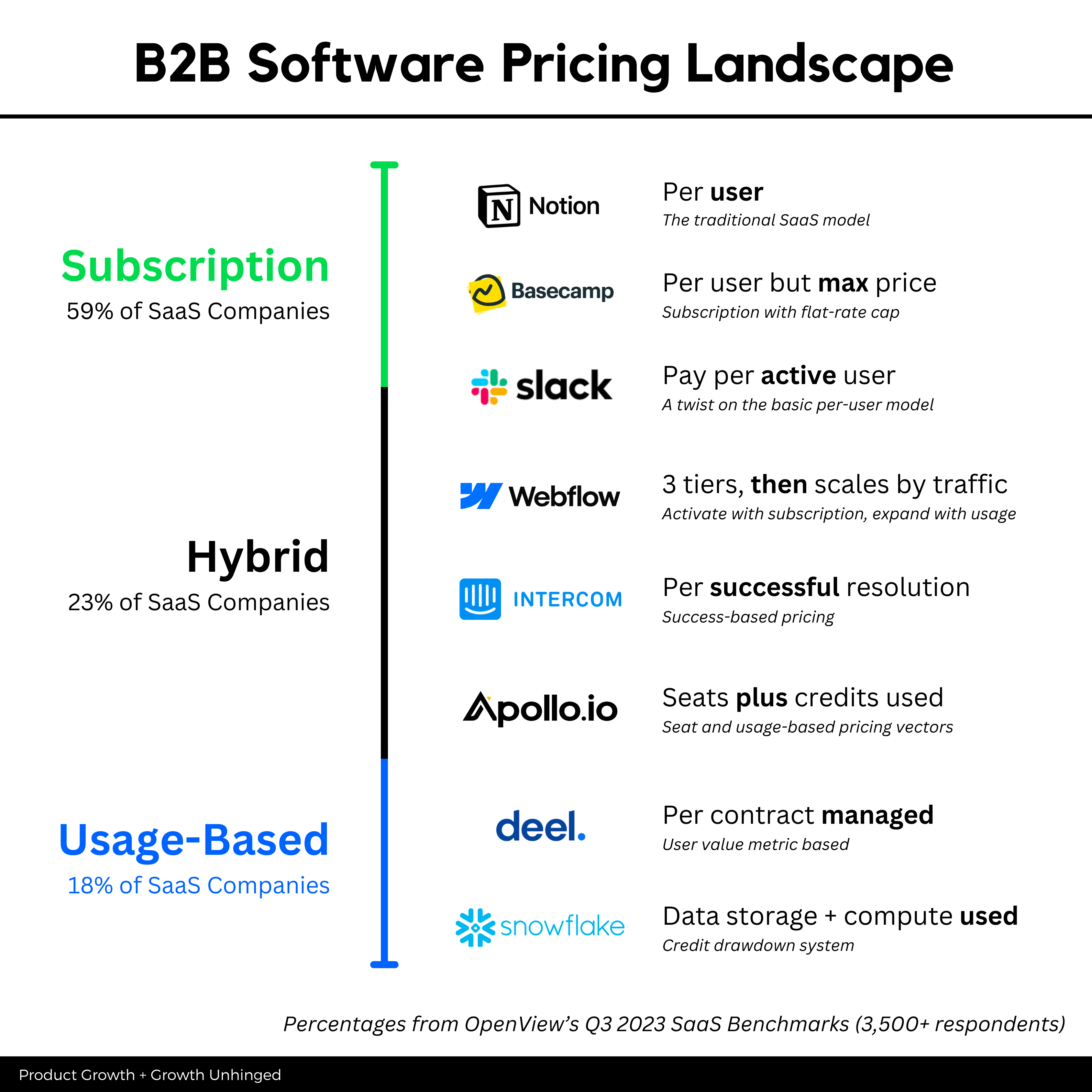
To navigate this, we need a framework for choosing the right model for your new AI-powered platform.
The Complete Guide to SaaS Pricing Models
Let's review a brief guide to the most common SaaS pricing models. This will provide us with a shared vocabulary for the rest of the lesson.
Please read the section 'Top 10 SaaS Pricing Models and Their Examples Explained'. Skim through the descriptions for Per-User, Tiered, Usage-Based, Credits, and Value-Based pricing. We will be combining these ideas later.
For AI products specifically, a very useful framework considers two dimensions: attribution (can you prove your AI caused the outcome?) and autonomy (does the AI work on its own, or as a co-pilot?).
Pricing your AI product: Lessons from 400+ companies and 50 unicorns | Madhavan Ramanujam
Let's return to Madhavan Ramanujam's talk. He presents a powerful 2x2 framework for selecting an AI pricing model based on attribution and autonomy.
Watch from 00:39:06 to 00:44:41. Focus on understanding the four quadrants: seat-based, hybrid, usage-based, and the 'magic quadrant' of outcome-based pricing. Think about where different features of your new platform might fit.
This framework is key. Your new platform will likely have some features that are "co-pilot" like (low autonomy) and others that are fully automated (high autonomy). This points towards a hybrid pricing model as the most likely destination.
Part 2: Designing Your Target Pricing Model
Before you can create migration offers, you must define what you are migrating customers to. What will the pricing for the new platform look like for a brand-new customer? This is your "target pricing model."
Given the modular nature of microservices and the variable cost/value of AI, a pure subscription is often a poor fit. Hybrid models, which combine a predictable subscription base with a variable usage component, offer the best of both worlds.
Adopt Usage-Based Pricing: Practical Guide for SaaS & AI
Let's explore the most common and effective hybrid models. This guide from Chargebee provides excellent, practical examples.
Please read the section '4 Popular Hybrid Models (And When to Use Them)'. As you read, think about which of these models—Base plan + Overage, Block-Based Capacity, Minimum Commitment, or Prepaid Credits—would be the best fit for your new 'Intelligent Lending Platform'.
So, what might a target model look like for your new platform?
Let's imagine you choose a hybrid model combining a base plan with prepaid credits:
- Base Subscription (Tiers):
- Starter / Pro / Enterprise Tiers: These provide access to the core platform, with tiers differentiated by the number of users, access to enterprise features (like SSO, advanced security, from resource LINK), and a baseline number of included "AI credits" per month. This provides predictable recurring revenue.
- Usage Component (Prepaid Credits):
- AI Credits: Customers draw from a wallet of credits to use high-value, high-cost AI features. For example:
- Running an AI compliance check on a loan file costs 10 credits.
- Using the AI-driven underwriting suggestion engine costs 5 credits per loan.
- This aligns price directly with value and cost, and the prepaid nature gives customers budget predictability. You can see this pattern in companies like OpenAI and ElevenLabs (resource LINK).
- AI Credits: Customers draw from a wallet of credits to use high-value, high-cost AI features. For example:
This target model gives you a clear destination. Now, how do you get your existing customers there?
Part 3: A Phased Playbook for Migration Offers
Changing pricing for existing customers is one of the riskiest maneuvers in business. It must be handled with a clear strategy, empathy, and excellent communication. You cannot simply flip a switch. This is where your wave-based segmentation becomes your playbook.
The following resources provide an excellent, field-tested process for this.
The Complete Guide to SaaS Pricing Models
First, let's review a step-by-step playbook specifically for migrating from a seat-based model to a usage-based one. This is likely the exact transition you'll be managing.
Read the section 'Migrating from Seat Based to Usage Based: A Step-by-Step Playbook'. Pay special attention to points 3, 4, and 5: introducing hybrid plans, offering commitment discounts, and exposing billing telemetry.
Adopt Usage-Based Pricing: Practical Guide for SaaS & AI
This next resource provides even more detail on the migration process, framing it as a structured rollout rather than a hard cutover.
Read the section 'Moving Customers to New Pricing Without Losing Them'. The concepts of setting 'Target vs. Floor' pricing and using a phased rollout are critical for creating your offers.
Synthesizing these playbooks with your migration waves, here is a structured approach to designing your offers:
Wave 0: Net New Customers
- Offer: No special offer needed. They start directly on your new Target Pricing Model.
- Rationale: This is non-negotiable. It stops the legacy problem from growing and immediately establishes the value of the new platform in the market.
Wave 1: The Volunteers & Friendlies
- Offer: A "Co-Creation Partnership."
- Incentives:
- Heavily Discounted/Free Pilot: Frame the pilot not as a technical test, but as an exercise to jointly build a business case and co-create an ROI model (as described in resource LINK).
- White-Glove Migration: Full, dedicated support from your best engineers and CSMs.
- Price Lock: Offer to lock them into a very favorable, fixed price for 1-2 years post-migration.
- Influence: Give them a seat on a customer advisory board to shape the product roadmap.
- Rationale: The goal here is not revenue, but learning and advocacy. You need their success stories.
Waves 2, 3, ...: The Main Migration Engine (Easy Wins & Feature Cohorts)
- Offer: A "Structured Transition Program" with a clear deadline.
- Incentives (The "Carrots"):
- Commitment Discounts: This is your primary lever. "Migrate by [Date] and lock in a 25% discount on the new pricing for your first 12 months." (from resource LINK).
- Grandfathering: Allow them to stay on their old per-seat pricing for a limited time (e.g., 6-12 months) after migrating, giving their finance team time to adjust.
- Migration Credits: "Commit to migrating now and we'll give you a welcome bonus of 50,000 AI credits to use on the new platform." This encourages them to try (and see the value of) the new usage-based features.
- Waived Migration Fees: Offer free data migration and onboarding for a limited time.
- The "Stick":
- Subtly introduce the concept of the end-of-life for the old platform. Communicate that new features and major enhancements will only be developed for the new platform.
- Rationale: For this large group, you need a scalable, compelling offer that creates a sense of urgency while feeling fair. The combination of a temporary discount and the fear of being left behind is powerful.
Final Wave: The Complex Giants & Laggards
- Offer: A "Mandatory Upgrade Program."
- Incentives: These are minimal and focused on reducing friction, not providing a reward.
- A structured, project-managed migration plan with dedicated resources.
- Perhaps flexible payment terms for the migration project itself.
- The "Stick":
- A formal end-of-life (EOL) announcement for the old platform. "Support for Platform X will cease on [Date]." This is the final, unavoidable trigger.
- Rationale: This group will not move without a forcing function. The negotiation here will be less about the price of the new software (which will be the standard target price) and more about the terms, timing, and cost of the migration project. Your experience in project and product management will be critical here, focusing on value selling and ROI to justify the move even at this late stage.
Practical Application Exercise
Let's apply these concepts to the scenario from our last lesson. You are migrating customers from a monolithic Loan Origination System (LOS) to a new microservices-based Intelligent Lending Platform.
Your Task (10 minutes):
Design a migration offer for two specific customer segments you identified:
- The Innovative Regional Credit Union (from Wave 1/2): They are agile, tech-forward, and you have a good relationship with them.
- The Large National Bank (from a later, feature-driven Wave 3/4): They are risk-averse, complex, and will only migrate once the new platform's "AI-Powered Predictive Compliance Module" is live and proven.
For each segment, briefly outline:
- The Core Offer: What is the headline of the deal?
- Key Incentives: List 2-3 specific "carrots" you would use.
- Pricing Consideration: How would you frame the new pricing to them?
Example Answer
1. Offer for the Innovative Regional Credit Union (Wave 1/2)
- Core Offer: "Join our 'Future of Lending' Partnership Program."
- Key Incentives:
- A 90-day, no-cost pilot focused on building a joint ROI model to prove a 20% reduction in loan processing time.
- A 3-year price lock on a "Pro" tier at a 50% discount, including a large bundle of AI credits.
- A guaranteed seat on our Product Advisory Council for the next 24 months.
- Pricing Consideration: We would introduce them to the hybrid (Tier + Credits) model, emphasizing that they will help us refine the credit cost for different AI features. We would frame it as them getting "wholesale" pricing in exchange for their partnership.
2. Offer for the Large National Bank (Wave 3/4)
- Core Offer: "Accelerated Compliance & Efficiency Program."
- Key Incentives:
- A "Migration Credit" bonus equivalent to 6 months of projected usage of the new AI Compliance Module, valued at an estimated $100k.
- Grandfathered pricing: they can remain on their existing flat-fee contract for the first 12 months post-migration, giving their procurement team a full budget cycle to adjust to the new model.
- A dedicated, on-site migration project management team at no additional cost if they commit within the quarter.
- Pricing Consideration: We would present a formal business case showing the projected multi-million dollar ROI from the AI Compliance Module (reduced fines, lower manual audit costs). We would position the new hybrid pricing as a "pay-for-performance" model that ensures they only pay for the value they are demonstrably receiving, de-risking their investment. We'd use the "Target vs. Floor" pricing internally to give our sales team negotiating room.
Conclusion
Today, we've moved from segmentation to motivation. You now have a comprehensive framework for designing the commercial offers that will power your customer migration.
Key Takeaways:
- Price for Value, Not Just Seats: The shift to AI and microservices demands a shift to pricing models that capture the value delivered, with hybrid (subscription + usage) models offering a powerful balance of predictability and scalability.
- One Size Does Not Fit All: Your migration offers must be tailored to the mindset and value drivers of each customer segment, from partnership-focused pilots for early adopters to ROI-driven business cases for laggards.
- Combine Carrots and Sticks: Successful migration campaigns pair attractive, time-bound incentives ("carrots") with the clear, long-term reality that the legacy platform will eventually be retired ("the stick").
- Migration is a Campaign: This isn't a single event but a structured, phased process of resetting the value conversation with your entire customer base, earning their trust and their business along the way.
Preview of the Next Lesson
You have now determined who to migrate (segmentation), when to migrate them (waves), and what to offer them (commercials). The final piece of the GTM puzzle is the narrative. How do you communicate all of this in a way that is clear, compelling, and consistent?
In our next lesson, we will focus on the next step in the course: "Develop a communication plan to guide customers through the migration journey." We will build the messaging and channel strategy to ensure every customer understands the path forward and feels confident in taking the next step with you.