Introduction
Welcome back. In our previous lesson, we outlined a comprehensive support model to guide your customers through the migration to your new platform, focusing on the Hypercare and Steady State phases. That model is designed to create a seamless external customer experience. However, an external strategy is only as strong as the internal team tasked with executing it.
This lesson directly addresses the learning outcome: Design an internal enablement program for sales and customer success teams on the new GTM approach.
Given your extensive background in Learning & Development and Organizational Design, you're already familiar with the principles of creating effective learning architecture. We will apply that expertise to the specific, high-stakes context of a Go-to-Market (GTM) transformation. This isn't about learning L&D from scratch; it's about sharpening your skills to prepare your revenue teams for a fundamental shift in how they sell and support your products.
Over the next 60 minutes, we will:
- Define the role of modern sales and customer success enablement.
- Walk through a structured framework for designing your enablement program.
- Focus on how to translate complex technical changes (microservices, AI) into compelling value for your non-technical teams.
- Discuss how to deliver and reinforce learning using a modern tech stack.
- Consider the human element of internal change and how to mitigate fatigue.
By the end of this lesson, you will have a clear blueprint for an enablement program that equips your teams with the confidence, knowledge, and skills to drive the GTM transformation successfully.
1. What is Modern Enablement?
First, let's establish a shared understanding of "enablement." It's more than just a single training session or a sales kickoff. Modern enablement is a strategic, ongoing function.
To get a quick overview, please watch the first two minutes of this video from Highspot.
The 5-Minute Guide to Everything Sales Enablement
This video, 'The 5-Minute Guide to Everything Sales Enablement,' offers a concise definition of the practice and its core components.
Watch from the beginning to 02:03. Pay attention to how enablement is described as a 'connective arm' for the entire go-to-market organization and its foundational components.
As the video explains, enablement is about systematically providing customer-facing teams with the content, guidance, training, and coaching they need to be effective. For your transformation, this means enabling them to articulate the new value proposition stemming from your shift to microservices and AI.
2. A Framework for Designing Your Enablement Program
A successful enablement program requires a deliberate, structured design. We will use a five-step framework to build your plan.
The following article provides an excellent, practical guide to building an enablement strategy. We'll use its structure as the backbone for this section.
Sales Enablement Strategy: 6 Examples + How to Build Yours
The article 'Sales Enablement Strategy: 6 Examples + How to Build Yours' by Spekit provides a clear, step-by-step framework for designing a modern enablement strategy. We will walk through these steps to build your program.
Please read the section titled 'How to build a sales enablement strategy that works'. We will explore each of these five steps in detail.
Let's apply this framework to your transformation.
Step 1: Define Your Business Goals
As the article states, enablement must be tied to measurable business outcomes. For your GTM transformation, these goals could include:
- Sales Team: Increase the average deal size by successfully cross-selling new modular services. Reduce the sales cycle for new customers by 15% through clearer value articulation.
- Customer Success Team: Improve the adoption rate of the new AI features by 30% within 90 days of customer migration. Reduce time-to-first-value for new customers on the migrated platform.
Your first task is to align the enablement program with the strategic objectives of the entire transformation.
Step 2: Map Your Audience and Needs
Sales and Customer Success (CS) teams have different roles and therefore different enablement needs.
- Sales Teams need to:
- Understand the new pricing and packaging for the modular, microservices-based offerings.
- Articulate the strategic value of AI features to C-level executives.
- Handle objections related to migration complexity or the "newness" of the platform.
- Know which customer segments to target for which new services.
- Customer Success Teams need to:
- Master the new user onboarding flow for the migrated platform.
- Proactively identify customers who are not adopting key AI features and intervene.
- Run effective Quarterly Business Reviews (QBRs) that demonstrate ROI from the new platform.
- Execute the Hypercare and Steady State support models you designed in the last lesson.
Step 3: Identify Key Enablement Moments (The "What" to Teach)
This is the core content of your program. The biggest challenge here, one you've specifically highlighted, is translating the highly technical shift to microservices and AI into a compelling, value-based narrative for your non-technical teams. This is where you craft your internal "change narrative."
This article offers excellent techniques for this exact challenge.
5 Ways to Communicate Complex Technology Strategies to Non ...
The article '5 Ways to Communicate Complex Technology Strategies to Non-Technical Stakeholders' provides concrete methods for bridging the gap between technical reality and business value.
Read the sections 'Strip Jargon and Tell a Compelling Story,' 'Use Relatable Analogies for Complex Concepts,' 'Focus on Customer Journey Not Technical Details,' and 'Translate Tech into Business Outcomes.' Think about how you could apply these techniques to explain microservices and AI to a salesperson.
Applying these lessons, your enablement content shouldn't be about explaining Kubernetes or LLMs. It should be about:
- Storytelling: "Before, updating one feature took months and risked the whole system. Now, with our new architecture (the hero), we can deliver new value to you in weeks without disruption (the resolution)."
- Analogies: "Think of our old product as a single house where a plumbing issue could flood every room. Our new microservices architecture is like a city of independent buildings—if one has an issue, the others continue to operate perfectly."
- Business Outcomes: Instead of "We migrated to microservices," say "We restructured our system so you can launch new features in days, not months, and it won't crash your checkout process."
Your enablement program must equip your teams with these stories, analogies, and outcome-focused statements.
Step 4: Provide Enablement in the Flow of Work (The "How")
Your L&D experience has shown you that traditional, one-off training has limited impact due to the "Forgetting Curve." Modern enablement focuses on "just-in-time" learning, delivering information where and when your teams need it.
The Spekit article you read earlier describes several powerful strategies for this, including:
- A Unified Content Hub: A single source of truth for all playbooks, case studies, demo decks, and pricing sheets. No more hunting through SharePoint or Slack.
- In-Flow Enablement: Using Digital Adoption Platforms (DAPs) like Spekit to provide tooltips, guides, and reminders directly within your CRM (e.g., a pop-up in Salesforce reminding a rep of the new qualification criteria for an AI module). This is a key part of your "Transformation Tech Stack."
- Continuous Onboarding ("Everboarding"): Reinforcing knowledge with bite-sized content and quick quizzes delivered over time, rather than a one-time info dump.
Step 5: Build a Feedback and Measurement Loop
How will you know if the program is working? You need both qualitative and quantitative measures.
- Qualitative Feedback: Anonymous surveys asking reps, "How confident do you feel selling the new AI module?" or "What part of the new GTM strategy is least clear?"
- Quantitative Metrics:
- Leading Indicators: Content usage (are people accessing the new playbooks?), quiz scores, demo certifications completed.
- Lagging Indicators: Track the business goals you defined in Step 1. Are sales cycles shortening? Is the adoption of new features increasing? Can you correlate these improvements to the reps who completed the enablement program?
3. Managing the Human Element of Internal Change
A GTM transformation is a significant change for your own employees. They may feel anxious about their ability to sell a new product, worried about their commissions, or simply exhausted by the pace of change. Your enablement program is a primary tool for managing this.
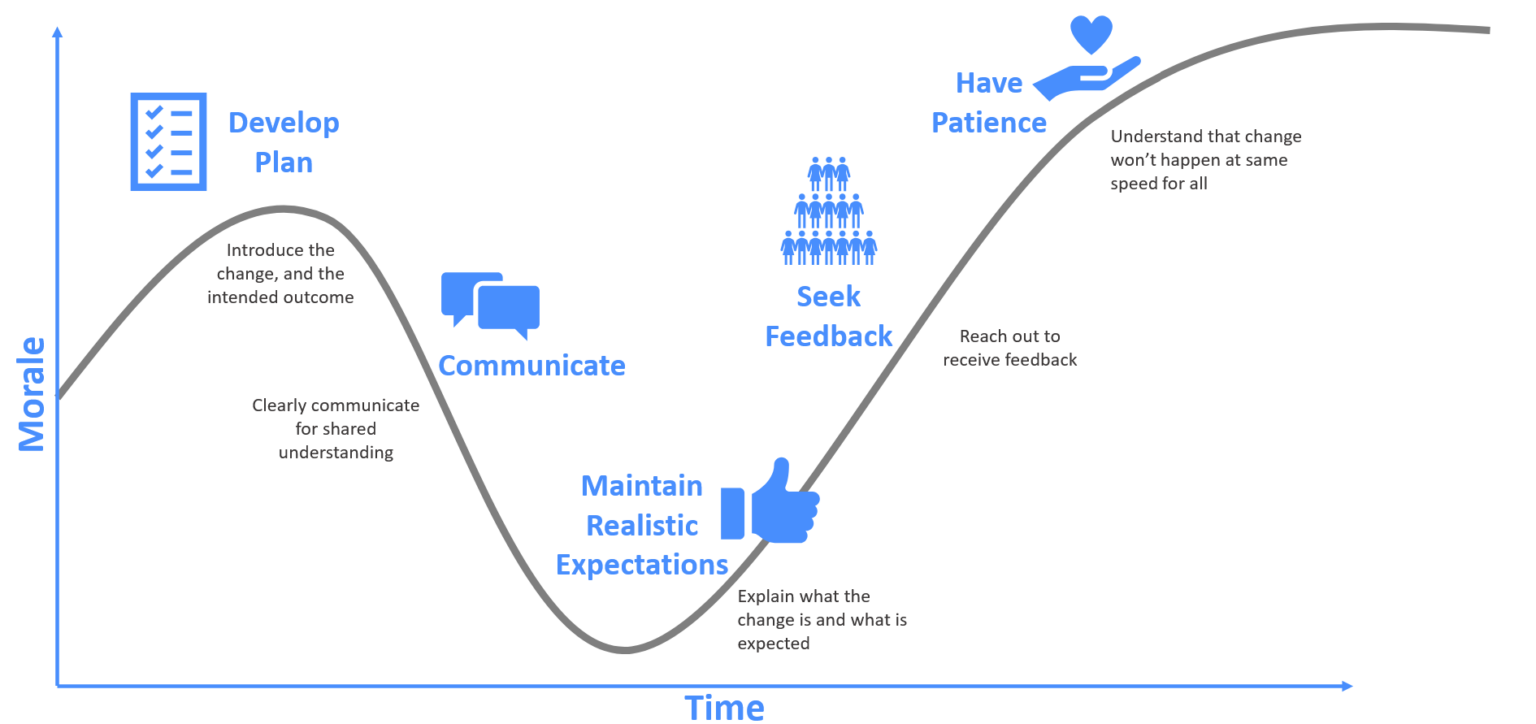
The enablement program helps by:
- Communicating Clearly: Providing a single source of truth reduces ambiguity and anxiety.
- Maintaining Realistic Expectations: By teaching new skills and certifying competence, you build confidence and show a clear path to success.
- Seeking Feedback: The measurement loop in your program is a formal channel for employees to voice concerns and ask questions.
- Having Patience: Phased "everboarding" respects that people learn at different paces and builds mastery over time.
Practical Application Exercise
Now it's time to put these concepts together. Let's create the high-level design for an enablement program focused on your sales team.
Your Task (10 minutes):
Outline an enablement plan for your B2B software sales team as they transition to selling the new modular, AI-enhanced product.
- Primary Business Goal: What is the single most important business outcome for this sales enablement program?
- Key Enablement Content (The "What" - select 2): Based on the communication strategies we discussed, what are two critical topics or stories you would teach the sales team?
- Key Delivery Methods (The "How" - select 2): Based on the "in-flow" strategies, what are two ways you would deliver and reinforce this knowledge?
- Primary Success Metric: What is one leading indicator and one lagging indicator you would use to measure the program's success?
Example Answer
- Primary Business Goal: Increase the average contract value by 10% in the first six months by successfully upselling at least one new AI module to 50% of new customers.
- Key Enablement Content (The "What"):
- The "Lego Block" Analogy: A training module that teaches reps to explain the microservices architecture as a set of Lego blocks, allowing customers to build exactly the solution they need and add new blocks later, rather than buying a pre-built, inflexible model.
- Value Story for the AI Compliance Module: A one-page battle card with a clear narrative: "Our customers in regulated industries used to spend 40 hours per month on manual compliance checks. Our new AI module automates this, reducing risk and freeing up their team to focus on strategic work. Here's a case study from Credit Union X."
- Key Delivery Methods (The "How"):
- Unified Content Hub: A dedicated space in our knowledge management system with all new pricing sheets, battle cards, and demo videos, accessible with a single click from Salesforce.
- AI-Powered Conversation Analysis: Use a tool like Gong to analyze sales calls, flag when reps use old positioning, and provide managers with coaching moments to reinforce the new narrative.
- Primary Success Metric:
- Leading Indicator: Percentage of sales reps who are certified to demo the new AI module.
- Lagging Indicator: The percentage of new deals that include an AI module upsell.
Conclusion
In this lesson, you have leveraged your L&D background to design a strategic enablement program for your GTM transformation. We've moved beyond the idea of simple training to architect a continuous system for building the skills and confidence your teams need to succeed.
Key Takeaways:
- Enablement is a Strategic Function: It's not a one-time event but an ongoing process that connects GTM strategy to frontline execution and must be tied to clear business goals.
- Translate Tech to Value: The core of your enablement content is the "change narrative"—turning complex technical shifts into simple, compelling stories and analogies focused on business outcomes.
- Deliver Learning in the Flow of Work: To beat the "Forgetting Curve," use a modern tech stack to provide just-in-time, bite-sized knowledge directly within the tools your teams use every day.
- Measure to Improve: Use a mix of leading and lagging indicators to measure the impact of your program and create a continuous feedback loop for improvement.
- Enablement Manages Internal Change: A well-designed program is one of your most powerful tools for mitigating change fatigue and building team confidence during a transformation.
Preview of the Next Lesson
You have now designed the external customer support model and the internal enablement program. With the "what" (new GTM) and the "who" (customers and internal teams) addressed, the final piece of the puzzle is the "when" and "how" of the rollout itself.
In our next lesson, we will tackle the final learning outcome of this module: "Plan a phased GTM rollout aligned with the product migration roadmap." We will synthesize all the elements of the GTM transformation into an integrated, sequenced plan that balances speed with stability.