Introduction
Welcome to the final lesson in our Go-to-Market Transformation module. In the preceding lessons, we've systematically designed the core components of your new GTM strategy. You've:
- Redefined the value proposition for a modular, AI-enhanced product.
- Segmented your customer base for migration.
- Developed a customer communication plan and a post-migration support model.
- Designed an internal enablement program to prepare your sales and customer success teams.
Now, we must bring all these pieces together. This lesson addresses the final, crucial learning outcome for this module: Plan a phased GTM rollout aligned with the product migration roadmap.
Your background in project and product management will be a significant asset here. You're accustomed to managing dependencies, sequencing work, and aligning cross-functional teams toward a common goal. We will apply that same discipline to orchestrate the business-side activities of this transformation.
Over the next 60 minutes, we will synthesize all your previous work into an integrated, actionable plan. We will cover:
- The strategic rationale for a phased rollout versus a "big bang" launch.
- Different strategies for phasing your GTM activities.
- Techniques for synchronizing your GTM plan with the technical product roadmap.
- The key components of a comprehensive GTM rollout plan artifact.
By the end of this lesson, you will have a clear methodology for constructing a GTM plan that ensures your commercial activities are perfectly in sync with your product and technology delivery, minimizing risk and maximizing impact.
1. The Philosophy: Multi-Threaded Launch vs. Big Bang
Before diving into the "how," let's solidify the "why." For a complex transformation involving a migration from a monolithic architecture to microservices, a "big bang" launch—where everything changes for everyone at once—is exceptionally risky. A phased approach is not just a preference; it's a strategic necessity.
To explore this concept, let's watch a section of a video that contrasts these two approaches in the context of a SaaS launch. The principles are directly applicable to your GTM transformation.
Go-To-Market Launch Plan For A New SaaS Product
In this video, 'Go-To-Market Launch Plan For A New SaaS Product,' TK Kader explains the fundamental difference between a risky 'linear' launch and a more robust 'multi-threaded' launch model.
Please watch from 02:45 to 09:05. Pay close attention to the description of the 'linear launch model' and how the 'multi-threaded model' de-risks the process by creating continuous feedback loops between product development and go-to-market activities.
As the video argues, the multi-threaded approach, where you are simultaneously building the product and engaging the market in small, iterative loops, is far more effective. This is the essence of a phased rollout. It allows you to:
- Test and Learn: Validate your new messaging, pricing, and support model with a small, controlled group before a full-scale launch.
- Build Momentum: Early successes with pilot customers create powerful case studies and build internal confidence.
- Manage Risk: Technical or process issues can be identified and resolved with a limited audience, preventing a large-scale negative impact on your customer base.
- Align with Agile Development: A phased GTM rollout mirrors the iterative nature of agile software development, allowing business and tech teams to stay in sync.
2. Structuring the Rollout: How to Phase Your GTM
Once you've committed to a phased approach, the next question is: how do you phase it? The rollout can be sliced in several ways, and the best approach often combines these strategies.
A great resource for thinking about different migration strategies comes from the world of e-commerce replatforming. The concepts are perfectly analogous to your situation.
B2B eCommerce replatforming: A checklist for smarter growth | On Tap
This article, 'B2B eCommerce replatforming: A checklist for smarter growth,' details several migration approaches that we can adapt for our GTM rollout.
Please read section 2, 'Choose the right B2B eCommerce platform approach.' Focus on the descriptions of 'Big Bang Migration,' 'Incremental migration,' and 'Parallel migration.'
As the article describes, while a "Big Bang" is an option, the "Incremental" (phased) and "Parallel" approaches offer more control. Let's map these concepts to your GTM plan. An effective phased GTM rollout typically sequences activities based on one or more of the following dimensions:
-
By Customer Segment: This is the most common and often safest approach. You start with a small, carefully selected group and expand outwards. This aligns with the customer segmentation work you did in a previous lesson.
- Phase 1: Internal Pilot (Dogfooding): Your own teams use the new platform.
- Phase 2: Alpha/Beta Customers: A small group of trusted, tech-savvy customers who have agreed to be early testers in exchange for incentives.
- Phase 3: Early Adopters: The first wave of general customers, often those most likely to benefit from the new features.
- Phase 4: General Availability: The broader market.
-
By Product Capability: Your migration to microservices naturally allows you to roll out new capabilities incrementally. Your GTM plan should mirror this.
- Phase 1: Launch the new reporting module (built as a microservice) to all customers.
- Phase 2: Introduce the first AI-powered analytics feature to a pilot segment.
- Phase 3: Roll out the AI feature to the wider customer base.
-
By GTM Motion: You might use different go-to-market motions for different segments or products, which can also be phased. The Ziel Lab article, "Best Go-to-Market Strategy for a B2B SaaS Launch," discusses these motions. A hybrid approach is common:
- Use a high-touch, Sales-Led motion for migrating your strategic enterprise accounts.
- Use a more automated, low-touch Product-Led Growth (PLG) motion for a new self-service module aimed at smaller businesses.
Your final plan will likely be a matrix, combining these dimensions. For example: "In Q2, we will launch the AI Analytics Module (Product Capability) to our Enterprise Pilot Group (Customer Segment) using a high-touch sales and CS motion (GTM Motion)."
3. Aligning with the Product Roadmap
This is where your project management expertise becomes critical. The GTM plan is not a standalone document; it is a direct overlay on the product and engineering roadmap. However, these two artifacts serve different audiences and must communicate different things.
This next video provides excellent best practices for creating roadmaps that manage expectations and communicate effectively across different teams.
Best Practices for Product Roadmap —Jeff Lash
In 'Best Practices for Product Roadmap,' Jeff Lash discusses how to tailor roadmaps for various stakeholders and how to manage levels of certainty over time.
Please watch the following segments: What is a Roadmap? (02:13 - 06:43): Note the conflict that arises when a single roadmap is used for different audiences (e.g., engineering vs. sales). Product vs. Future Roadmap (07:14 - 09:47): Understand the distinction between the certain near-term and the speculative long-term. Time Horizon (13:57 - 16:35): Pay attention to the 'two quarters, two halves, two years' rule for managing timeline uncertainty. Focus on Value (20:54 - 22:46): Observe the shift from describing features to articulating the problems being solved.
Let's synthesize the key principles from the video into a method for aligning your GTM plan with the product roadmap:
- Treat them as Separate, Linked Artifacts: The product roadmap details technical deliverables and timelines (e.g., "AI Model v1 complete by May 15"). The GTM plan details the corresponding business activities (e.g., "Internal sales enablement on AI module begins May 16; pilot customer outreach begins June 1"). The link is the dependency.
- Use Themed, Value-Based Milestones: The GTM plan should not be a list of features. Group activities under strategic themes that resonate with the business.
- Product Roadmap says: "Deploy search microservice."
- GTM Plan says: "Phase 2: Enhanced Global Search Launch." This phase includes marketing campaigns, sales training, and customer success playbooks related to the new search capability.
- Embrace Rolling Wave Planning: Use the "Now, Soon, Later" or "2 Quarters, 2 Halves, 2 Years" model to manage expectations.
- Now (Next 3-6 months): Detailed GTM plan with specific tasks, dates, and owners. This aligns with the committed, short-term product roadmap.
- Soon (6-12 months): High-level GTM activities and objectives. You know what you need to do (e.g., prepare for the international launch), but the exact dates are flexible.
- Later (1-2 years): Aspirational GTM goals aligned with the long-term product vision.
4. The GTM Rollout Plan: The Artifact
Now, let's look at what the plan itself looks like. A good GTM plan is a comprehensive project plan that orchestrates all customer-facing activities.
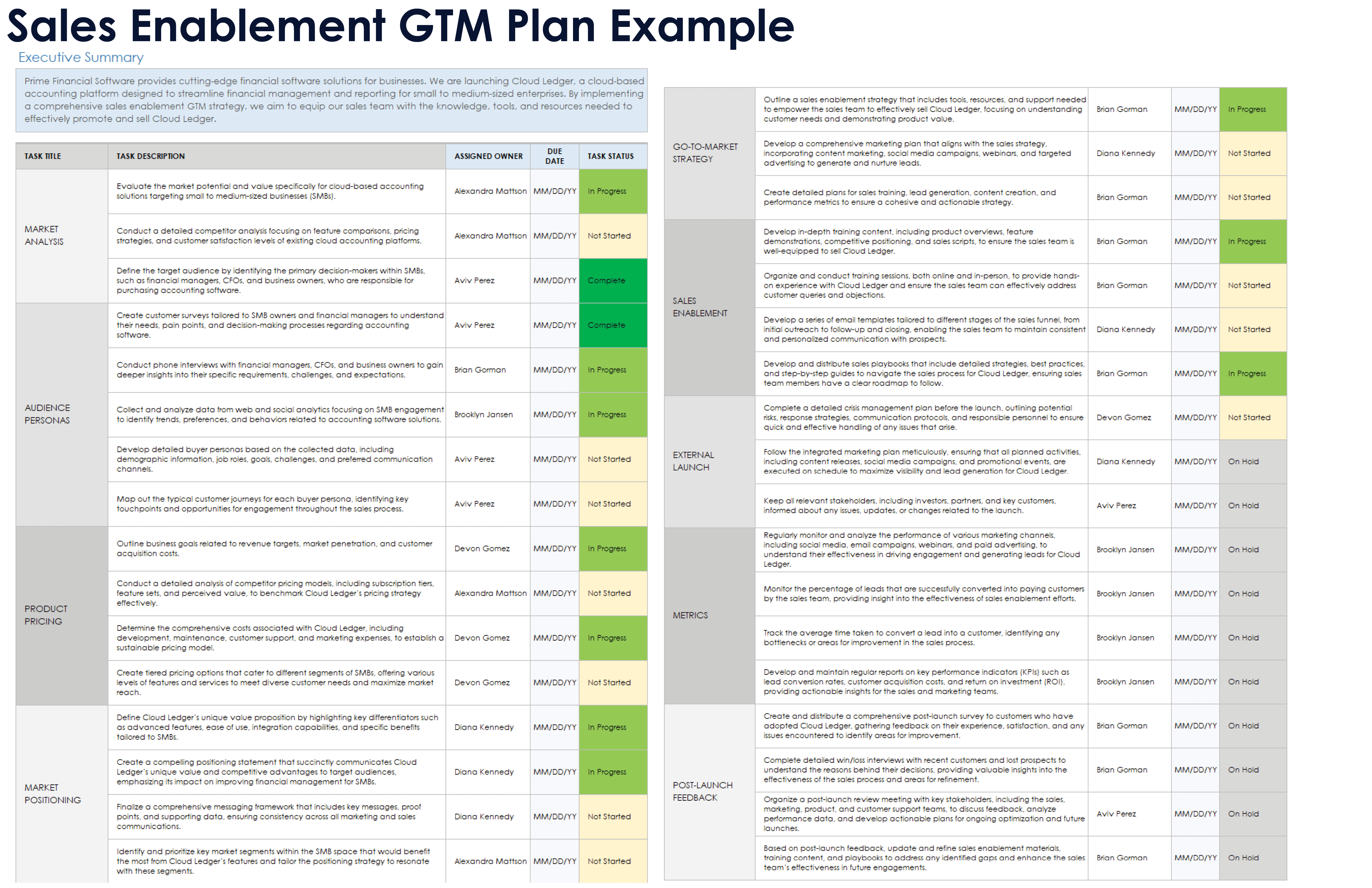
Your plan should contain sections or phases that cover the entire lifecycle of the rollout. We can use the checklist from the Ziel Lab article as a guide for the key activities to include.
Best Go-to-Market Strategy for a B2B SaaS Launch - Ziel Lab
This article, 'Best Go-to-Market Strategy for a B2B SaaS Launch,' provides a concise checklist that we can use to structure the tasks within our GTM plan.
Review the 'Your B2B SaaS GTM Checklist' at the end of the article. We will organize our plan around these Pre-Launch, Infrastructure, and Launch/Optimize phases.
Combining these ideas, your phased GTM rollout plan should be structured with clear phases, each containing specific workstreams and tasks:
Phase 0: Pre-Launch Readiness (e.g., This Quarter)
- Workstream: Strategy & Planning
- Finalize customer segmentation for pilot.
- Define migration offers and incentives for the pilot group.
- Set success metrics (KPIs) for the pilot launch.
- Workstream: Internal Enablement
- Develop sales and CS playbooks for the pilot.
- Conduct internal training and certification.
- Workstream: Marketing
- Create targeted messaging and content for the pilot.
- Workstream: Systems & Operations
- Ensure CRM is configured to track the pilot cohort.
Phase 1: Pilot Launch (e.g., Next Quarter)
- Workstream: Sales & Customer Onboarding
- Execute sales outreach to the pilot cohort.
- Onboard pilot customers onto the new platform.
- Workstream: Support
- Implement Hypercare support model for the pilot group.
- Workstream: Feedback & Measurement
- Collect structured feedback from pilot users and internal teams.
- Track KPIs against targets.
Phase 2: Iterate & Prepare for Scale (e.g., End of Next Quarter)
- Workstream: Analysis & Strategy
- Analyze pilot results and feedback.
- Refine messaging, pricing, and processes based on learnings.
- Finalize plan for the broader rollout.
Phase 3: General Availability Rollout (e.g., Following Half)
- (Repeat workstreams from Phase 1, but for the next customer segment)
Practical Application Exercise
Let's translate this into a concrete plan. Imagine your company is ready to roll out its first major new capability: an AI-powered Compliance Module. The product team has committed to delivering a production-ready version in Q3. Your task is to create a high-level, phased GTM plan that aligns with this.
Your Task (10 minutes):
Outline a two-phase GTM plan for the AI Compliance Module.
-
Phase 1: Pilot Launch (Q3)
- Define the Target Customer Segment for the pilot.
- List one key activity for each of the following GTM workstreams:
- Internal Enablement
- Marketing
- Customer Onboarding & Support
-
Phase 2: Broad Rollout (Q4)
- Define the Target Customer Segment(s) for the broader rollout.
- List one key GTM activity that will be different or expanded from the pilot phase, based on expected learnings.
Example Answer
-
Phase 1: Pilot Launch (Q3) - AI Compliance Module
- Target Customer Segment: 10-15 mid-market customers in the financial services industry who have previously expressed concerns about audit risks.
- Key Activities:
- Internal Enablement: Certify all account managers for the pilot customers on the new AI module demo and value proposition.
- Marketing: Create a "Pilot Program" landing page and a 1-page PDF explaining the benefits and expectations for pilot participants. No broad promotion.
- Customer Onboarding & Support: Assign a dedicated CS specialist to each pilot customer for white-glove onboarding and implement the Hypercare support model.
-
Phase 2: Broad Rollout (Q4)
- Target Customer Segment(s): All remaining financial services customers, plus initial outreach to customers in the healthcare sector.
- Key Expanded GTM Activity: Launch a full-scale marketing campaign leveraging case studies and testimonials gathered from the successful Q3 pilot. This includes webinars, blog posts, and paid ads targeting compliance-related keywords, which were validated during the pilot. The support model transitions from Hypercare to the standard Steady State model.
Conclusion
In this lesson, we have constructed the capstone of your GTM transformation strategy: the integrated, phased rollout plan. This plan operationalizes all the strategic decisions you've made in previous lessons, ensuring a coordinated and risk-managed execution.
Key Takeaways:
- Embrace Phased Rollouts: The "multi-threaded" approach of iterative, phased rollouts is superior to a "big bang" launch, as it de-risks the process and creates valuable feedback loops.
- Slice Strategically: You can phase your rollout by customer segment, product capability, or GTM motion. The most robust plans often combine these dimensions.
- Align, Don't Merge: The GTM plan and the product roadmap are distinct but tightly linked documents. The GTM plan translates technical deliverables into value-based business milestones, using rolling wave planning to manage uncertainty.
- Structure for Action: A comprehensive GTM plan is a detailed project plan organized into phases (e.g., Pre-Launch, Pilot, Scale) and workstreams (e.g., Enablement, Marketing, Support), with clear tasks, owners, and timelines.
Preview of the Next Lesson
You have now completed the Go-to-Market Transformation module. You have a comprehensive plan to bring your company's new product architecture to market successfully.
But a plan is only as good as the belief and energy people invest in it. How do you rally the entire organization—from engineering to sales to finance—behind this massive undertaking? Our next module, The Change Narrative and Internal PR, tackles this head-on. In our very next lesson, we will focus on the learning outcome: "Craft a compelling story of change that connects the transformation to organizational purpose." We will move from the "what" and "how" of the plan to the "why" that inspires action.