Introduction
Welcome to our final lesson in this foundational module. Over the last three lessons, you've built a solid understanding of three core change management frameworks:
- Lewin's Model: A high-level, three-stage map for framing the entire change journey (Unfreeze, Change, Refreeze).
- Kotter's 8-Step Model: A top-down, comprehensive process for leading large-scale organizational change.
- Prosci's ADKAR Model: A bottom-up, person-centric model focused on enabling the individual transitions that underpin all organizational change.
So far, we've treated these as separate tools. The goal of this lesson is to move beyond simply knowing what each model is, to understanding when and why to use them. As a consultant and change leader, your effectiveness will depend not on memorizing steps, but on critically evaluating your toolkit and selecting the right approach for a specific situation.
Today, you will learn to evaluate the strengths and weaknesses of Kotter's, ADKAR's, and Lewin's models for a given transformation scenario. This will equip you to make informed decisions about which framework—or combination of frameworks—is best suited to drive the complex transformation you aim to lead.
A Critical Perspective on Change Models
It's easy to see these frameworks as recipes for success, but in practice, they are not silver bullets. Experienced practitioners understand that each model has its biases, blind spots, and ideal use cases. Adopting a model without a critical eye can lead to a rigid, "paint-by-numbers" approach that fails to adapt to the unique culture and challenges of an organization.
To start, let's watch a video that offers a critical perspective on ADKAR and Prosci. While it focuses on one model, its message is broadly applicable: certification and methodology are no substitute for experience, strategic alignment, and a deep understanding of the organizational context.
Review of Prosci and ADKAR Change Management
This video, 'Review of Prosci and ADKAR Change Management' by Eric Kimberling, provides a valuable, real-world critique. It argues that models like ADKAR are a good starting point but are insufficient on their own. Listen for his arguments about the importance of business results, organizational assessment, and integrating change efforts.
Watch the following segments: from the beginning to 02:16, and the conclusion from 10:25 to 11:49. The speaker makes a powerful point about change initiatives needing to be grounded in tangible business value, a perspective that aligns well with your product and project management background.
The key takeaway here is that models are guides, not gospel. They provide structure, but you must overlay your own strategic judgment, diagnostic work, and leadership to make them effective.
Comparing the Models: Strengths and Limitations
Now, let's systematically compare the strengths and weaknesses of our three core models. This will help you build a mental checklist for when each might be most appropriate.
Unveiling Effective Change Management Models - Praxie.com
The article 'Unveiling Effective Change Management Models' provides a concise and direct comparison of the strengths and limitations of several models, including the three we've studied.
Please read the section 'Strengths and Limitations of Each Model'. Focus on the table comparing Lewin's, ADKAR's, and Kotter's models. This table is a powerful summary of their core trade-offs.
To reinforce and expand on this, here are two visual summaries that present similar information in slightly different ways. Comparing them can help solidify your understanding of each model's unique profile.
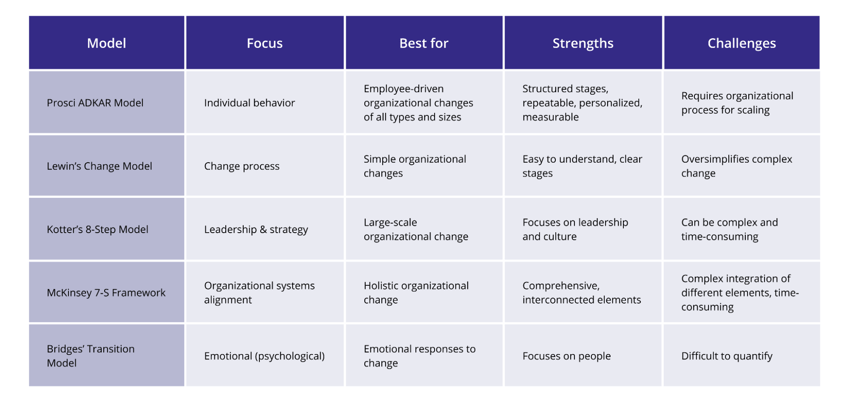

From this analysis, we can distill a few core themes:
- Lewin: Best for simplicity and communicating the overall 'shape' of a change. Its weakness is that it can be too high-level for complex transformations and the 'Refreeze' idea may not fit today's continuous-change environments.
- Kotter: Its strength lies in its comprehensive, step-by-step nature, making it excellent for driving large, top-down changes where strong leadership and urgency are required. Its limitations are its rigid, linear structure and potential to overlook bottom-up feedback.
- ADKAR: Uniquely powerful for the "people side" of change. It is an excellent diagnostic tool for identifying the root cause of resistance at an individual level. Its main limitation is that it doesn't prescribe the organizational strategy for change; it helps you implement a strategy that has already been decided.
Matching the Model to the Mission
The ultimate skill is not just knowing the pros and cons, but applying them to a real-world scenario. Your transformation goal involves multiple facets: technological shifts (microservices, AI), process changes (delivery model), and cultural evolution. Different models may be better suited to different parts of this journey.
Top Change Management Models Explained Simply - TechClass
The article 'Top Change Management Models Explained Simply' provides an excellent concluding section that helps connect specific types of change scenarios to the most appropriate models.
Please read the section 'Final Thoughts: Choosing the Right Model for Your Change'. Pay close attention to the table 'Matching the Model to the Mission', which provides clear examples of when to use Kotter vs. ADKAR.
Combining Models: A Hybrid Approach
As the articles suggest, the most sophisticated approach is often to combine models. You don't have to choose just one. For a large-scale transformation, a hybrid strategy is often most effective:
- Lewin can provide the high-level narrative for the entire organization: "We are currently 'unfreezing' our old way of working, moving through a period of 'change', and will 'refreeze' with new, more agile capabilities."
- Kotter can provide the macro-level playbook for the transformation management office (TMO) and leadership team: creating the guiding coalition, setting the vision, communicating it, etc.
- ADKAR can provide the micro-level toolkit for managers and change champions to use with their teams, ensuring individual employees have the Awareness, Desire, Knowledge, Ability, and Reinforcement to make the transition successfully.
This integrated approach allows you to manage the change from the top-down, the bottom-up, and at the individual level simultaneously.
Application Exercise
Let's apply this evaluative thinking directly to your goal.
Scenario: Your B2B software company is undertaking a major transformation. The plan is to migrate from a single, monolithic product to a modular platform built on a microservices architecture. A key part of this is introducing a new, AI-powered predictive analytics module that will be sold as a premium add-on.
This transformation impacts multiple departments:
- Engineering: Must adopt new architectures, tools, and team structures (e.g., stream-aligned teams).
- Sales: Must learn to sell modular solutions and articulate the value of the new AI module, a shift from selling a single, all-in-one product.
- Customer Success: Must support a more complex, modular product portfolio and guide customers through migrations.
Your Task:
For each of the three models, answer the following questions. There are no single right answers; the goal is to justify your reasoning based on the models' strengths and weaknesses.
-
Kotter's 8-Step Model:
- What specific aspect of this transformation would Kotter's model be most suitable for leading? Why? (e.g., getting initial executive buy-in, structuring the overall program, etc.)
- Where might a purely Kotter-based approach fall short in this scenario?
-
ADKAR Model:
- Identify one stakeholder group (e.g., veteran salespeople, senior engineers, customer support managers). For this group, why is ADKAR a particularly powerful model to apply? What specific challenge would it help you diagnose and solve?
-
Hybrid Approach:
- Describe how you would combine at least two of the models to manage the rollout of the new AI-powered analytics module. Explain what purpose each model would serve in your integrated strategy.
Take about 15 minutes to think through and jot down your answers. This exercise directly simulates the kind of strategic thinking required at the start of any major change program.
Conclusion
This lesson completes our tour of foundational change management models. You've moved from learning the definitions to critically evaluating their application.
Key Takeaways:
- No single change management model is universally superior. They are tools with specific strengths and weaknesses.
- Lewin's model is a simple, powerful framework for communication.
- Kotter's model provides a robust, top-down process for large, structured organizational changes.
- ADKAR is an indispensable tool for managing change at the individual level and diagnosing sources of resistance.
- The most effective change leaders often use a hybrid approach, combining models to manage the different layers of a transformation.
Preview of the Next Module:
You now have the foundational theory. In our next module, "Diagnosing Readiness and Building the Coalition," we will put this knowledge into practice. Your first lesson will guide you in applying a selected framework to begin the critical work of diagnosing a real transformation scenario, starting with one of the most important first steps: conducting a stakeholder analysis.