Introduction
Welcome to our third lesson on the foundations of organizational change. In our previous sessions, we explored Lewin's high-level Unfreeze-Change-Refreeze model and then delved into Kotter's 8-Step process, a detailed, top-down playbook for leading change at an organizational level.
This lesson shifts our focus from the organization to the individual. For any large-scale transformation to succeed—especially one as complex as shifting to microservices and AI—the organization doesn't change until the people within it do. Your goal for this lesson is to learn a framework that manages this individual journey: Prosci's ADKAR model. By the end of this lesson, you will be able to describe its five core elements.
Understanding ADKAR provides a powerful lens for diagnosing resistance, tailoring communications, and ensuring that new processes, technologies, and mindsets are truly adopted. It complements Kotter's organizational "what to do" with a person-centric "how to help them do it."
The ADKAR Model: Change One Person at a Time
The ADKAR model was developed by Jeff Hiatt of Prosci after studying change patterns in hundreds of companies. Its core premise is that organizational change is the cumulative result of successful individual change.
ADKAR is an acronym for the five sequential outcomes or building blocks that an individual must achieve to make a change successfully. Let's start with a short video that introduces the model and its unique focus on the individual.
This video, 'ADKAR Change Management Model', provides a concise overview of the framework's origin and its five steps. It clearly explains why focusing on individual change is a prerequisite for organizational change.
Please watch from the beginning to 01:53 to understand the core concept and individual-centric philosophy of the model. You can then watch the summary from 07:55 to 08:47 for a quick recap.
As the video highlights, the model is powerful because it gives you, as a change leader, a way to break down the transformation into manageable, human-sized pieces. Let's explore each of those pieces in detail.
The Five Elements of ADKAR
The five elements of ADKAR represent a sequence. A person must progress through them in order. For instance, trying to build Knowledge of a new system is ineffective if the person has no Awareness of why it's needed or the Desire to use it.
We'll use an article from Prosci, the creators of the model, as our primary guide.
Use the ADKAR Model for Change Success - Prosci
The article 'Use the ADKAR Model for Change Success' from Prosci is the definitive guide to the model. We'll read through the sections describing each of the five elements.
Please open the article and prepare to read the section titled 'Prosci ADKAR Model,' starting from 'Awareness' and ending after 'Reinforcement.' We will tackle each element one by one.
1. Awareness
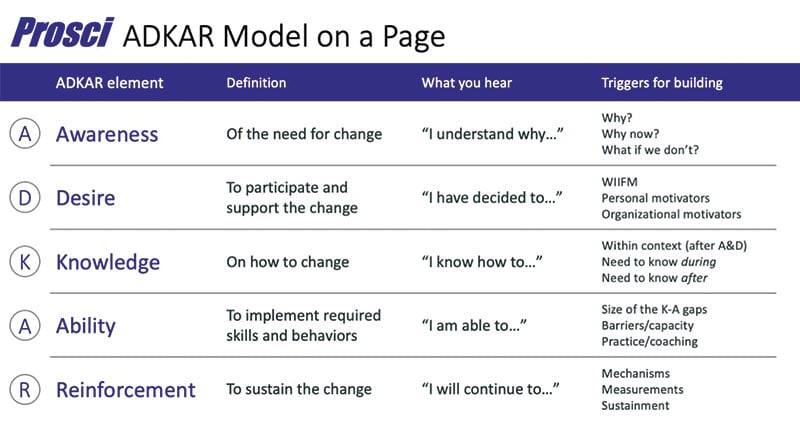
Awareness is about understanding the why behind the change. It addresses the nature of the change, why it's happening, and the risk of not changing. Without this, you get confusion and resistance from the start.
In your context, this means an engineer doesn't just know "we are moving to microservices," but understands why: "We are moving to microservices to reduce deployment friction, improve system resilience, and enable faster delivery of value to our customers, which is critical to staying ahead of our competitors."
- Instruction: Read the subsection on Awareness in the Prosci article. Note the emphasis on communicating the business reasons for the change.
2. Desire
Desire is the personal decision to support and participate in the change. This is often the most challenging element, as it moves from organizational reasons to an individual's personal motivation. It's about answering the question, "What's in it for me?" (WIIFM).
For some, desire might come from the opportunity to learn new skills. For others, it might be about improved job security or being part of an innovative project. As a leader, your role is to influence this personal choice, not command it.
- Instruction: Now, read the subsection on Desire. Pay attention to the different factors that can influence an individual's desire to change.
3. Knowledge
Knowledge is about knowing how to change. This encompasses both knowledge of the tools and systems (e.g., how to use a new CI/CD pipeline) and the skills and behaviors required to support the change (e.g., how to collaborate as a stream-aligned team).
A crucial point made in the Prosci article is that organizations often make the mistake of starting with knowledge (i.e., training) before establishing awareness and desire. If an employee doesn't know why they should change or want to change, training efforts will largely be wasted.
- Instruction: Read the subsection on Knowledge in the article. Reflect on your own experience in L&D and how this insight aligns with it.
4. Ability
Ability is the demonstrated capability to implement the change. It's the difference between knowing how to do something and being able to actually do it proficiently in a real-world environment. This stage requires practice, coaching, and feedback.
For example, a developer may have the knowledge of test-driven development from a workshop but only develops the ability after writing and refactoring tests on the job with support from a senior mentor.
- Instruction: Please read the subsection on Ability. Notice the distinction between theoretical knowledge and practical application.
5. Reinforcement
Reinforcement is about making the change stick. Human beings and organizations naturally tend to revert to old, comfortable habits. Reinforcement includes any action or event that strengthens and sustains the new way of working. This can include formal recognition, performance metrics aligned with the new behaviors, celebrating successes, and feedback mechanisms.
Your experience in designing talent development systems is highly relevant here, as reinforcement must be embedded into the organization's formal and informal systems.
- Instruction: Finally, read the subsection on Reinforcement. This step is critical for avoiding "snap back" and is often the most neglected.
To help consolidate your understanding, here is a helpful one-page summary of the model.
Applying ADKAR to Your Transformation Goal
The ADKAR model is not just a theory; it's a practical tool. Given your goal to lead a transformation involving AI, let's look at how the model can be applied directly to that challenge. Many employees harbor fears about AI replacing their roles, making the Desire element particularly critical.
The following resource provides a concrete example of using ADKAR to guide an AI integration project.
AI Integration and the Human Side of Transformation - Prosci
This article, 'AI Integration and the Human Side of Transformation' by Prosci, is highly relevant to your goals. It demonstrates how to apply each ADKAR element to address the specific challenges of AI adoption.
Please read the section titled 'Prosci ADKAR Model' which provides bullet points on how to apply Awareness, Desire, Knowledge, Ability, and Reinforcement in an AI context.
This application shows how you can move from a technical plan (implementing an AI layer) to a human-centric one that anticipates and addresses employee concerns, thereby building buy-in and ensuring successful adoption.

Application Exercise
Now, let's put this into practice. Consider the transformation at your B2B software company. Think about a specific role, such as a veteran salesperson who is highly successful with the current monolithic product. How would you guide them through the ADKAR journey for the new microservices-based, AI-enhanced product?
Jot down your initial ideas for the following:
- Awareness: What is the single most important message this salesperson needs to hear about why the company must make this change? What customer pain point or competitive threat would you emphasize?
- Desire: The new modular product may mean a more complex sales process. What's in it for them? How could you build their personal Desire to champion this new way of selling?
- Knowledge & Ability: What specific Knowledge do they need beyond just product features (e.g., solution selling, value-based pricing)? How could you provide a safe space for them to practice and build Ability before they face a live customer?
- Reinforcement: How would you change the sales commission or recognition structure to Reinforce selling the new modular solutions instead of the old monolithic ones?
This exercise helps you shift your perspective from a program manager's "rollout plan" to a change leader's "adoption strategy."
Conclusion
In this lesson, we have focused on the human dimension of change through the lens of Prosci's ADKAR model.
Key Takeaways:
- ADKAR is a model for managing change at the individual level.
- Its five sequential elements are Awareness (the why), Desire (the will), Knowledge (the how-to), Ability (the execution), and Reinforcement (the follow-through).
- The model serves as both a planning tool and a diagnostic tool to identify why a change might be stalling (e.g., "Our people have the knowledge, but they lack the ability because they haven't had a chance to practice").
- Successfully guiding individuals through their own ADKAR journey is essential for achieving broad organizational transformation.
Preview of the Next Lesson:
You now have three distinct change management models in your toolkit: Lewin's foundational stages, Kotter's top-down organizational process, and ADKAR's bottom-up individual journey. In our next lesson, we will bring them all together. You will learn to evaluate the strengths and weaknesses of each model, enabling you to select and even combine them to create a robust strategy tailored to any specific transformation scenario.