Introduction
Welcome to our final lesson in the "Foundations of Organizational Change Management" module. In our previous lesson, we critically evaluated the strengths and weaknesses of Lewin's, Kotter's, and ADKAR's models. You now have a solid theoretical understanding of what structured change management looks like.
However, as any experienced project or product manager knows, even the best plans can go awry. In the world of large-scale transformation, the stakes are incredibly high, and the failure rates are sobering. Today, we shift our focus from theory to reality by examining why so many transformations fail.
This lesson is designed to help you analyze case studies of failed transformations to identify common failure patterns in large-scale change initiatives. Understanding these pitfalls is not about being pessimistic; it's about developing the foresight to anticipate, diagnose, and mitigate risks in the transformation program you aim to lead.
Let's start with a data point that underscores the importance of this topic.
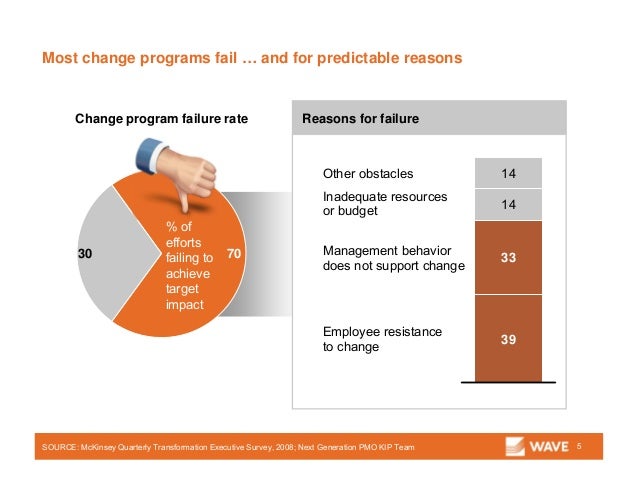
This data confirms that the "people side" of change, which we've been discussing, is where the biggest battles are won or lost.
A Framework for Analyzing Failure: Kotter's 8 Errors
To structure our analysis, we can turn to the work of John Kotter. Just as he developed an 8-step model for success, he also identified 8 common errors that cause transformations to fail. These errors are often the inverse of his steps. Reading his classic Harvard Business Review article will provide you with a powerful diagnostic lens for the case studies we'll examine.
[PDF] Leading Change: Why Transformation Efforts Fail (HBR Classic)
Please read the article 'Leading Change: Why Transformation Efforts Fail' by John Kotter. It's a foundational text that clearly articulates the most common, critical mistakes leaders make when trying to implement large-scale change.
Read the article from 'Error 1: Not Establishing a Great Enough Sense of Urgency' through to 'Error 8: Not Anchoring Changes in the Corporation’s Culture'. As you read, notice how each error is a direct counterpart to the 8-step model you learned about. Think of this as a checklist of 'what not to do'.
Case Studies in Transformation Failure
With Kotter's framework in mind, let's examine real-world examples. The following video discusses several recent, high-profile ERP implementation failures. While the context is ERP systems, you'll recognize the patterns are universal to any large-scale technology and process transformation, including the shift to microservices and AI.
ERP Implementations Failed Again in 2025 | Here's Why
This video from 'Digital Transformation with Eric Kimberling' provides several concise case studies of recent ERP project failures. It's a goldmine for identifying recurring themes.
Watch the case studies from 01:29 to 10:48. Pay attention to the specific reasons cited for each failure (e.g., SAQ, Zimmer Biomet, Spar Group, Cook County). Then, watch the summary section from 13:16 to 15:37, where the presenter synthesizes the common patterns. As you watch, try to map the issues back to Kotter's 8 errors.
Did you notice the recurring themes? Issues like inadequate planning, lack of change management focus, ignoring warning signs, and poor project governance are not unique to ERPs. They are fundamental breakdowns in leading change. For example, the SAQ case, which cited a lack of focus on change management and ignoring warning signs, demonstrates a failure in nearly all of Kotter's early steps: creating urgency (Error 1), forming a powerful coalition (Error 2), and developing a clear vision (Error 3).
A Deeper Dive: The US Air Force's $5 Billion Failure
Now, let's move from a series of short cases to a deep dive into one of the most infamous transformation failures in history. The scale of this failure provides stark lessons about what can happen when fundamentals are ignored.
Lessons from the US Air Force ERP Failure | Oracle ERP Implementation Case Study
This video, also from Eric Kimberling, analyzes the US Air Force's failed Oracle ERP implementation. It provides a detailed post-mortem that touches on strategy, culture, leadership, and execution.
Watch the core analysis from 02:02 to 13:19. The presenter breaks down the failure into several key areas. Pay close attention to the discussion of cultural resistance, the failure to define business processes, the lack of leadership, and the multiple execution failures.
The Air Force case is a textbook example of systemic failure. Note the key points:
- Lack of Leadership (Error 2 & 4): No clear executive sponsor and high turnover at the project level created a vacuum of direction.
- Cultural Resistance (Error 1 & 5): The organization was described as "too big to change," and there was no effective strategy to overcome this inertia or remove obstacles.
- Failure to Define Processes (Error 3): The project team looked to the technology to define the future state, rather than developing a clear vision and strategic processes first.
- Excessive Customization: This is often a symptom of failing to challenge the status quo (Error 1) and not removing process-related obstacles (Error 5). Instead of changing the process to fit the new system, they changed the new system to fit the old, broken processes.
Synthesizing the Common Patterns of Failure
Across all these cases, a clear set of common failure patterns emerges. They are rarely about the technology itself. More often, they are about strategy, leadership, and people.
Digital Transformation Failure: What Are The Rate and Main Cause?
To broaden our perspective, let's look at a list of common reasons for digital transformation failure from Magenest. This will help us consolidate what we've seen in the videos.
Please read the section 'Reasons for digital transformation failure'. This provides a concise, categorized list of common pitfalls.
Drawing from all the resources, we can group the most common failure patterns into four categories:
1. Leadership and Vision Failures
- Lack of executive sponsorship and alignment: No single, accountable leader driving the change.
- Unclear or uninspiring vision: The "why" is not well-defined or communicated.
- Conflicting priorities: The transformation is not protected from competing business-as-usual demands.
2. Planning and Governance Failures
- Insufficient planning and estimation: Unrealistic timelines and budgets set the project up for failure.
- Poor governance and decision-making: No clear process for making choices, resolving conflicts, or escalating issues.
- Ignoring warning signs: Pressing forward despite clear signals that the project is off track.
3. People and Culture Failures
- Failure to create urgency: Employees don't understand why change is necessary and remain in their comfort zones.
- Underestimating and mismanaging resistance: Viewing resistance as a problem to be crushed rather than a symptom to be understood.
- Inadequate investment in skills and training: Expecting people to perform new roles without the necessary knowledge or ability.
4. Execution Failures
- Poor communication: The vision is communicated once and then forgotten.
- Failure to remove obstacles: Obvious blockers (like misaligned incentive systems or resistant managers) are left in place.
- Declaring victory too soon: Losing momentum after early successes and allowing the organization to regress to old habits.
Application Exercise: Post-Mortem of GE Digital
Now it's your turn to act as a consultant. General Electric's ambitious "GE Digital" initiative is another well-known case of a transformation that failed to meet its lofty goals.
Your Task:
Read the brief case summary below and review the accompanying image. Then, write a short post-mortem analysis (a few paragraphs).
Case Information:
From the Magenest article (resource LINK):
With the goal to become the top software company by the end of the decade, GE set their step on a digital journey in 2011. ... The next step took place in 2015, with the establishment of a new business unit called GE Digital, with the goal of turning GE into a technology powerhouse. The failure of GE’s digital transformation can be attributed to the company’s attempt to accomplish an excessive amount of work without a strategic focus in any area. Simply put, the organization was too large to undergo a complete transformation at once, especially in the absence of a clear objective. ... after 6 years of implementation, GE was challenged with unmet objectives and considerable technical problems... As a result, the company’s stock price continued to decline and other products suffered despite the investment of billions of dollars in GE Digital...
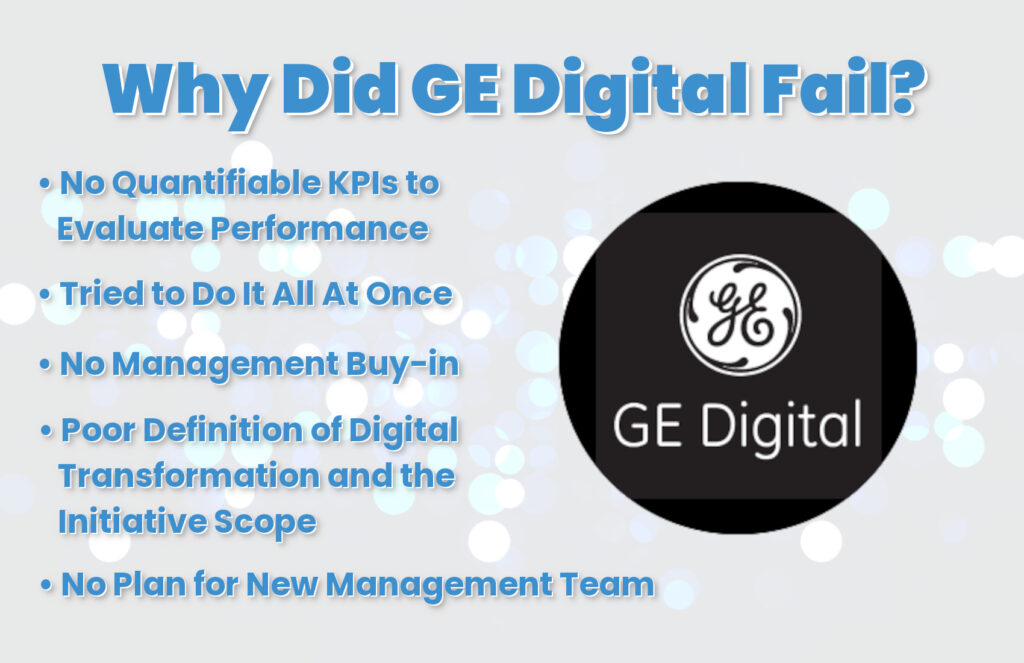
Your Post-Mortem Analysis should:
- Identify what you believe are the top two failure patterns in the GE Digital case, using the categories we synthesized above (Leadership/Vision, Planning/Governance, etc.).
- For each pattern, cite specific evidence from the text or the image.
- Connect each pattern to one of Kotter's 8 Errors.
- Suggest one key action that could have helped mitigate one of these failures.
Take about 10-15 minutes to structure your analysis. This exercise mimics the critical thinking you'll need to apply to diagnose potential risks in your own organization.
Conclusion
This lesson has been a crucial, if sobering, look at the realities of large-scale change. By studying failure, we arm ourselves with the knowledge to create success.
Key Takeaways:
- Transformation failure is common (up to 70%), and the primary causes are related to people, leadership, and process, not technology.
- Common failure patterns are recognizable and preventable. These include failures in leadership and vision, planning and governance, managing people and culture, and project execution.
- Frameworks like Kotter's 8 Errors provide a powerful lens for diagnosing what went wrong in a failed transformation and, more importantly, for proactively identifying risks in a planned one.
Preview of the Next Module:
You have now completed the foundational module of this course. You understand the "what" and "why" of core change models, and you've seen the consequences of ignoring their principles.
This sets the stage perfectly for our next module, "Diagnosing Readiness and Building the Coalition." Instead of analyzing past failures, you will begin the proactive work of preventing them. Your very first lesson will focus on applying a framework to diagnose a transformation scenario, starting with one of the most critical activities: conducting a stakeholder analysis. This is the first step in building the support and mitigating the resistance that, as we've seen today, so often determines the fate of a transformation.