Introduction
Welcome back! In our previous lesson, we used the Competing Values Framework to diagnose AlphaTech's organizational culture. We hypothesized that its current culture is likely strong in Hierarchy (control, process) and Market (competition, results) but weak in Adhocracy (innovation, risk-taking)—the very culture needed for "Project Phoenix" to succeed. This cultural gap represents a massive, systemic force that will resist your transformation.
Today, we will learn how to map out and evaluate all the forces—both helpful and unhelpful—that are influencing your change initiative. Your learning outcome for this lesson is to apply force field analysis to evaluate driving and restraining forces for a proposed transformation.
Developed by social psychologist Kurt Lewin, Force Field Analysis is a simple but powerful diagnostic tool. It will allow you to consolidate your previous findings on stakeholder resistance and cultural gaps into a single, visual strategic overview. This map will show you exactly where you need to apply pressure to build momentum and where you need to reduce friction to clear the path for change.
The Core Concepts of Force Field Analysis
At its heart, Force Field Analysis operates on a simple principle: any situation is held in a state of equilibrium by a balance of two opposing sets of forces.
- Driving Forces: These are the factors pushing for the change to happen. They can be internal (like a new corporate strategy) or external (like new competitors).
- Restraining Forces: These are the factors holding the change back. They represent the various forms of resistance, inertia, and constraints you'll face.
Change only occurs when the driving forces become stronger than the restraining forces.
To get a clear overview of this model, let's start with a video.
Force Field Analysis by Kurt Lewin Explained
This video, 'Force Field Analysis by Kurt Lewin Explained' from EPM, provides an excellent introduction to the core concepts, the model's origins, and its purpose in change management.
Please watch the first 2 minutes and 36 seconds (00:00 - 02:36). Focus on understanding: The definition of driving and restraining forces. The concept of 'equilibrium' and what is required for change to become possible.
As the video explains, your strategic task isn't just to push harder on the driving forces. Often, it's more effective to weaken or remove the restraining forces. A key insight from Lewin's work is that increasing driving forces without addressing restraining forces can simply increase tension and conflict.
Here is a classic example of what a completed Force Field Analysis looks like.
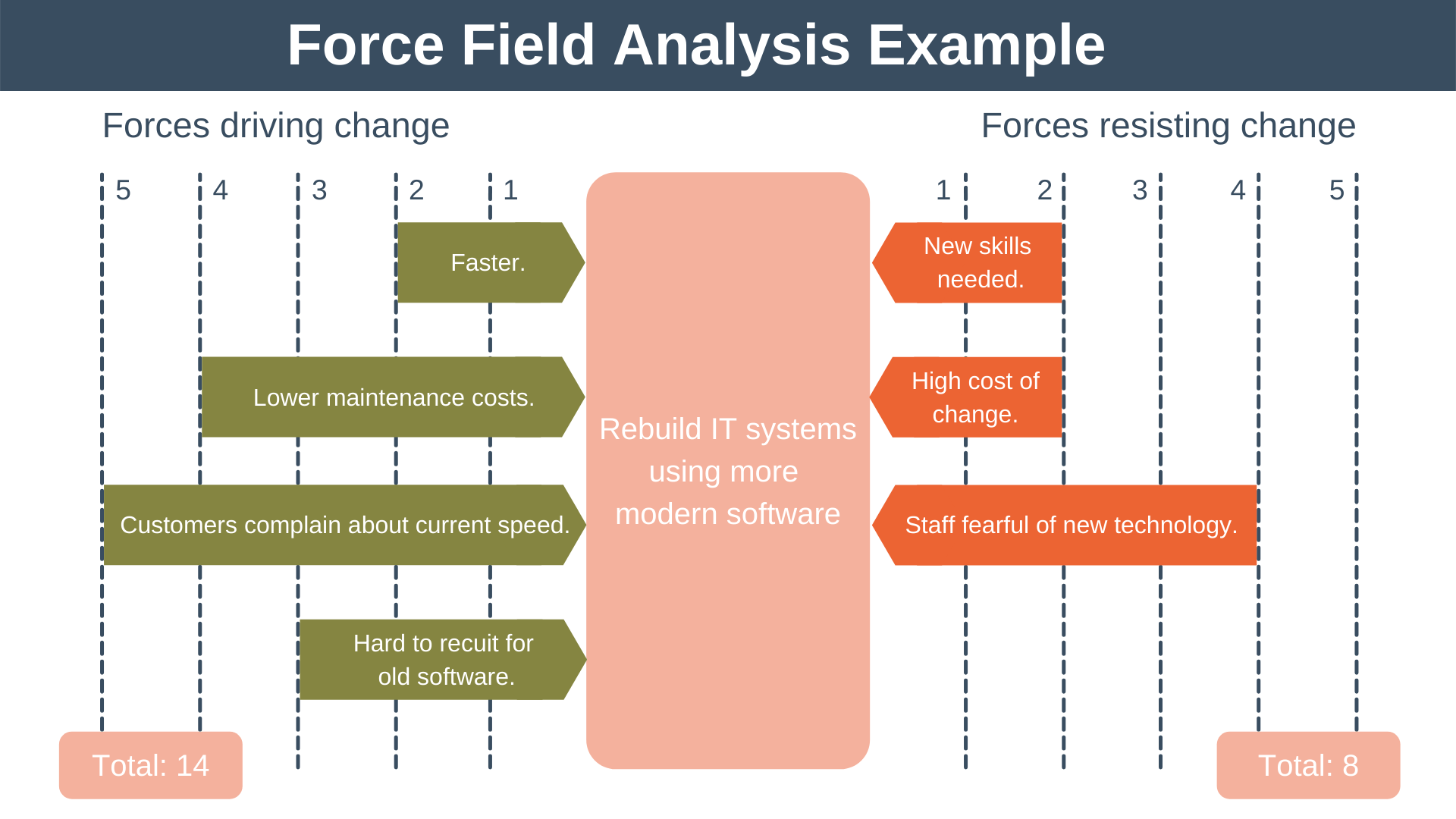
A Step-by-Step Guide to Performing the Analysis
Now that you understand the concept, let's walk through the practical steps of conducting a Force Field Analysis. This structured process turns a simple idea into a robust diagnostic tool.
The following guide provides a detailed, step-by-step methodology that is highly applicable to a corporate transformation context.
Understanding Force Field Analysis: A Comprehensive Guide
This article, 'Understanding Force Field Analysis: A Comprehensive Guide' from Insia.ai, offers a clear and practical walkthrough. Its example of a CRM migration is very relevant to your work in B2B software.
Please read the section titled 'How to Conduct a Force Field Analysis: Step-by-Step Guide'. Pay close attention to the six steps, from defining the objective to strategizing action plans. This process is the core of today's learning outcome.
To summarize the key steps you just read about:
- Define the Desired Change: State your goal clearly. For us, this is the successful implementation of "Project Phoenix."
- Identify Driving Forces: Brainstorm all factors pushing the organization toward this change.
- Identify Restraining Forces: Brainstorm all obstacles and sources of resistance holding it back.
- Assign Scores to Each Force: Rate the strength of each force, typically on a scale of 1 (weak) to 5 (strong). This step is crucial for moving from a qualitative list to a quantitative assessment.
- Analyze the Balance: Sum the scores for both sides. This gives you an immediate sense of whether the change is likely to succeed, stall, or fail in the current environment.
- Strategize Action Plans: This is the most important step. Develop concrete actions to strengthen key driving forces and weaken key restraining forces.
Application Exercise: Force Field Analysis for "Project Phoenix"
It's time to apply this framework to your transformation at AlphaTech. In previous lessons, we've already identified many of the forces at play; now we'll organize and quantify them.
Your Task (20 minutes):
Complete the Force Field Analysis in the table below for "Project Phoenix."
- List Forces: Based on your own experience and our previous discussions on resistance and culture, list at least four driving forces and four restraining forces.
- Assign Scores: Rate the strength of each force on a scale of 1 (very weak) to 5 (very strong).
- Calculate Totals: Sum the scores for each side to determine the balance of forces.
- Propose Actions: For the highest-scoring restraining force, propose one concrete action to weaken it. For the highest-scoring driving force, propose one action to strengthen it.
| Driving Forces for "Project Phoenix" | Score (1-5) | Restraining Forces for "Project Phoenix" | Score (1-5) |
|---|---|---|---|
| e.g., Competitors are launching AI features | e.g., Fear of job loss among senior engineers | ||
| Total Driving Score: | Total Restraining Score: |
Action to Weaken a Key Restrainer:
Action to Strengthen a Key Driver:
Click here for a sample analysis after completing your own.
| Driving Forces for "Project Phoenix" | Score (1-5) | Restraining Forces for "Project Phoenix" | Score (1-5) |
|---|---|---|---|
| Competitive pressure to offer AI capabilities | 5 | Deeply ingrained 'Hierarchy' culture (process-heavy, risk-averse) | 5 |
| Customer dissatisfaction with monolithic product's slow feature delivery | 4 | Senior engineers' fear of their skills becoming obsolete | 4 |
| Leadership's strategic vision and sponsorship for the change | 4 | High cost and perceived risk of a large-scale migration | 3 |
| Difficulty hiring/retaining talent for the old technology stack | 3 | Sales team's anxiety about selling new, unproven modules | 3 |
| Total Driving Score: | 16 | Total Restraining Score: | 15 |
Analysis of the Balance:
In this scenario, the driving forces (16) are only slightly stronger than the restraining forces (15). The system is near equilibrium, meaning the transformation is at high risk of stalling or failing without targeted interventions. The change is possible, but it will be a difficult struggle.
Action to Weaken a Key Restrainer:
- Restraining Force: Deeply ingrained 'Hierarchy' culture (Score: 5)
- Action: To weaken this, we can introduce a "dual-operating model." For a few pilot teams working on the new microservices, we can explicitly suspend old, bureaucratic approval processes and empower them with full autonomy. We would celebrate their speed and learnings (even failures) publicly, demonstrating a new way of working and creating a "bubble" of the desired 'Adhocracy' culture.
Action to Strengthen a Key Driver:
- Driving Force: Competitive pressure (Score: 5)
- Action: To strengthen this, we can create and share a "State of the Market" dossier with middle managers and key influencers. This would include detailed analysis of competitors' AI features, customer testimonials about those features, and analyst reports on market trends. This makes the external threat more tangible and urgent throughout the organization, rather than just an abstract concern for senior leadership.
From Whiteboard to Dashboard: Modernizing the FFA
While Force Field Analysis is often done on a whiteboard, it's important to recognize how this classic tool is being integrated into modern transformation management. Your interest in a "Transformation Tech Stack" is highly relevant here.
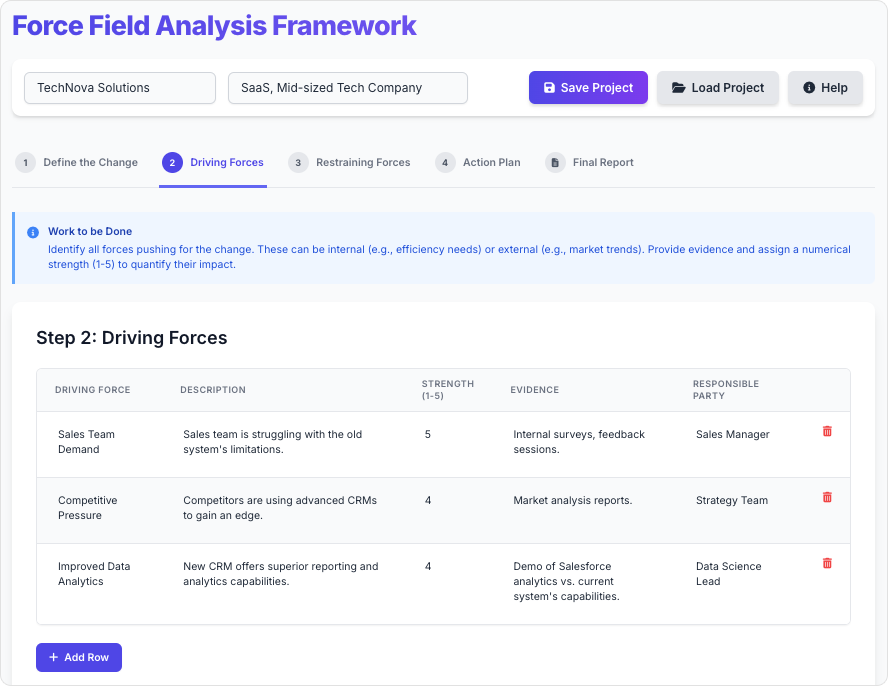
By digitizing the FFA, you can:
- Link forces to live data: A restraining force like "low user adoption" can be tied directly to login data from a Digital Adoption Platform (DAP).
- Assign accountability: Each action plan to weaken a restrainer or strengthen a driver can be assigned to a specific person or team.
- Track progress in real time: A central dashboard can show how the balance of forces is shifting as a result of your interventions.
This addresses one of the main limitations of traditional FFA—that it can be a one-time, static snapshot.
Conclusion
In this lesson, you've learned to apply Force Field Analysis, a cornerstone diagnostic technique in change management. You now have a method to systematically map the battlefield for your transformation, clarifying what is helping you and what is holding you back.
Key Takeaways:
- Change is a battle of forces: Your transformation's success depends on making the driving forces for change decisively stronger than the restraining forces.
- Quantifying forces creates clarity: Assigning scores to each force moves you beyond a simple list of pros and cons to a weighted analysis of the change landscape.
- FFA turns diagnosis into action: The ultimate goal is to develop specific strategies to weaken restrainers and strengthen drivers, shifting the balance in your favor.
- FFA is a synthesis tool: It effectively integrates your previous analyses of stakeholder resistance and organizational culture into a single, coherent strategic picture.
Preview of the Next Lesson:
Your Force Field Analysis has revealed the key drivers you need to amplify and the critical restrainers you must overcome. But you cannot do this alone. In our next lesson, we will address the question of "who?" We will focus on how to design and build a guiding coalition of sponsors and change champions—the influential group of leaders and advocates you will recruit to help you execute the very action plans you just started to outline.