Introduction
Welcome to our next lesson. In our previous session, we diagnosed the likely sources of resistance to the "Project Phoenix" transformation at AlphaTech. We saw that different groups, like senior engineers and the sales team, might resist for very different reasons, ranging from self-interest to a genuine disagreement with the strategy.
That analysis focused on individual and group-level resistance. Today, we zoom out to examine a powerful, systemic force that shapes those very reactions: organizational culture. Culture is the "operating system" of a company—the shared assumptions, values, and practices that determine "how we do things around here." It can be a major accelerator or a formidable barrier to any transformation.
Your learning outcome for this lesson is to analyze organizational culture using the Competing Values Framework (CVF). This framework will provide you with a structured, practical way to diagnose your organization's current culture, define the culture required for your future state, and identify the critical gaps you must address in your change management plan. Understanding this is essential for your goal of leading a large-scale transformation, especially one that involves a fundamental shift in technology and business models.
Understanding the Competing Values Framework (CVF)
The Competing Values Framework, or CVF, is a model developed by Robert Quinn and Kim Cameron to understand and classify organizational cultures. It's built on the idea that all organizations must balance two fundamental tensions.
To get a solid overview of the framework's structure and purpose, let's start with a video.
Competing Values Framework introduction the tool OCAI by Robert E Quinn and Kim S Cameron
This video, 'Competing Values Framework introduction the tool OCAI', provides a clear explanation of the two dimensions that form the CVF and how they create the four distinct cultural archetypes.
Please watch from the beginning to 03:42. Focus on understanding the two core tensions: Flexibility/Dynamism vs. Stability/Control (the vertical axis) Internal Orientation vs. External Orientation (the horizontal axis)
As the video explains, these two axes create four quadrants, each representing a distinct cultural archetype.
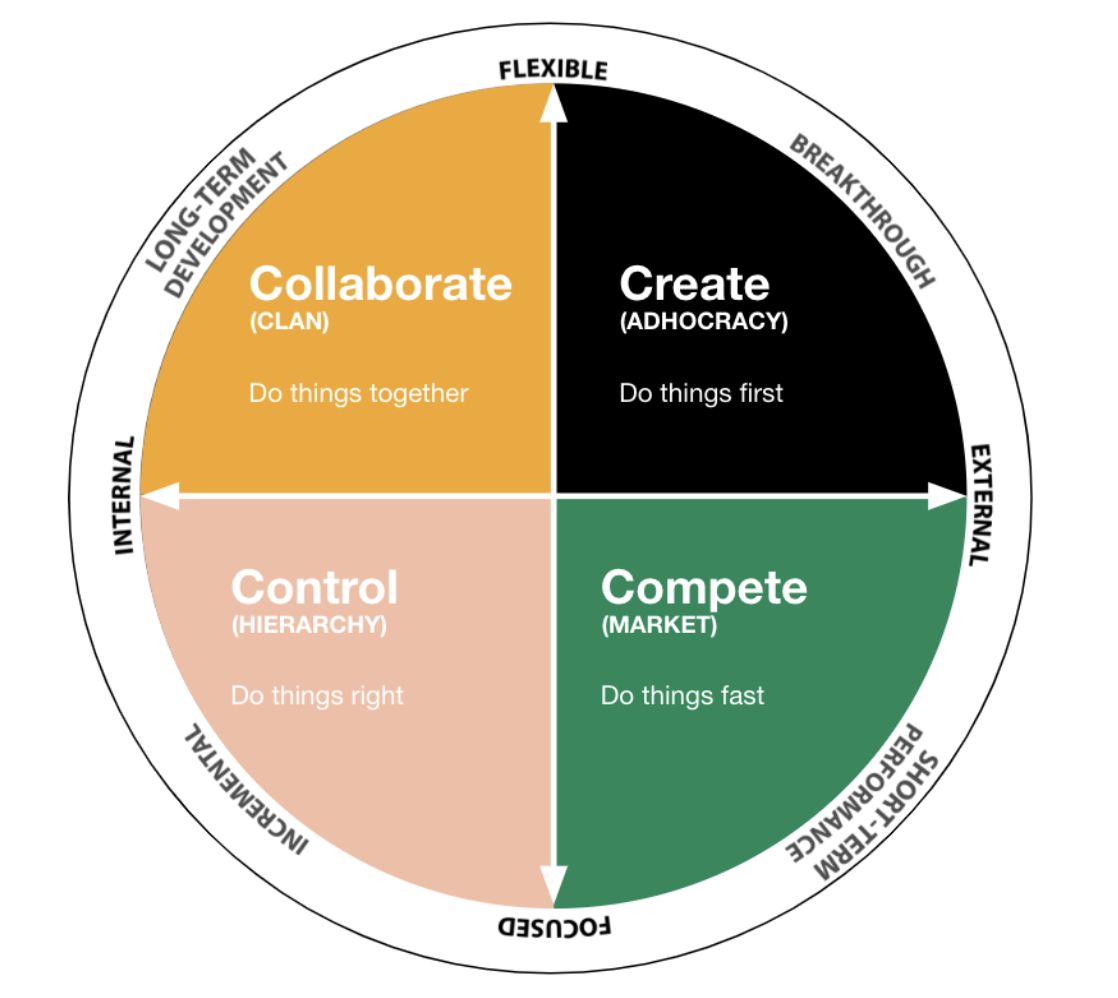
Let's look at each of these quadrants in more detail.
Competing Values Framework introduction the tool OCAI by Robert E Quinn and Kim S Cameron
Continuing with the same video, the next sections offer a concise description of each of the four cultural types.
Please watch from 03:42 to 08:01. As you watch, think about which of these descriptions sound most like a typical B2B software company you've encountered in your career.
To solidify your understanding and add more detail, the following reading provides an excellent summary of each archetype, including their core values, leadership styles, and potential risks when overemphasized.
Competing Values Framework (Cameron–Quinn)
This article from Umbrex, 'Competing Values Framework (Cameron–Quinn)', provides a detailed breakdown of each culture type. It's a resource you may find useful to bookmark for future reference.
Read section 1, 'What Is the Competing Values Framework?', and the subsection 'The four culture archetypes' within section 3. Pay attention to the 'Risks if overdone' for each quadrant, as these highlight the 'competing' nature of the values.
Here's a quick summary of the four archetypes:
- Clan (Collaborate): An internally focused and flexible culture. It feels like a family, valuing teamwork, participation, and employee development. Think of it as "doing things together."
- Adhocracy (Create): An externally focused and flexible culture. It's dynamic and entrepreneurial, valuing innovation, risk-taking, and being on the cutting edge. Think of it as "doing things first."
- Market (Compete): An externally focused and stable culture. It's results-oriented and competitive, valuing market share, goal achievement, and winning. Think of it as "doing things fast."
- Hierarchy (Control): An internally focused and stable culture. It's structured and formal, valuing efficiency, predictability, and formal procedures. Think of it as "doing things right."
A key insight of the CVF is that the values are "competing." A culture that heavily emphasizes Hierarchy (control, process) will naturally struggle with the demands of Adhocracy (innovation, risk-taking). This is why a transformation often requires a conscious and deliberate cultural shift.
Measuring Culture: The OCAI
The CVF is not just a theoretical model; it comes with a practical diagnostic tool called the Organizational Culture Assessment Instrument (OCAI). This survey-based instrument allows you to create a quantitative profile of your organization's culture.
The OCAI asks respondents to complete a survey twice:
- Current Culture: How they perceive the organization "now."
- Preferred Culture: How they believe the organization "should be" in the future to succeed.
The gap between these two profiles is where the work of transformation begins.
Competing Values Framework: Methods, Tools, Templates - OpinionX
To understand how the OCAI survey works in practice, let's look at the specific questions it uses. This article from OpinionX provides a complete template.
Read the sections 'Measuring Company Culture using the Competing Values Framework' and 'Implementing the OCAI'. Familiarize yourself with the six dimensions the survey covers (e.g., Dominant Characteristics, Organizational Leadership) and the structure of the questions.
By averaging the points allocated across all respondents, you can plot the relative strength of each of the four cultures on a radar chart, giving you a powerful visual diagnosis of where you are and where you need to go.
Application Exercise: Profiling AlphaTech's Culture
Let's apply this to your transformation at AlphaTech. Your goal is to shift from a monolithic product to a microservices architecture with an integrated AI layer. This strategic change has significant cultural implications.
- Microservices require more decentralized decision-making, collaboration between smaller, autonomous teams, and a focus on speed and experimentation.
- AI development thrives on innovation, risk-taking, and being at the leading edge of technology.
Your Task (15 minutes):
Based on your experience with established B2B software companies and the descriptions of the four CVF archetypes, create a hypothetical cultural profile for AlphaTech.
- Estimate the Current Culture: In the table below, allocate 100 points among the four culture types to represent AlphaTech's likely current culture. In the "Rationale" column, briefly explain your reasoning. Most established, successful companies are not single-cultured, so expect a mix.
- Define the Preferred Culture: Allocate another 100 points to represent the preferred culture needed to successfully execute the "Project Phoenix" transformation. Again, provide your rationale.
- Identify the Gaps: Which quadrants have the largest gaps between "Current" and "Preferred"? What do these gaps tell you about the challenges ahead?
| Culture Type | Current Culture (Points) | Rationale for Current Culture | Preferred Culture (Points) | Rationale for Preferred Culture |
|---|---|---|---|---|
| Clan | ||||
| Adhocracy | ||||
| Market | ||||
| Hierarchy | ||||
| Total | 100 | 100 |
Click here to see a sample analysis after you've completed your own.
| Culture Type | Current Culture (Points) | Rationale for Current Culture | Preferred Culture (Points) | Rationale for Preferred Culture |
|---|---|---|---|---|
| Clan | 15 | Some teamwork exists, but it's likely within functional silos (e.g., the 'sales family'). Cross-functional collaboration is probably not a core strength. | 25 | Microservices require strong collaboration within and between teams. A more people-centric approach will be needed to manage the human side of the change. |
| Adhocracy | 10 | As an established company, true risk-taking and innovation have likely been suppressed in favor of predictable product roadmaps. | 35 | This is the biggest required shift. The move to AI and a fast-evolving microservices landscape demands a culture of experimentation, agility, and entrepreneurship. |
| Market | 40 | B2B software is a competitive space. There is likely a strong focus on hitting sales targets, beating competitors, and market share, which drives performance. | 25 | While still important, an over-emphasis on short-term results can stifle the long-term investment and learning required for a major architectural shift. The focus needs to be more balanced. |
| Hierarchy | 35 | To ensure stability and quality for large enterprise clients, the company probably has many processes, controls, and approval gates. This leads to reliability but also slowness. | 15 | The existing bureaucracy will strangle the speed and autonomy needed for microservices. Processes need to be streamlined, and control needs to be decentralized, while retaining just enough for stability. |
| Total | 100 | 100 |
Analysis of Gaps:
The biggest gaps are the need to dramatically increase Adhocracy (from 10 to 35) and significantly decrease Hierarchy (from 35 to 15). This is the classic "control vs. innovation" tension. It signals that the primary cultural challenge of Project Phoenix will be to dismantle bureaucratic controls and create psychological safety for risk-taking and experimentation, which directly explains the resistance from process-oriented managers and risk-averse engineers we discussed in the last lesson.
From Diagnosis to Action
The CVF is more than just a diagnostic tool; it's a roadmap for action. By identifying the cultural gaps, you can design targeted interventions.
For example, to bridge the Hierarchy-to-Adhocracy gap at AlphaTech, you would need to introduce new systems and behaviors.
Competing Values Framework (Cameron–Quinn)
The Umbrex article you reviewed earlier contains a superb, practical guide for using the CVF to drive change. It's highly relevant to your goal of implementing a transformation program.
Please read section 5, 'How to Apply the CVF: Step-by-Step'. Focus on how the framework translates into concrete actions like defining new behaviors, changing systems, and running pilots.
A crucial point, especially for a company like AlphaTech, is the existence of subcultures. Your Engineering department's culture is likely different from your Sales or Finance departments'. The transformation will not require a uniform cultural shift across the entire organization.
- R&D/Product Teams: Need to shift heavily toward Adhocracy and Clan to foster innovation and collaboration.
- Platform/Infrastructure Teams: May need to maintain a strong Hierarchy culture to ensure the stability and reliability of core services.
- Sales Teams: Will need to balance their Market focus with a greater degree of Clan (internal collaboration with product teams) and Adhocracy (learning to sell new, evolving solutions).
Analyzing the culture at this granular, subculture level is where the CVF becomes a truly powerful strategic tool.
Conclusion
In this lesson, you've learned how to use the Competing Values Framework to diagnose and analyze organizational culture. This moves your diagnostic skills from the individual/group level to the systemic level, giving you a more complete picture of the landscape for your transformation.
Key Takeaways:
- Organizational culture is defined by competing values: The tension between stability vs. flexibility and internal vs. external focus shapes how a company operates.
- The CVF identifies four cultural archetypes: Clan (Collaborate), Adhocracy (Create), Market (Compete), and Hierarchy (Control). No single culture is "best"; success depends on aligning culture with strategy.
- The OCAI is the practical tool for measurement: It helps you map your organization's current and preferred cultural profiles, revealing critical gaps.
- Cultural analysis must inform your change strategy: The gaps identified through the CVF should guide the design of specific interventions, from changing leadership behaviors to redesigning performance management systems.
- Analyze subcultures for a nuanced view: Different parts of the organization have different cultures and may require different shifts to support the overall transformation.
Preview of the Next Lesson:
We've now diagnosed readiness, identified sources of resistance, and analyzed the underlying organizational culture. In the next lesson, we will learn to apply force field analysis to evaluate driving and restraining forces for a proposed transformation. This tool will help you synthesize your findings about resistance and culture into a single visual map, clearly showing the forces you need to weaken and those you need to amplify to build momentum for change.