Introduction
Welcome back! In our last lesson, we conducted a readiness assessment for the "Project Phoenix" transformation at AlphaTech. We used a structured tool to rate dimensions like motivation, capability, and leadership support, revealing several high-risk areas. That assessment told us that the organization might not be fully prepared for change.
Today, we'll explore the why behind that risk. The learning outcome for this lesson is to identify and categorize sources of resistance to change within an organization. Instead of viewing resistance as a monolithic barrier, you'll learn to deconstruct it into its specific drivers. This is a critical skill for any change leader, as understanding the root cause of resistance is the first step toward addressing it effectively.
Rather than seeing resistance as something to be "overcome," we will also explore the idea that it can be a valuable source of feedback—a form of engagement that, if understood correctly, can help you refine your transformation strategy.
The Psychological Core of Resistance
Before we get into formal frameworks, let's start with the human element. At its core, resistance to change is rarely a logical disagreement; it's almost always an emotional response.
Simon Sinek offers a concise and powerful perspective on this.
The Truth About CHANGE | Simon Sinek
In this short video, 'The Truth About CHANGE', Simon Sinek argues that resistance is fundamentally rooted in fear and that you cannot combat an emotional reaction with a purely rational argument.
Please watch the entire clip (it's just over two minutes). As you watch, consider how his points about fear, disruption, and the need to 'meet emotion with emotion' might apply to the senior engineers or the sales team at AlphaTech.
Sinek's point is crucial: people resist the disruption of what is working for them, fearing the loss of status, security, or competence. Your experience in customer-facing roles has likely shown you that simply presenting facts about a new product isn't enough; you must also address the customer's underlying concerns and emotions. The same principle applies tenfold to internal change management.
Furthermore, it's helpful to reframe resistance not as a problem to be crushed, but as a signal to be decoded.
The Psychology of Resistance to Change in Organizations
The article 'The Psychology of Resistance to Change' from Neurofied offers a valuable perspective on this. It suggests that resistance is a form of engagement and an opportunity for leaders.
Please read the first section, 'The Importance of Understanding Resistance to Change'. Focus on the idea that resistance isn't just an obstacle but a sign that employees care enough to have an opinion.
This mindset shift—from battling resistance to diagnosing it—is the foundation of effective change leadership.
Frameworks for Categorizing Resistance
To move from a general understanding of fear to a specific diagnosis, we need structured frameworks. Different models offer different lenses for categorizing resistance. We'll explore a few of the most useful ones.
1. Individual vs. Organizational Sources
A fundamental way to categorize resistance is to distinguish between factors related to individual psychology and those embedded in the organization's structure and politics.
The following video provides a clear overview of these two categories.
This video from GreggU, 'Organizational Change', provides a concise breakdown of the most common sources of individual and organizational resistance.
First, watch the segment on individual resistance from 00:13:47 to 00:16:28. It covers factors like habit, security, and fear of the unknown. Then, watch the segment on organizational resistance from 00:10:49 to 00:14:02. It discusses issues like structural inertia, threatened expertise, and power dynamics.
This initial split helps you determine whether you're dealing with personal anxieties or systemic blockages. An intervention to address an employee's fear of learning a new skill is very different from one designed to address a power struggle between departments.
2. Kotter & Schlesinger's Four Reasons for Resistance
John Kotter and Leonard Schlesinger developed a classic framework that is highly practical for managers. They argue that resistance typically stems from one of four situations.
Overcoming Resistance To Change: 7 Strategies
The article 'Overcoming Resistance To Change' from Primeast clearly explains Kotter and Schlesinger's influential model.
Please read the section titled '4 Reasons for Resistance to Change'. This will introduce you to the concepts of self-interest, misunderstanding and lack of trust, different evaluations, and low tolerance for change. We will use this framework in our application exercise.
Here is a summary of the four key reasons:
- Self-Interest: People are focused on what they will lose (e.g., power, status, convenience, or even their job).
- Misunderstanding & Lack of Trust: People resist when they don't understand the purpose of the change or they distrust the people leading it.
- Different Evaluations: People genuinely disagree with the rationale for the change. They may have different information or see the situation from a different perspective, leading them to believe the change is a mistake.
- Low Tolerance for Change: People fear they won't be able to develop the new skills and behaviors required of them.
3. A Multi-Faceted Psychological View
For a more granular view, we can turn to a model that breaks resistance down into more specific psychological, social, and political drivers.
The Psychology of Resistance to Change in Organizations
The Neurofied article we looked at earlier introduces Paul Gibbons’ holistic model, which provides a rich vocabulary for describing different types of resistance.
Read the section 'Resistance to Change Model' and pay close attention to the table titled 'Gibbons’ Holistic Model of Resistance'. This table details 11 different types of resistance, including rational, habitual, emotional, identity, and political resistance.
This model shows the complexity you'll face. For example, resistance from an engineer could be partly Pragmatic (they don't feel they have the skills), partly about Identity (their role as a "monolith expert" is threatened), and partly Political (they feel their team is losing influence).
Visualizing the Sources of Resistance
Mind maps can be a great way to consolidate these frameworks. These two images provide excellent visual summaries of the different ways to categorize resistance.

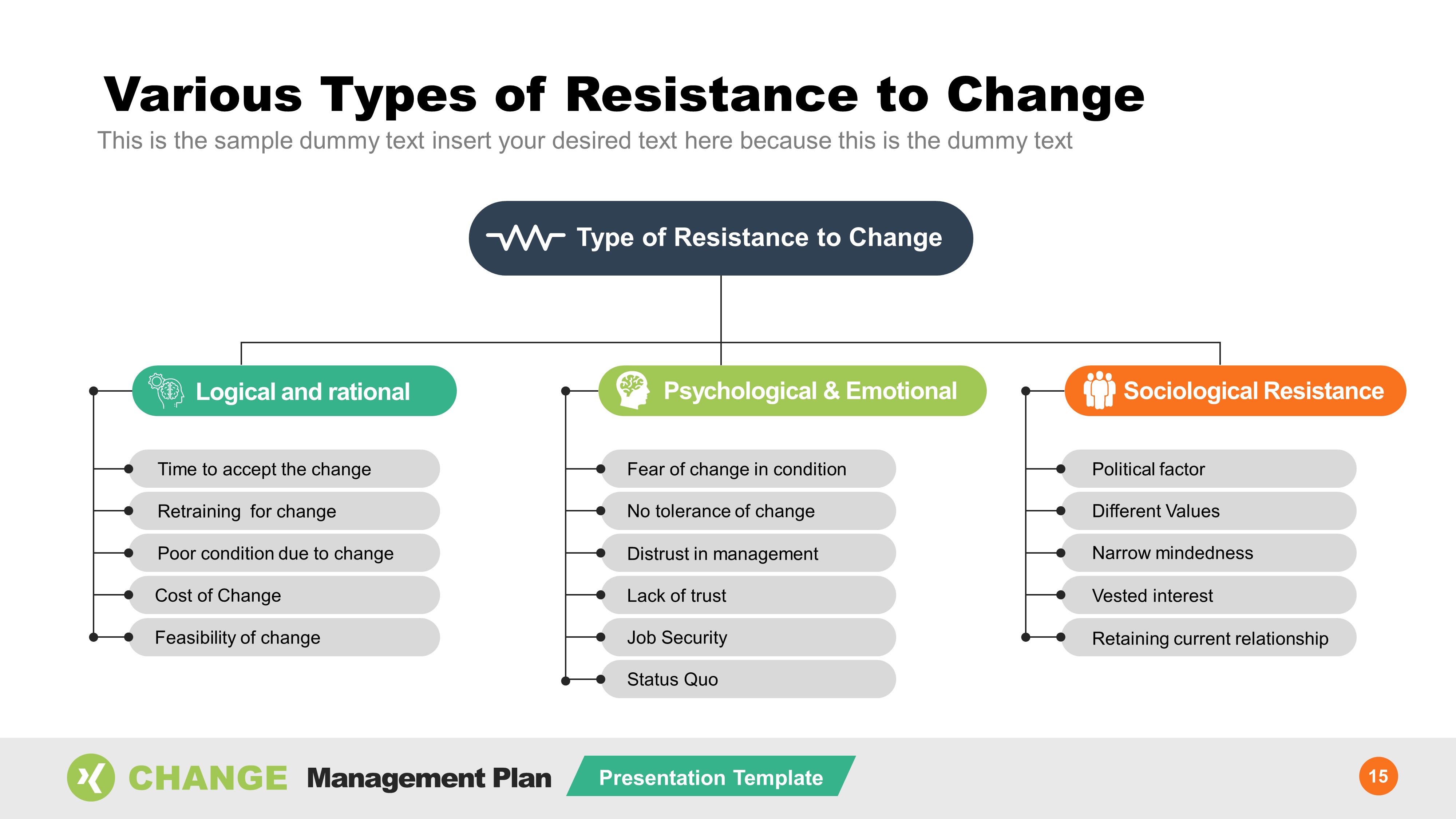
As you can see, while the labels differ, the underlying concepts—fear, loss of control, social pressure, and conflicting interests—are consistent across all models.
Application Exercise: Diagnosing Resistance at AlphaTech
Now, let's apply these concepts to the "Project Phoenix" transformation. In our last lesson's readiness assessment, we flagged Motivation/Desire and Capability/Know-how as "Red" or "Amber" for groups like the senior engineers and the sales team. Your task is to use the Kotter & Schlesinger framework to diagnose the likely sources of this resistance for these two groups.
Your Task:
Complete the table below. For each group, brainstorm the specific reasons they might resist the change, categorizing your points under the four headings.
(Take about 15 minutes for this exercise. There are no perfect answers; the goal is to practice applying the framework.)
| Stakeholder Group | Source of Resistance | Analysis for "Project Phoenix" |
|---|---|---|
| Senior Engineers | 1. Self-Interest | How is their status, power, or expertise threatened by the move to microservices? |
| 2. Misunderstanding & Lack of Trust | What might they misunderstand about the goals? Might they distrust that leadership has a sound technical strategy? | |
| 3. Different Evaluation | Why might they genuinely believe the current monolith is a better solution for the business? What data or experience might inform this view? | |
| 4. Low Tolerance for Change | What are their fears about their ability to learn an entirely new architecture and toolset? | |
| Sales Team | 1. Self-Interest | How does this change threaten their compensation plan, sales process, or relationships with customers? |
| 2. Misunderstanding & Lack of Trust | Do they understand how to sell a modular product? Do they trust that the new system will be stable and market-ready? | |
| 3. Different Evaluation | Might they believe customers don't want or need this change? Could they see it as an unnecessary complication to the sales cycle? | |
| 4. Low Tolerance for Change | How might they feel about having to learn a completely new product portfolio and value proposition? |
Click here to see a sample analysis after you've completed your own.
| Stakeholder Group | Source of Resistance | Sample Analysis for "Project Phoenix" |
|---|---|---|
| Senior Engineers | 1. Self-Interest | Their status as "gurus" of the monolith is threatened. They may lose their unique value and influence. |
| 2. Misunderstanding & Lack of Trust | They might see this as a "flavor-of-the-month" initiative and distrust that management understands the complexity involved, setting them up for failure. | |
| 3. Different Evaluation | They have years of experience with the monolith's stability and performance. They may evaluate the risk of a distributed system (complexity, latency) as being much higher than leadership does. | |
| 4. Low Tolerance for Change | They may fear they are too old or too specialized to learn a new stack (e.g., containers, new languages, event-driven architecture), risking obsolescence. | |
| Sales Team | 1. Self-Interest | Their compensation is tied to selling the existing, well-understood product. A new, modular system could mean smaller initial deal sizes and a more complex commission structure, directly hitting their wallets. |
| 2. Misunderstanding & Lack of Trust | They likely don't understand the customer benefits of "microservices." They may not trust Engineering to deliver a stable product on time, fearing it will damage their reputation with clients. | |
| 3. Different Evaluation | They may believe that customers value the all-in-one nature of the current system and will see a modular offering as confusing or incomplete. They have direct customer feedback that leadership may not. | |
| 4. Low Tolerance for Change | They are comfortable with their current sales pitch, demos, and pricing. The prospect of learning an entirely new way of selling is daunting and takes time away from hitting their quota. |
This exercise demonstrates that "resistance" is not a single entity. The engineers' resistance is likely rooted in identity and technical evaluation, while the sales team's resistance is driven by financial incentives and customer-facing risks. By diagnosing the specific sources, you can now design targeted interventions, which we will cover in later lessons.
Conclusion
In this lesson, you moved from identifying the presence of risk to diagnosing the sources of resistance. This is a fundamental shift from a reactive to a proactive approach to change management.
Key Takeaways:
- Resistance is a natural and often emotional reaction to perceived threats, rooted in fears of loss—of control, status, competence, or security.
- Effective change leaders treat resistance as data. It's a signal that provides valuable insight into misalignments, legitimate concerns, and hidden anxieties.
- Categorizing resistance allows for targeted strategies. Using frameworks like Individual vs. Organizational or Kotter & Schlesinger's Four Reasons helps you move beyond a generic response and address the specific drivers for different groups.
- Different groups resist for different reasons. A one-size-fits-all communication plan will fail. Your strategy must be tailored to the unique self-interests, beliefs, and fears of each key stakeholder group.
Preview of the Next Lesson:
Now that we have explored resistance at the individual and group levels, we need to zoom out and examine a powerful, systemic force that shapes how everyone in the organization responds to change: the organizational culture. In our next lesson, you will learn to analyze organizational culture using the Competing Values Framework. This will help you understand how "the way we do things around here" can be either a major accelerator or a formidable barrier to your transformation efforts.