Introduction
Welcome back! In our last lesson, we created a stakeholder map for the "Project Phoenix" transformation, categorizing individuals and groups by their power, interest, and readiness for change. This gave us a qualitative, person-by-person view of the human landscape.
Today, we'll scale up from individual analysis to an organization-wide diagnosis. The learning outcome for this lesson is to perform an organizational readiness assessment using a structured diagnostic tool.
This process is about moving from intuition and anecdotal evidence to a more systematic, data-driven understanding of the entire organization's preparedness for change. Given your work in designing 360-degree assessment systems, you're already familiar with using structured diagnostics to gather data, identify gaps, and inform development plans. We're going to apply a similar logic here, but the "subject" is the organization itself, and the "development plan" is our change management strategy.
This assessment will provide the evidence needed to build a compelling case for specific interventions and to anticipate challenges before they derail your transformation.
Why Conduct a Readiness Assessment?
A common mistake is to assume that because a change is necessary, the organization is ready for it. A readiness assessment shifts the question from if the organization is ready to how ready it is, and where the specific risks and strengths lie.
Let's start with a short video that frames this crucial distinction.
The 5 Most Important Steps to An Organizational Change Management Strategy and Plan
This clip from Eric Kimberling at Digital Transformation explains why a change readiness assessment is a critical first step. It reframes the goal as proactively understanding and anticipating resistance, not just getting a 'go/no-go' decision.
Please watch from 01:36 to 04:11. Pay close attention to how the speaker distinguishes between determining whether you're ready and how ready you are. Note the two-pronged approach he suggests: quantitative online tools and qualitative focus groups.
As the video highlighted, the assessment is a diagnostic tool. It's not about judging but understanding. To formalize this, let's clarify what a readiness assessment is and how it differs from the change impact assessment we'll touch on later.
How To Conduct a Change Readiness Assessment [+ Template]
The article 'How To Conduct a Change Readiness Assessment' from AIHR provides a clear definition and outlines the key benefits of this process. It will serve as our main guide for this lesson.
Please read the introduction and the sections titled 'What is a change readiness assessment?', 'When is it best to conduct a change readiness assessment?', and 'Benefits of a change readiness assessment'. Focus on the distinction it makes between a readiness assessment (evaluating capability and mindset) and an impact assessment (mapping out what will change).
To make this distinction even clearer, here is a helpful visual comparison.

In essence, while stakeholder analysis helps you understand the key players, a readiness assessment gives you a data-backed snapshot of the entire playing field.
Key Dimensions of a Readiness Assessment
So, what exactly do we measure in a readiness assessment? Different frameworks exist, but they generally converge on a set of core human and organizational factors. A structured diagnostic tool is built around these dimensions.
First, let's explore a comprehensive, general-purpose framework.
How To Conduct a Change Readiness Assessment [+ Template]
The AIHR article breaks down readiness into seven critical aspects. Understanding these will form the basis of our diagnostic tool.
Read the section 'Key aspects of a change readiness assessment'. Notice how each of the seven aspects (Awareness, Motivation, Capability, etc.) ties back to the ADKAR and Kotter models we covered in the first module.
Since your goal involves a significant digital transformation (microservices and AI), it's also useful to see how these dimensions are framed in a specifically technological context.
Digital Transformation Readiness Assessment
This article from Svitla Systems, 'Digital Transformation Readiness Assessment', offers a checklist of eight dimensions tailored to tech-driven change. This provides a valuable lens for your specific transformation.
Read the section 'Digital Transformation Readiness Checklist: Key Dimensions To Evaluate'. Compare these eight dimensions (e.g., 'Technology and infrastructure', 'Data readiness') with the seven from the AIHR article. You'll see significant overlap, with this one adding a more explicit technology and data focus.
Both frameworks highlight that readiness is multi-faceted. It's not just about employee motivation; it's also about leadership alignment, available resources, and the underlying organizational culture.
How to Perform the Assessment: A Step-by-Step Guide
Now, let's turn to the practical process of conducting the assessment. A structured approach ensures your findings are credible and actionable.
The AIHR article provides an excellent 7-step guide that takes you from planning to action.
How To Conduct a Change Readiness Assessment [+ Template]
This section provides the 'how-to' for our lesson. It outlines a clear, repeatable process for conducting the assessment.
Read the section '7 steps to conduct a change readiness assessment'. Pay attention to the 'Try this' tips for each step, as they provide concrete actions. This process is the core methodology you would use in a real-world scenario.
The data gathering step (Step 3) is where your diagnostic tool comes to life. The questions you ask in surveys and interviews should be directly mapped to the readiness dimensions we just discussed.
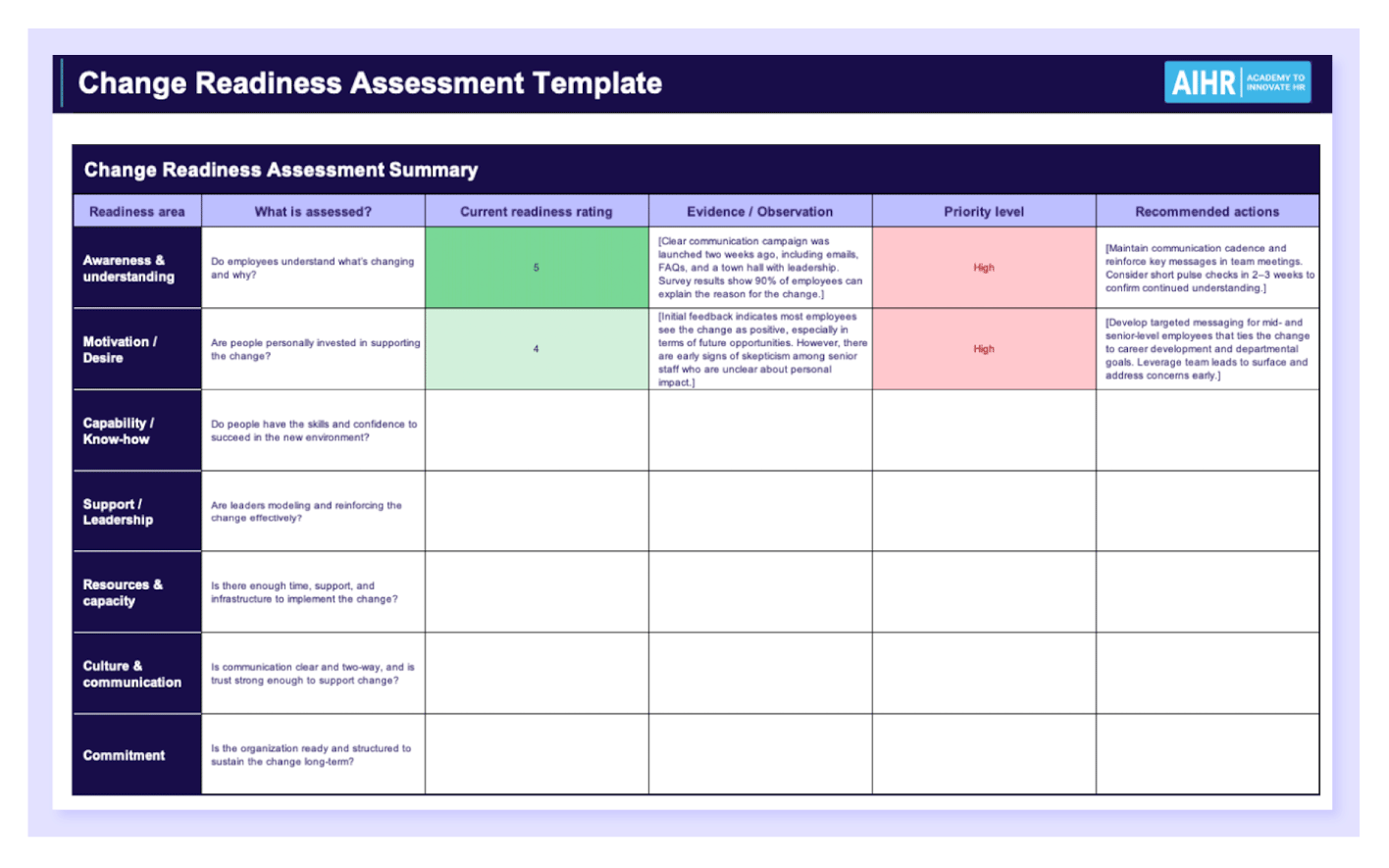
The AIHR article provides an excellent bank of sample questions for each of its seven dimensions. These questions are the heart of a structured assessment.
Application Exercise: Conducting a Simulated Readiness Assessment
It's time to put this into practice. You won't have real survey data, but you can perform a simulated assessment for AlphaTech's "Project Phoenix" based on the scenario details and the stakeholder analysis you did in the previous lesson. This exercise mirrors the "Analyze the results" and "Prioritize issues" steps of the process.
Your Task:
Use the seven readiness dimensions from the AIHR article as your framework. For each dimension, provide:
- A Readiness Rating (use a simple Red/Amber/Green scale).
- Evidence/Justification for your rating, drawing on what you know about the CEO, senior engineers, sales team, and the nature of the change.
Create a simple table to capture your analysis.
| Readiness Dimension | Rating (R/A/G) | Evidence & Justification |
|---|---|---|
| 1. Awareness & Understanding | ? | Example: Are people clear on what 'microservices' means for their work? Do the sales teams understand the 'why' behind this multi-year project? |
| 2. Motivation / Desire | ? | Example: How do the senior engineers feel about their monolith being replaced? Are sales teams motivated by a change that disrupts their comp plan? |
| 3. Capability / Know-how | ? | Example: Do the engineers have skills in the new tech stack? Do managers know how to lead teams through this kind of change? |
| 4. Support / Leadership | ? | Example: The CEO is the sponsor (a plus), but are middle managers equipped and aligned to support the change? |
| 5. Resources & Capacity | ? | Example: Has a budget been allocated for training? Do teams have the bandwidth to learn new systems while maintaining the old one? |
| 6. Culture & Communication | ? | Example: Is there a history of successful (or failed) changes? Is there psychological safety to raise concerns about the new architecture? |
| 7. Commitment | ? | Example: Are there plans to align performance metrics and incentives with the new model to ensure the change sticks? |
(Take about 15 minutes to complete this table based on the scenario.)
Click here to see a sample analysis after you've completed your own.
Sample Analysis:
| Readiness Dimension | Rating (R/A/G) | Evidence & Justification |
|---|---|---|
| 1. Awareness & Understanding | Amber | The 'what' (migrating LoanSphere) is likely known at a high level, but the 'why' and 'how it impacts me' is probably unclear, especially for non-technical teams like Sales. Misinformation risk is high. |
| 2. Motivation / Desire | Red | This is a major risk area. Senior Engineers may feel their legacy work is being devalued. The Sales team's compensation is tied to the old product, creating active disincentives to support the change. |
| 3. Capability / Know-how | Red | Significant skills gaps are likely. Engineers need training in microservices, CI/CD, and possibly new languages. The IT Infrastructure team needs to learn to manage a more complex environment. |
| 4. Support / Leadership | Amber | We have strong top-level sponsorship from the CEO (Ally). However, the readiness of middle and frontline managers to lead the change is unknown and likely a gap. They may not be equipped to handle resistance. |
| 5. Resources & Capacity | Amber | While a project exists, it's unclear if dedicated budget exists for critical change enablers like backfilling roles, extensive training, and productivity dips. Teams may be expected to do this on top of their day jobs. |
| 6. Culture & Communication | Amber | The culture seems siloed (Engineering vs. Sales). A history of past changes is unknown but critical. There's a risk that engineers won't feel safe admitting they don't know the new tech. |
| 7. Commitment | Red | There is no evidence of a plan to reinforce the change. Sales compensation remains tied to the old system, and there's no mention of updated performance metrics for engineers that reward learning new skills. |
Your completed table is a high-level diagnostic summary. It immediately flags Motivation, Capability, and Commitment as critical areas of risk that require priority intervention in your change management plan.
Conclusion
In this lesson, you learned how to use a structured diagnostic approach to perform an organizational readiness assessment. This moves you beyond individual stakeholder views to create a data-driven, holistic picture of the organization's preparedness for transformation.
Key Takeaways:
- Readiness assessments are diagnostics, not judgments. They ask "how ready?" and "where are the risks?" to inform your strategy.
- Assessment is multi-dimensional. You must evaluate factors ranging from leadership support and employee motivation to resource availability and cultural norms.
- A structured process is key. Following a clear methodology (like the 7 steps) and using a defined tool (like the AIHR template) ensures your analysis is credible and comprehensive.
- The output is an action plan. The assessment's value lies in its ability to pinpoint high-risk areas, allowing you to design targeted interventions like leadership coaching, specific training programs, or revised communication plans.
Preview of the Next Lesson:
Our readiness assessment has identified several areas with "Red" and "Amber" ratings, indicating a high potential for resistance. In the next lesson, we will dive deeper into this specific challenge. You will learn to identify and categorize sources of resistance to change within an organization, moving from knowing that resistance might happen to understanding the specific forms it will take and the root causes behind it.