Hello! Welcome back to your third lesson on Mandarin pronunciation.
In our last session, you moved from theory to practice by learning to produce the four main tones on the six simple finals (a, o, e, i, u, ü). This was a crucial step in developing the muscle memory for speaking. Today, we shift our focus from production to perception. The goal is to train your ear.
This lesson is dedicated to helping you distinguish minimal tone pairs by listening. A minimal pair consists of two words that sound identical except for one single phonological element—in our case, the tone. The ability to hear the difference between syllables like mǎi (to buy) and mài (to sell) is not just an academic exercise; it's fundamental to understanding and being understood in Mandarin.
The Importance of Isolating Tones
Why is it so important to focus on just the tones? In a real conversation, you can often guess the meaning of a word from context. However, relying on context as a beginner can become a crutch that prevents your ear from truly learning to distinguish tones. To become an accurate listener, you must first learn to hear the tones in isolation.
This resource explains the concept of minimal pairs and offers a powerful analogy for why this focused practice is so effective.
Mǎ or Mà? Chinese Tone Practice.
Please read the introduction on the 'Mǎ or Mà?' website. It explains the concept of minimal pairs. Then, click on the orange arrow to read the section 'why this is the most direct way to learn Chinese tones properly', which uses an insightful story from physicist Richard Feynman.
First, read the text under the heading 'What is it?'. Then, find and click the link with the orange arrow that says 'why this is the most direct way to learn Chinese tones properly'. Focus on understanding why eliminating contextual clues is essential for effective tone practice.
The key takeaway is that by removing all other clues, minimal pair drills force you to rely on the one thing that's different: the tone. This is the most direct way to train your auditory perception.
To see this principle in action, let's look at the classic example using the syllable ma.
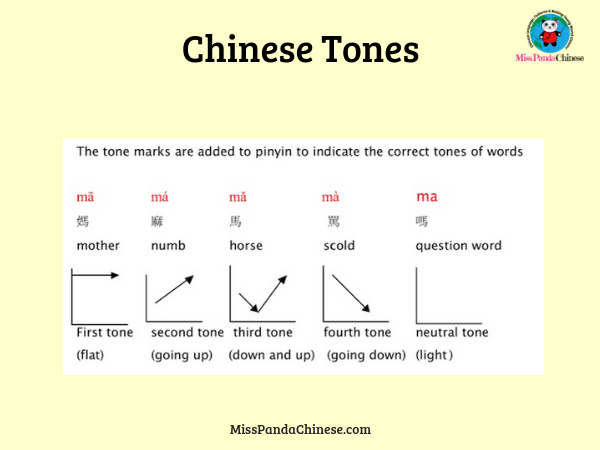
As you can see:
- mā (1st tone) means mother
- má (2nd tone) means hemp
- mǎ (3rd tone) means horse
- mà (4th tone) means to scold
Hearing these differences is the skill we will practice today.
Guided Listening: Common Tone Pairs
Now, let's practice distinguishing some of the most commonly confused tone pairs with guided examples. The following video provides clear, native-speaker audio and helpful tips. Don't worry about the new consonant and vowel sounds in these examples; your only task is to focus on the pitch and contour of the tones.
Don’t Mix Them Up! 10 Tone Minimal Pairs You Must Know
This video from Grace Mandarin Chinese will walk you through several important minimal pairs. It's an excellent way to start training your ear with clear examples.
Please watch the following segments. For each pair, listen carefully to the difference and try to mimic the sounds yourself. Introduction (00:00 - 00:54): Understand the video's goal. 3rd Tone vs. 4th Tone (01:37 - 03:00): Focus on mǎi (buy) vs. mài (sell). Notice how the 3rd tone starts low, while the 4th tone starts high. 1st Tone vs. 4th Tone (06:34 - 08:15): Focus on jīng vs. jìng. Both start high, but the 1st tone stays flat while the 4th tone falls sharply. 2nd Tone vs. 4th Tone (10:04 - 11:30): Focus on jí vs. jì. Notice the rising vs. falling contours.
Let's recap the key distinguishing features from the video:
-
3rd Tone (low) vs. 4th Tone (high-falling): The main difference is the starting pitch. The 3rd tone (
mǎi, ǎ) starts low and dips. The 4th tone (mài, à) starts high and falls sharply.- Listen for: Low start vs. High start.
-
1st Tone (high-flat) vs. 4th Tone (high-falling): Both start at a high pitch. The 1st tone (
jīng, ī) stays high and steady. The 4th tone (jìng, ì) starts high and immediately drops.- Listen for: Steady pitch vs. Falling pitch.
-
2nd Tone (rising) vs. 4th Tone (falling): These tones move in opposite directions. The 2nd tone (
jí, í) starts mid-low and rises. The 4th tone (jì, ì) starts high and falls.- Listen for: Upward movement vs. Downward movement.
Interactive Practice
You've learned the theory and listened to guided examples. Now it's time to put your ear to the test. We will use the interactive tool from the Mǎ or Mà website. This will play a syllable, and your task is to identify which tone was used.
Mǎ or Mà? Chinese Tone Practice.
It's time for you to practice actively. This website provides an interactive drill specifically designed for distinguishing minimal tone pairs.
Scroll down to the green arrow and click the link that says 'right now and find out how good your tones really are!'. You can use the site as a guest user. The default settings are perfect for a beginner. Try a few rounds of the listening test. Don't be discouraged if it's difficult at first—this is a skill that takes time to develop.
Practice Tip: When you get one wrong, listen to the correct answer and your incorrect choice back-to-back. Try to hear the difference. Replay the sound as many times as you need. The goal is to build a strong mental model for each tone's contour.
Conclusion
Well done. Today's lesson was a focused workout for your ears. By concentrating on minimal pairs, you have begun building one of the most critical skills for fluency in Mandarin: accurate tone perception.
Here are the key takeaways from our session:
- Minimal pairs are words that differ by only one sound, such as tone, and are a powerful tool for ear training.
- Isolating tones from context is crucial to avoid developing a "context crutch" and to truly learn the sounds.
- You practiced distinguishing the most common and difficult tone combinations: 3rd vs. 4th, 1st vs. 4th, and 2nd vs. 4th.
In our next lesson, we will officially introduce the neutral tone. You've already had a preview of it with ma (吗) in the image today. We will explore its characteristics and see how it functions in some of the most common words in the Chinese language.