Hello! Welcome to your second lesson.
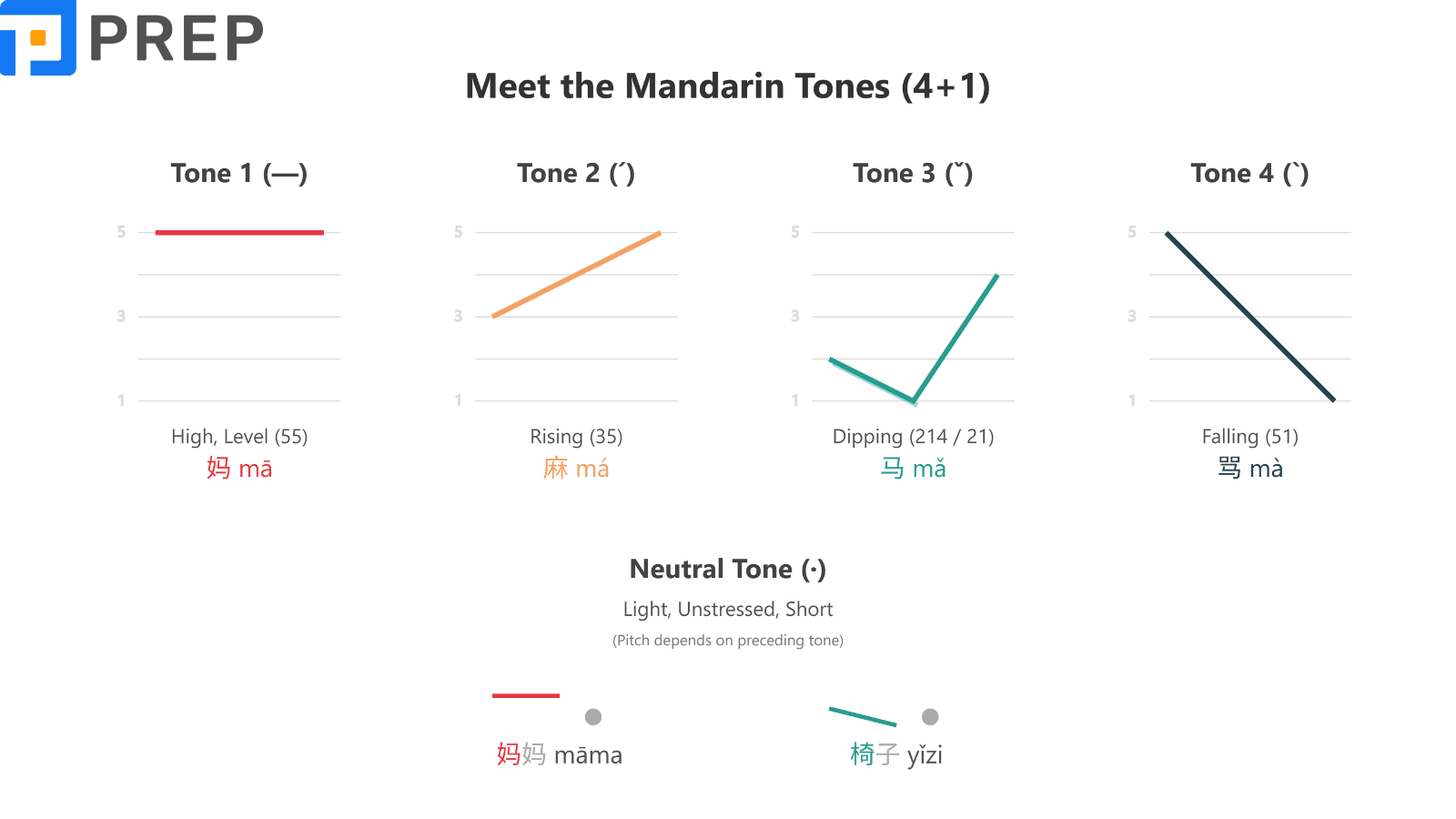
In our first lesson, we established the theoretical foundation for Mandarin tones. You learned to describe the distinct pitch contours, durations, and intensities of the four main tones. As a quick recap:
- 1st Tone (ā): High and flat.
- 2nd Tone (á): Rising from mid to high pitch.
- 3rd Tone (ǎ): Long, low, and "creaky." (Often just a dip, not a full dip-rise).
- 4th Tone (à): Short, sharp, and falling.
Today, we move from theory to practice. The goal of this lesson is to learn to produce the four tones on isolated syllables. To do this, we'll first learn the six most basic vowel sounds in Mandarin, known as the simple finals. Then, we will combine these sounds with the tones you've learned, building the first blocks of your spoken Mandarin.
Let's begin by mastering the vowels.
The Six Simple Finals
In Pinyin, a syllable is usually made of an "initial" (a consonant sound) and a "final" (a vowel sound, which can be simple or complex). We are starting with the six simple finals, which are the fundamental vowel sounds of Mandarin: a, o, e, i, u, ü.
Mastering their pronunciation is your first practical step. This video provides an excellent demonstration of each sound, complete with comparisons to English and visuals of the speaker's mouth shape.
Chinese finals "a, o, e, i, u, ü" & tones | Pinyin Lesson 01 - Learn Mandarin Chinese Pronunciation
Watch this segment from 'Learn Chinese with Litao' to hear and see how to pronounce each of the six simple finals.
Watch from 01:27 to 03:41. Listen carefully and try to mimic the sounds. Pay special attention to 'e' and 'ü', which do not have direct equivalents in English.
To reinforce what you've just heard and seen, here is a breakdown of how to form each sound. Having this written guide allows you to analyze the specific mouth and tongue positions.
Chinese Pinyin Lesson 2 | Six Simple Finals/Vowels: a, o, e, i, u, ü
This text provides a detailed written guide to the pronunciation of each simple final. It's a great reference to consult after watching the video.
Please read the section titled 'Single Vowels(Finals) Pronunciation Guide'. Compare these descriptions to what you heard in the video. You don't need to read the character examples that follow this section yet.
Here's a summary of the key points for each final:
- a: Like the 'a' in "father". Your mouth should be wide open.
- o: Like the 'aw' in "law". Your lips should be rounded.
- e: This is a tricky one. It sounds like the 'e' in "the" or the 'u' in "but", made further back in the throat. Your mouth is relaxed and not rounded.
- i: Like the 'ee' in "bee". Your lips should be spread wide, as if smiling.
- u: Like the 'oo' in "mood". Your lips should be tightly rounded.
- ü: This sound does not exist in English. The best way to produce it is to first say the Mandarin i sound ('ee'), hold your tongue in that position, and then round your lips as if you were going to say u ('oo'). The sound is produced with rounded lips but with the tongue in the 'i' position.
Spend a few minutes practicing these six sounds in isolation until you feel comfortable with them.
Applying Tones to the Simple Finals
Now it's time to combine what we've learned. We will take each of the six finals and apply the four tones to them. This drill is fundamental for building muscle memory and training your ear.
This next video segment demonstrates this process. The instructor will first use 'a' to show all the tones, and then quickly go through the others.
Chinese finals "a, o, e, i, u, ü" & tones | Pinyin Lesson 01 - Learn Mandarin Chinese Pronunciation
Let's return to the video from 'Learn Chinese with Litao'. This time, focus on how the tones are applied to the simple finals you've just learned.
Watch the section from 04:53 to 07:39. Repeat after the speaker. Notice how the same vowel sound changes meaning and contour with each tone.
While the video gives you a good overview, dedicated, repetitive practice is key. The webpage we looked at earlier has a fantastic audio drill for this very purpose.
Chinese Pinyin Lesson 2 | Six Simple Finals/Vowels: a, o, e, i, u, ü
This resource provides the crucial practice you need. It includes a table with all four tones for each of the six simple finals, accompanied by a native speaker audio track.
First, find the 'Lesson Audio Review' near the top of the page and play the audio. Let it play in the background. Then, scroll down to the section 'Tone Drills of Single Finals: a, o, e, i, u, ü'. Follow along with the table, listening and repeating each sound. Do this several times.
Here is the table from the resource for your reference. Use the audio from the webpage to guide your pronunciation.
| 1st Tone | 2nd Tone | 3rd Tone | 4th Tone |
|---|---|---|---|
| ā | á | ǎ | à |
| ō | ó | ǒ | ò |
| ē | é | ě | è |
| ī | í | ǐ | ì |
| ū | ú | ǔ | ù |
| ǖ | ǘ | ǚ | ǜ |
Practice Tip: As a beginner, it's best to exaggerate the tones.
- Make the 1st tone high and unnaturally flat.
- Really make the 2nd tone go up, like you're asking "huh?".
- For the 3rd tone, go very low and hold it for a moment (remember it's the longest tone).
- Make the 4th tone sharp and forceful, like a command.
By over-emphasizing now, the tones will become more natural and subtle over time.
Conclusion
Excellent work. In this lesson, you have moved from theory to practice, taking a significant step towards speaking Mandarin. You are building the foundation from the most basic elements, just as you intended.
Here are the key takeaways from today's session:
- You learned to pronounce the six simple finals: a, o, e, i, u, ü.
- You practiced applying the four tones to each of these finals, creating 24 distinct syllables.
- This practice is crucial for developing the muscle memory and auditory discrimination needed for fluent pronunciation.
In our next lesson, we will continue to train your ear. We will focus on distinguishing minimal tone pairs by listening. You'll be challenged to hear the difference between syllables like mā (mother) and mǎ (horse), a critical skill for understanding spoken Chinese.