Welcome to your first lesson in Mandarin Chinese! I'm excited to guide you on this journey. Given your goal to build a solid foundation from the ground up, we will start with the most fundamental aspect of Mandarin pronunciation: the tones.
In this lesson, you will learn to describe the pitch contour of each of the four Mandarin tones. Understanding tones is crucial because in Mandarin, changing the tone of a syllable can completely change its meaning. We will explore what tones are, how to visualize them, and describe the unique shape of each of the four main tones. This will be the bedrock upon which all your future pronunciation skills are built.
Let's begin.
What Are Tones?
In a non-tonal language like English, we use pitch changes for intonation—to express emotion or to signal a question versus a statement. For example, the pitch of your voice rises at the end of "You're coming?" but falls at the end of "You're coming." In both cases, the word "coming" still refers to the same action.
In Mandarin, pitch is used differently. It's a core part of the word itself. A change in pitch, or tone, creates a completely different word.
To understand this better, please read the following brief introduction.
The Hacking Chinese guide to Mandarin tones
This text from the 'Hacking Chinese' guide provides a clear explanation of what tones are and how they differ from the intonation you're used to in English.
Please read the section titled '1.1 Tones are differences in pitch that are used to differentiate words in Mandarin'. Focus on the distinction between tone and intonation and the 'mā/mǎ' example.
As you read, the key takeaway is that getting the tone wrong isn't just a matter of having a slight accent; it's like saying "horse" when you meant to say "mother." This is why we are dedicating our first few lessons to mastering them.
Visualizing the Four Tones
To talk about tones, linguists and teachers use a five-point scale, where 1 represents the lowest pitch in your natural vocal range and 5 represents the highest.
Here is a standard diagram showing the pitch contour of the four main tones. Each tone has a number, a name, a diacritical mark used in pinyin writing (which we'll cover later), and a shape.
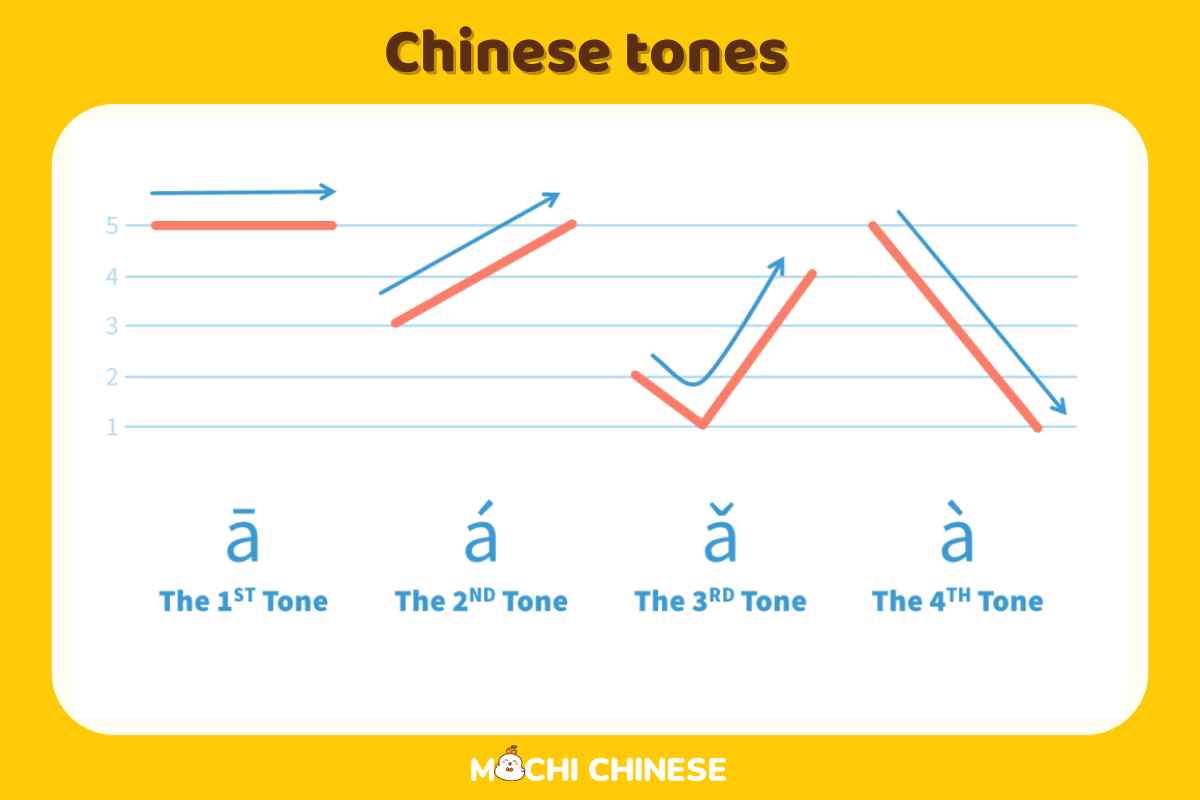
Now, let's break down each tone one by one.
The Standard Description of the Four Tones
We'll start with the classic, standard way each tone is taught. This video provides clear demonstrations of each tone's sound and shape.
Learn All 4 Mandarin Chinese Tones (Pronunciation Guide) | Lesson 1
The following video from the 'ChineseFor.Us' channel will walk you through the standard pronunciation of each of the four tones. Listen carefully to the audio and pay attention to the animated pitch chart.
Watch the following four segments, focusing on the description and sound of each tone: First Tone: Watch from 01:53 to 02:33. Second Tone: Watch from 02:33 to 03:40. Third Tone: Watch from 03:40 to 04:43. Fourth Tone: Watch from 04:43 to 05:45.
Based on the video and the chart, here is a summary of each tone's pitch contour:
-
First Tone (ā): High and Level
- Contour: Starts high and stays high. It's flat and sustained, like holding a single, high musical note. (Pitch: 5-5)
- Analogy: The sound you might make for a dentist saying "say ahhh."
-
Second Tone (á): Rising
- Contour: Starts from a mid-range pitch and rises to the top. (Pitch: 3-5)
- Analogy: The upward inflection you use in English when asking a question like "What?" or "Huh?".
-
Third Tone (ǎ): Dipping
- Contour: Starts mid-low, dips to the bottom of your vocal range, and then rises again. This is the most complex contour. (Pitch: 2-1-4)
- Analogy: There isn't a perfect English equivalent, but you can think of it as a "bouncing" sound.
-
Fourth Tone (à): Falling
- Contour: Starts high and falls sharply and quickly to the bottom. (Pitch: 5-1)
- Analogy: The sound of a curt command, like saying "No!" or "Stop!".
A More Nuanced, Practical Description
The standard descriptions are a good starting point, but they don't always reflect how native speakers actually talk. Your preference for an analytical approach will be well-served by understanding these nuances from the beginning.
This next video, from a native Mandarin speaker with a PhD in Chinese Linguistics, reveals some "secrets" about the tones that will make your pronunciation sound more natural.
The SECRET to Perfect Mandarin Tone Pronunciation 🇨🇳
This video from Julesy challenges the standard tone charts and offers a more accurate description of how tones are used in natural speech. This will refine your understanding, especially for the first and third tones.
Please watch the following segments: First Tone nuance: Watch from 01:57 to 02:52. Notice the point about it being a 'mid-high' tone, not extremely high. Third Tone nuance: Watch from 03:21 to 04:10. This is very important. Pay close attention to the fact that the third tone is often just a low tone and doesn't always rise at the end.
Let's update our understanding with these crucial insights:
- Refined First Tone (ā): Instead of straining to make it extremely high (5-5), think of it as a natural, mid-high, flat tone. It should feel relaxed, not forced.
- Refined Third Tone (ǎ): This is a critical point. While the "full dip" (2-1-4) is the dictionary form, in most real-world situations, the third tone is simply a low, creaky tone that dips and stays low (2-1). The final rise is usually omitted unless the third tone is said in isolation or at the end of a phrase. For now, thinking of it as a "low tone" is a very effective strategy.
Beyond Pitch: Duration and Intensity
To deepen your analytical understanding, there's one more layer to tones. They don't just differ in pitch; they also have distinct properties of duration (how long they last) and intensity (volume). Native speakers unconsciously use these cues to identify tones, even if the pitch information is unclear.
The SECRET to Perfect Mandarin Tone Pronunciation 🇨🇳
Let's return to the Julesy video to explore these 'hidden' properties of tones. This will give you a much more complete picture of what defines each tone.
Watch the segment from 08:19 to 12:06. Focus on how each tone is described in terms of its length and volume changes.
Here’s a summary of those additional properties:
| Tone | Pitch Contour | Duration | Intensity (Volume) |
|---|---|---|---|
| 1st | High-Flat | Normal | Even |
| 2nd | Rising | Normal/Slightly Long | Starts quiet, gets louder |
| 3rd | Low (Dipping) | Longest | Quietest (low and creaky) |
| 4th | Falling | Shortest | Starts loud, gets quieter |
This multi-faceted view—pitch, duration, and intensity—gives you a powerful analytical framework for both listening to and, eventually, producing the tones accurately.
Conclusion
In this lesson, we have laid the essential groundwork for understanding Mandarin tones. You have learned not only the standard descriptions but also the practical nuances that will help you develop a more authentic accent.
Here are the key takeaways:
- Tones are essential for meaning in Mandarin, distinguishing words that otherwise have the same pronunciation.
- The four main tones have distinct pitch contours:
- 1st Tone (ā): A steady, mid-high pitch.
- 2nd Tone (á): A rising pitch, like asking a question.
- 3rd Tone (ǎ): A low, creaky pitch. It is the longest and quietest tone.
- 4th Tone (à): A sharp, falling pitch. It is the shortest and starts loud.
- Thinking of the third tone as simply a "low tone" is a powerful and practical simplification for beginners.
In our next lesson, we will move from theory to practice. You will learn to produce these four tones on simple syllables and begin training your ear to tell them apart. You'll be taking your first steps toward actually speaking and hearing Mandarin.