Hello! Welcome to the fifth lesson in our module on Pinyin fundamentals.
In our last session, we explored the neutral tone and saw how an unstressed syllable's pitch is determined by the tone of the syllable before it. This was our first look at a core concept in Mandarin phonetics: tones are not always pronounced in their "pure" form but can change depending on their neighbors. This phenomenon is known as tone sandhi (音变, yīnbiàn).
Today, we will focus on the most important and frequent tone sandhi rule in Mandarin. Our goal is to apply the third-tone sandhi rule when two third tones occur consecutively. You will learn why this change happens, how to pronounce it correctly, and how to identify it, using the famous greeting 你好 (nǐ hǎo) as our primary example.
The Challenge of the Third Tone
As we've practiced, the full third tone has a "dipping and rising" pitch contour (˨˩˦). Trying to pronounce two of these full, complex tones back-to-back is slow, awkward, and requires significant vocal effort.
Try it yourself with the syllables nǐ and hǎo. Pronouncing the full dip-and-rise for both (nǐ... hǎo...) feels unnatural. Because of this difficulty, native speakers almost never do it. Instead, a change occurs to make speech more fluid.
Before we learn the specific rule for two third tones, it's helpful to understand that the full third tone is actually quite rare in natural speech. Let's watch a video that explains this context.
The 3rd Tone in Mandarin Chinese: Pronunciation Tips and Tricks!
This video from Skritter explains that the full third tone is often simplified in everyday speech, which is the underlying reason for the tone sandhi rules we are about to learn.
Please watch from 01:23 to 03:12. Pay close attention to the explanation of how the third tone is often pronounced as just a low, 'creaky' tone without the final rise. This context helps explain why it needs to change when followed by another third tone.
As the video explains, the third tone often gets reduced to just its initial low-dipping part. This is sometimes called the "half-third tone." This makes pronunciation faster. But what happens when another third tone follows? Keeping both syllables low would sound muddy and indistinct. This leads to our main rule for today.
The 3+3 Tone Sandhi Rule
When two third-tone syllables appear in a row, a simple and consistent rule applies to make them easier to pronounce.
The Rule: The first third tone changes its sound to a second tone (rising). The second third tone remains a third tone.
So, the pattern is: 3rd tone + 3rd tone → 2nd tone + 3rd tone
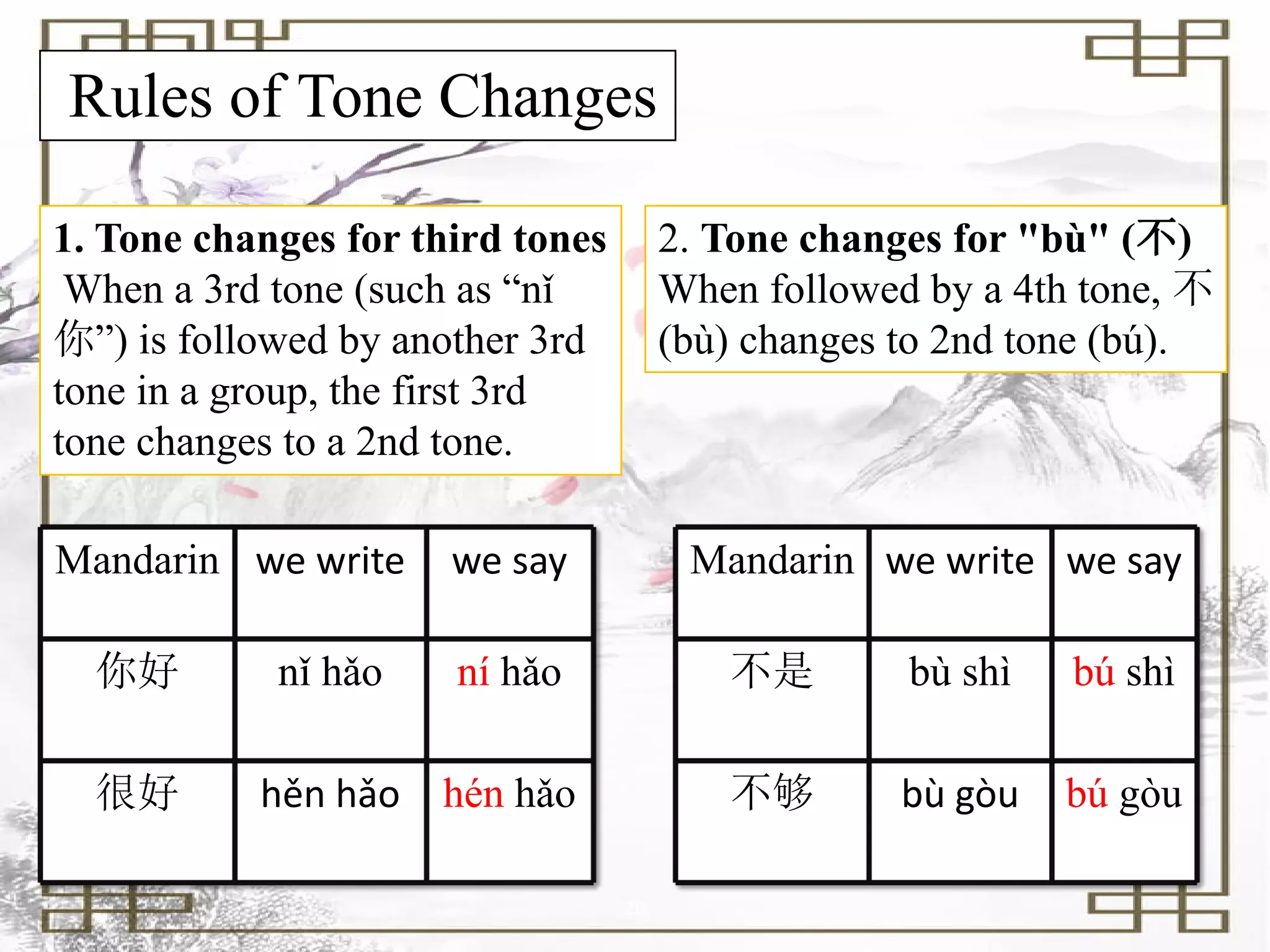
A critical point to remember is that this change only happens in pronunciation. When you write the pinyin, you must still use the original third-tone mark.
- Written: nǐ hǎo
- Spoken: ní hǎo
Let's see this rule in action.
How to Pronounce Two Third Tones Together in Chinese. | Mandarin Chinese Tones Practice. | Lesson 06
This video from ChineseFor.Us clearly demonstrates the rule and explains the practical reason behind it.
First, watch from 01:19 to 02:07 to hear the rule explained with examples. Then, watch from 02:56 to 03:07 for a concise explanation of why this change occurs.
This visual summary clearly lays out the rule for our key example, nǐ hǎo, as well as another common phrase, hěn hǎo (very good).
Listening and Practice
Now it's time to train your ear and voice. We'll use a few resources with native audio to help you internalize the sound of this tone change.
First, let's review a clear written summary with audio examples.
Tone Sandhi Rules for the 3rd Tone
This webpage from the University of Kansas provides a concise table of the 3+3 rule with embedded audio. This is excellent for focused listening practice.
Read the section that begins 'When two syllables with 3rd tone occur side-by-side...'. Play the audio for each example in the table several times and try to mimic the pronunciation. Notice how 'nǐ hǎo' becomes 'ní hǎo' and 'hěn hǎo' becomes 'hén hǎo'.
Production Practice
Let's move on to active production. The following video provides a series of words for you to repeat. Try to say them along with the speaker.
How to Pronounce Two Third Tones Together in Chinese. | Mandarin Chinese Tones Practice. | Lesson 06
We'll return to the ChineseFor.Us video for a dedicated practice session.
Watch the segment from 02:07 to 02:56. Repeat each word after the speaker. I've listed them below so you can follow along: kěyǐ (can, may) shǒubiǎo (wristwatch) lǎoshǔ (mouse) xǐshǒu (to wash hands) yǔsǎn (umbrella) yǎnxiǎng (imagine)
Ear Training: Distinguishing Tone Pairs
A common challenge is learning to distinguish a genuine 2+3 tone combination from a 3+3 combination that sounds like 2+3. The next exercise is designed to sharpen that skill.
How to Pronounce Two Third Tones Together in Chinese. | Mandarin Chinese Tones Practice. | Lesson 06
This final practice from ChineseFor.Us will help you contrast real second tones with the changed third tone.
Watch from 03:07 to 05:02. The speaker will present pairs of words. The word on the left is a true 3rd + 2nd tone combination. The word on the right is a 3rd + 3rd tone combination. Close your eyes and listen carefully to the subtle differences, then try to repeat both words in each pair.
This kind of contrastive practice is extremely effective for training your ear to pick up the nuances of Mandarin tones.
A Note on Other Third Tone Changes
Today we focused on the 3+3 → 2+3 rule. For completeness, you should be aware that the third tone also changes when followed by any other tone (1st, 2nd, 4th, or neutral). In those cases, it is pronounced as the "half-third tone" (a low tone, ˨˩) that we encountered at the beginning of the lesson.
lǎoshī(teacher) 3+1 → (half 3)+1hǎorén(good person) 3+2 → (half 3)+2hěn bàng(very awesome) 3+4 → (half 3)+4
You don't need to master this today, but it's important context. It helps reinforce the idea that the third tone is a "chameleon" – it almost always changes its shape in multi-syllable words. The only time you reliably hear the full dip-and-rise is when a third-tone syllable is said in isolation.
Conclusion
Great work today. You have just mastered the single most important tone sandhi rule in Mandarin. This is a huge step toward making your pronunciation sound natural and fluid.
Let's summarize the key takeaways:
- Tone Sandhi is the process where tones change their sound based on adjacent tones.
- The third tone is phonetically demanding, so it changes frequently in spoken language.
- The core rule for this lesson is: When two third tones are together, the first one is pronounced as a second tone. (3+3 → 2+3)
- This change is spoken, not written. The pinyin mark remains a third tone (e.g.,
nǐ hǎo).
In our next lesson, we will wrap up our pinyin foundation by learning to read and write the pinyin for the numbers 1 through 10. This will be our first set of truly practical vocabulary, and you will get to apply your knowledge of all the tones, including the third tone sandhi for the number jiǔ bǎi (nine hundred) later on.