Hello! Welcome back to our module on Ethical Persuasion and Influence.
In our last lesson, we defined the foundational frameworks of persuasion: Aristotle's three appeals—Ethos, Pathos, and Logos—and Cialdini's principles of influence. You learned to identify these powerful tools in communication. Today, we shift from identification to application.
Our learning outcome is to construct persuasive arguments using the Ethos-Pathos-Logos framework. This is where theory becomes practice. We'll move beyond simply knowing what the appeals are and focus on how to strategically weave them together to create arguments that are credible, logical, and emotionally resonant. Mastering this skill is a crucial step toward becoming a more effective debater and a more convincing communicator in any setting.
From Theory to Deeper Understanding
Before we start building arguments, let's add more depth to our understanding of each appeal. While the basic definitions are useful, true mastery comes from appreciating the nuance within each.
To do this, we'll watch a detailed video that uses memorable examples from films to illustrate how these appeals are constructed in compelling ways. It also introduces a more sophisticated model for Ethos that will be very helpful.
Ethos, Pathos, and Logos — The Art of Persuasion Explained
This video from StudioBinder, 'Ethos, Pathos, and Logos — The Art of Persuasion Explained,' offers a masterclass in how these appeals work. It breaks them down into practical, observable components.
Please watch from 01:23 to 17:32. This covers all three appeals. As you watch, focus on: Ethos (01:23–07:49): Pay close attention to the three elements of ethos: Phronesis (perceived intelligence/wisdom), Arete (moral character/integrity), and Eunoia (goodwill/likability). Pathos (07:49–12:42): Notice the different techniques used to create an emotional response, such as crafting empathetic characters and using vivid analogies. Logos (12:42–17:32): Observe how structure, evidence, and addressing counter-arguments build a logical case. Think about how this relates to structuring an economic argument.
As the video demonstrates, these appeals are not just abstract ideas but concrete rhetorical choices. Let's briefly crystallize those insights:
- Ethos (Credibility) is not just about having credentials. It's a combination of:
- Phronesis (Wisdom): Do you seem intelligent and knowledgeable?
- Arete (Virtue): Do you seem like a good, trustworthy person?
- Eunoia (Goodwill): Do you seem to have the audience's best interests at heart?
- Pathos (Emotion) is about moving your audience. This can be achieved through storytelling, connecting to shared values, using metaphors, and showing your own genuine passion.
- Logos (Logic) is the skeleton of your argument. It requires not just facts, but a clear structure that connects those facts in a way that feels inevitable. Addressing the other side of an issue can, paradoxically, make your own logical case even stronger.
How to Construct a Balanced Argument
The most persuasive arguments don't just use one appeal; they blend all three. Relying only on Logos can make you seem cold and detached. Relying only on Pathos can make you seem manipulative or irrational. Relying only on Ethos can make you seem arrogant. The magic is in the synthesis.
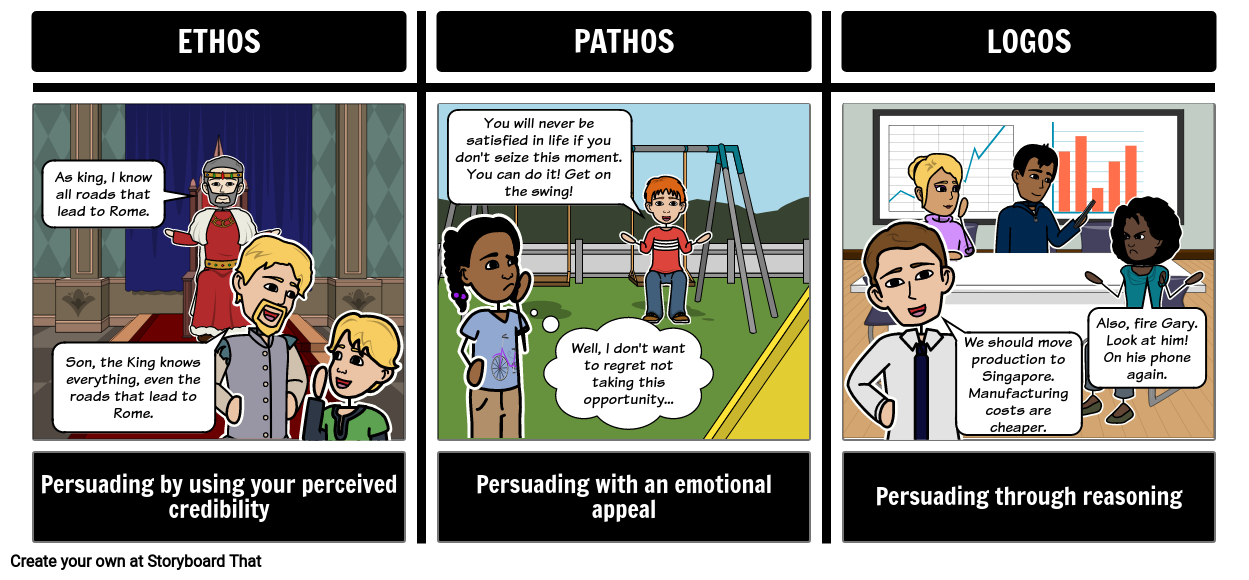
A practical way to structure your argument is to sequence the appeals. A common and effective model is: Start with Ethos, support with Logos, and finish with Pathos.
- Establish Ethos: First, give your audience a reason to listen. Why are you the person to be speaking on this topic? This builds trust and opens the door to persuasion.
- Present Logos: Next, lay out your rational case. Present your data, your evidence, and your reasoning. This gives the audience a logical foundation for agreement.
- Incorporate Pathos: Finally, connect the argument to an emotion. Make the audience feel the importance of your point. This inspires them to care and motivates them to act.
The following resource offers a concise guide to this combination strategy.
Apply Persuasive Strategies Using Ethos, Pathos, and Logos
Let's look at a practical guide for combining the three appeals into a single, cohesive message. This reading from 'Business Communications in the Modern Age of Artificial Intelligence' provides a clear, step-by-step approach.
Please read the sections titled 'Step-by-Step: Using Ethos, Pathos, and Logos Together' and 'Real-World Scenario: Effective Persuasion in Action'. Focus on the proposed sequence (Ethos -> Logos -> Pathos) and how each element builds upon the last in the example.
Tying it to Your Background
Let's apply this structure to a topic that aligns with your interest in Applied Economics. Imagine you are at a city council meeting, arguing for the implementation of a congestion charge to reduce downtown traffic.
-
Ethos (Establish Credibility):
"Good evening. As a student of Applied Economics specializing in urban policy, I have spent the last year studying the economic and social impacts of traffic management. I've analyzed the data from cities like London and Singapore that have successfully implemented similar policies."
-
Logos (Provide the Logical Case):
"The data is unambiguous. These cities saw an average traffic reduction of 15-20% within the first year. The revenue generated, which we estimate at $50 million annually for our city, can be directly reinvested into improving our public transit system. This isn't a penalty; it's a market-based solution to manage a scarce resource—our road space—and fund a superior alternative."
-
Pathos (Connect Emotionally):
"But this isn't just about numbers. This is about the kind of city we want to live in. Imagine a downtown where the air is cleaner for our children. Imagine a commute that doesn't steal an hour of your day—time you could be spending with your family. This policy is our chance to build a more efficient, healthier, and less stressful city for everyone."
Notice how the argument first establishes why you should be heard, then provides the rational proof, and finally connects that proof to a vision that people can feel and desire.
Time to Practice
Now it's your turn to construct an argument. This is a key step in moving from passive knowledge to an active skill you can use in your public speaking club and beyond.
Exercise 1: The Debate Tournament Pitch
You want to persuade your public speaking club to host a competitive debate tournament. Some members are hesitant because it sounds like a lot of work and they worry it might be too confrontational.
Your task: Draft a short (approx. 1-minute) pitch using the Ethos-Logos-Pathos structure to win them over.
Show a possible answer
Here's one way you could structure the pitch:
-
(Ethos) "I know many of us joined this club to become more confident speakers, and I've been a member right alongside you for the past year. I've also participated in impromptu competitions and understand the challenges. It's based on that shared experience that I'm proposing we take the next step."
-
(Logos) "Hosting a small-scale debate tournament gives us a concrete goal to work toward. The structure of debate—forming an argument, finding evidence, and thinking on your feet—directly trains us for the 'hot seat' scenarios we want to master. We can start with just four teams, which is a manageable workload, and use it as a powerful recruiting tool to grow our club for next semester."
-
(Pathos) "I want you to imagine the buzz in the room, the focus, the energy. But more importantly, imagine the feeling of accomplishment after, knowing we didn't just practice speaking—we engaged with important ideas, challenged ourselves, and did it as a team. This isn't about being confrontational; it's about becoming sharper, smarter, and more confident together."
Exercise 2: The "Hot Seat" Defense
You're in a conversation, and you mention your interest in quantum physics. Someone dismissively says, "That's just a bunch of weird theories with no real-world use."
Your task: Formulate a quick, persuasive response using the Ethos-Logos-Pathos framework to defend its importance.
Show a possible answer
Here's one potential response:
-
(Ethos) "I can see why you'd say that; it's definitely counterintuitive. It's a subject I'm passionate about and have been studying for a while now, and the practical applications are actually closer than we think." (This establishes you're knowledgeable but also validates their perspective, showing goodwill—Eunoia).
-
(Logos) "In fact, the technology in your smartphone, from the transistors to the lasers in its camera, is based on principles of quantum mechanics. The next generation of computing—quantum computing—relies on it entirely and will solve problems we can't even touch today, from developing new medicines to creating new materials."
-
(Pathos) "So while it sounds like sci-fi, it's really the fundamental rulebook for the building blocks of our reality. And the most exciting part is that we're just beginning to understand how to use that rulebook to create a future we can barely even imagine." (This evokes a sense of wonder and excitement).
Conclusion
Today, we transitioned from defining persuasion to practicing it. You've learned to construct arguments that appeal not just to the mind, but also to the heart and to a listener's sense of trust.
Key Takeaways:
- Effective persuasion rarely relies on a single appeal. It skillfully blends Ethos, Pathos, and Logos.
- Ethos is multi-faceted, built on perceived wisdom (Phronesis), moral character (Arete), and goodwill (Eunoia).
- A powerful structure for building arguments is to first establish credibility (Ethos), then present your logic (Logos), and finally inspire emotion (Pathos).
Preview of the Next Lesson:
Constructing a solid argument is half the battle. The other half is ensuring it lands with your specific audience. In our next lesson, we will focus on the crucial skill of framing proposals in terms of the audience's values, interests, and desired outcomes. This will teach you how to adapt your beautifully constructed arguments for maximum impact with any group or individual.