Hello! Welcome back to our module on Ethical Persuasion and Influence.
In our last lesson, you learned how to construct a robust argument by weaving together Ethos, Pathos, and Logos. You now have the tools to build a case that is credible, logical, and emotionally compelling. However, the most well-constructed argument can fail if it doesn't connect with the specific audience you're addressing.
Today, we'll focus on that crucial next step. Our learning outcome is to frame proposals in terms of the audience's values, interests, and desired outcomes. This is the art of adaptation. You'll learn to take your core message and present it in a way that resonates most powerfully with the person or group you want to persuade. This skill transforms a good argument into an influential one, a vital step toward becoming a more charismatic and convincing communicator.
The Foundational Shift: From Inward to Outward
The single most important principle of persuasion is to shift your focus from your own thoughts, desires, and brilliant ideas to the world of your audience. Before you can frame a proposal for them, you must first understand them. This means moving from being self-absorbed to being "outer-oriented."
Author Robert Greene discusses this fundamental shift with compelling clarity.
In this clip from a talk by Robert Greene, author of 'The 48 Laws of Power,' he explains why the most common mistake in persuasion is self-absorption. Watch this to understand the core mindset you need to adopt.
Please watch the following segments: The introduction from 00:00 to 00:27, which states the core idea. The explanation of the problem from 01:12 to 02:10. The practical example of pitching a film from 02:10 to 03:48. The concluding summary from 05:06 to 05:52. Focus on his central message: to influence others, you must first stop thinking about yourself and start thinking about them—their needs, their problems, and their mindset.
As Greene emphasizes, persuasion begins with empathy and research. Instead of leading with your own passion, you lead with your understanding of theirs.
Overcoming the Curse of Knowledge
Why is this shift so hard? We are often trapped by what communication experts call the "curse of knowledge." We know too much about our topic and are too passionate about it, causing us to use jargon, skip important context, and generally fail to meet the audience where they are.
The antidote is structured, empathetic research. The next video provides a practical framework for what you need to discover about your audience before you even begin to frame your message.
Persuasion Techniques: Connect with Your Audience Like Never Before
In this video from the 'Think Fast, Talk Smart' series, Stanford lecturer Matt Abrahams explains how to focus your communication by performing 'reconnaissance' on your audience.
Watch the segment from 02:29 to 05:52. Pay close attention to the three key aspects you need to understand about your audience: Knowledge Level: What do they already know? Attitudes: Are they likely to be for or against your idea? Resistance: What are their primary concerns or hesitations (e.g., cost, time, change)?
This framework gives you a clear research goal. Before a meeting, a debate, or even an important conversation, ask yourself: What does this person know? What is their likely attitude? And what are their biggest concerns? Answering these questions is the foundation of effective framing.
The Art of Framing: Shaping Perception
Once you understand your audience's perspective, you can begin to frame your proposal. Framing isn't about changing the facts; it's about choosing which facts to highlight and how to present them to create a specific impression. It’s about putting a frame around your idea that helps the audience see it in the most favorable light.
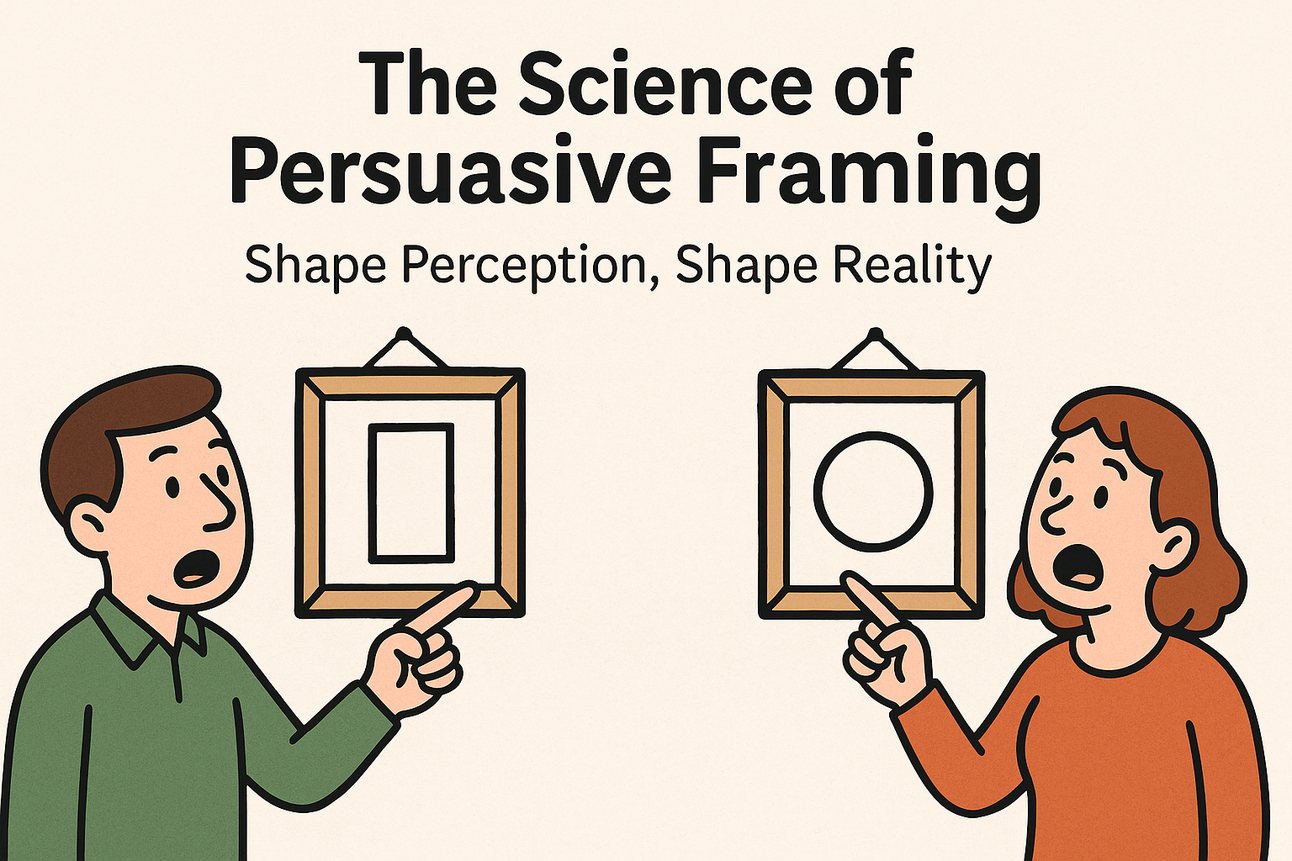
Here are three powerful strategies for framing your proposals.
1. Frame in Terms of Tangible Benefits and Common Ground
The most direct way to persuade is to connect your proposal to something the audience already wants. This involves translating your goals into their benefits.
The Necessary Art of Persuasion
This article, 'The Necessary Art of Persuasion,' provides a clear, actionable guide to finding this overlap between your goals and your audience's interests.
Please read the section that begins with 'Once you've established credibility...' and ends just before 'Ordinary evidence only goes so far...'. Focus on the bolded concepts: search for common ground and describe tangible benefits. Notice how the example dialogue shifts the conversation by framing the proposal in terms of Dan's concerns.
This strategy is very similar to an economic principle: people respond to incentives. Your task is to identify the right incentives for your audience. Are they motivated by saving money, gaining status, saving time, or ensuring security? Frame your proposal to show how it delivers their preferred outcome.
2. Frame as a Response to a Violation of Shared Values
Sometimes, the most powerful connections are not about tangible benefits but about shared principles. If you can show that a problem violates a value the audience holds dear—such as fairness, equality, freedom, or community—your proposed solution becomes a way for them to affirm that value.
Developing Your Persuasive Speech Through Invention, Framing, and Refutation
This next resource, from a public speaking textbook, explains this advanced technique with a compelling real-world example.
Please read the subsection titled 'Violation of Values' under 'Demonstrate the Issue as Worthy of Attention'. Pay close attention to how the basketball coach, Muffet McGraw, framed her controversial hiring policy not as a personal preference, but as a small step toward correcting a national problem of gender inequity—a violation of the shared value of fairness.
This technique elevates the conversation. Instead of arguing about the small details of your proposal, you invite the audience to join you in upholding a principle they believe in.
3. Use a "Gain Frame"
How you word your proposal can have a dramatic impact on its reception. Research in behavioral economics, particularly prospect theory, shows that people are often more motivated by the prospect of a gain than they are deterred by an equivalent loss. This insight leads to a powerful framing strategy: always frame your proposal in terms of what can be gained.
The "Think Fast, Talk Smart" video you watched earlier contains a perfect illustration of this.
Persuasion Techniques: Connect with Your Audience Like Never Before
Let's return to the 'Think Fast, Talk Smart' video to see a classic example of framing.
Please re-watch the segment from 16:21 to 19:23. The core of this section is the medical study example: a treatment with a '33% success rate' is far more appealing than one with a '67% failure rate,' even though they are statistically identical. This is the power of a 'gain frame.'
A problem can be framed as an opportunity. A cost can be framed as an investment. A weakness can be framed as a chance for growth. By consistently choosing the "gain frame," you make your proposals more optimistic and motivating.
Test your understanding!
Imagine you are trying to convince a friend who is very busy with work to join your public speaking club. Which of these is the best example of "gain framing"?
- "If you don't join, you'll miss out on a great chance to improve your skills."
- "The club helps you stop being so nervous during presentations at work."
- "The skills you'll build in the club can help you lead meetings more effectively and could even help you get that promotion you want."
Show answer
Option 3 is the best example. It frames the commitment not as a time cost, but as an investment that leads to a direct, positive outcome (a promotion) that is tied to the friend's existing values (career success). Option 1 uses a loss frame ("miss out"), and Option 2 focuses on solving a negative (nervousness) rather than achieving a positive gain.
Practice Your Framing Skills
Let's apply these strategies.
Exercise 1: Reframing the Debate Tournament
In the last lesson, you pitched a debate tournament to your club members, focusing on their personal growth. Now, imagine you have to pitch the same idea to a faculty advisor to get funding. Her primary concerns are the school's reputation, the budget, and student engagement metrics.
Your task: How would you re-frame your proposal to align with the faculty advisor's values and interests? Write down 2-3 key talking points.
Show a possible answer
Here are some possible talking points, reframed for the advisor:
- (Common Ground/Tangible Benefit - Reputation): "This tournament is an opportunity to showcase our school's commitment to academic excellence and critical thinking. We can invite other local colleges, positioning us as a leader in intellectual engagement."
- (Gain Frame - Budget/Metrics): "This isn't just an expense; it's an investment in student engagement. We anticipate this event will be a major recruiting tool for the club, boosting our membership numbers for next semester. The small budget required will generate a significant return in student participation."
- (Shared Values - Academic Excellence): "We both believe in providing students with rigorous intellectual challenges. A debate tournament provides a structured, academic forum for students to apply what they learn in their classes in a dynamic, real-world setting."
Exercise 2: The Solar Panel Pitch
You want to convince your parents to install solar panels on the family home. Your father is very pragmatic and cost-conscious. Your mother is aesthetically-minded and worries about how they will look.
Your task: How would you frame the proposal differently for each parent?
Show a possible answer
-
For the Father (Cost-Conscious): You would use a gain frame focused on tangible financial benefits. "Dad, I know this is a big purchase, but we should see this as a long-term investment, not a cost. Based on current electricity rates, the panels will pay for themselves in 7-8 years. After that, we're essentially generating free electricity. Plus, it increases the resale value of the house by an average of 4%—that's a solid return on investment."
-
For the Mother (Aesthetically-Minded): You would address her resistance directly and frame it positively. "Mom, I know you're worried about how they'll look. I've been looking at the new models—they're incredibly sleek and low-profile, and they sit flush with the roofline. They look very modern and high-tech. It's a way to show we're a forward-thinking family, and it's a visible symbol of our commitment to doing the right thing for the environment."
Conclusion
Today, you've learned to bridge the gap between your argument and your audience. A great idea is not enough; it must be framed in a way that the listener can understand, appreciate, and embrace.
Key Takeaways:
- The foundation of all persuasion is an outward focus on the audience's needs, values, and concerns.
- Before you speak, conduct reconnaissance on your audience's knowledge, attitudes, and areas of resistance.
- You can strategically frame proposals by connecting them to tangible benefits, showing how they uphold shared values, and using a "gain frame" to emphasize positive outcomes.
Preview of the Next Lesson:
Now that you can construct an argument (Ethos, Pathos, Logos) and frame it for your audience, we will add another layer of psychological sophistication. In our next lesson, you will learn to apply Cialdini's principles of influence (e.g., reciprocity, social proof). These are powerful psychological triggers that can make your well-framed arguments even more persuasive.