Hello! Welcome to the first lesson in our module, "Ethical Persuasion and Influence."
In the last module, we focused on developing your personal charisma through presence, power, and warmth, culminating in the strategic use of silence. We established that how you communicate—with composure, confidence, and focus—is just as important as what you say. Now, we're going to build on that foundation by equipping you with the fundamental frameworks of persuasion. Your ability to command a room with presence will be the platform from which you deliver these persuasive messages with maximum impact.
Today, our learning outcome is to describe Aristotle's three appeals (Ethos, Pathos, Logos) and Cialdini's principles of influence. These two frameworks are the "operating systems" of persuasion. Understanding them will give you a powerful lens through which to analyze communication, structure your own arguments, and achieve your goals, whether in a formal debate or in building a deeper personal connection.
1. The Classical Foundation: Aristotle's Three Appeals
Over 2,300 years ago, the philosopher Aristotle codified the art of persuasion, which he called rhetoric. He identified three core appeals that a speaker can use to convince an audience: Ethos, Pathos, and Logos. These "three pillars" are as relevant today as they were in ancient Greece.
To get a dynamic overview of these concepts, let's start with a short, engaging video.
How to use rhetoric to get what you want - Camille A. Langston
This TED-Ed video, 'How to use rhetoric to get what you want,' provides an excellent introduction to Aristotle's three appeals, using historical examples to bring them to life.
Please watch the segment from 01:41 to 03:54. Focus on how ethos, pathos, and logos are defined and how they function differently to persuade an audience.
As the video explained, these three appeals are distinct but often work together.
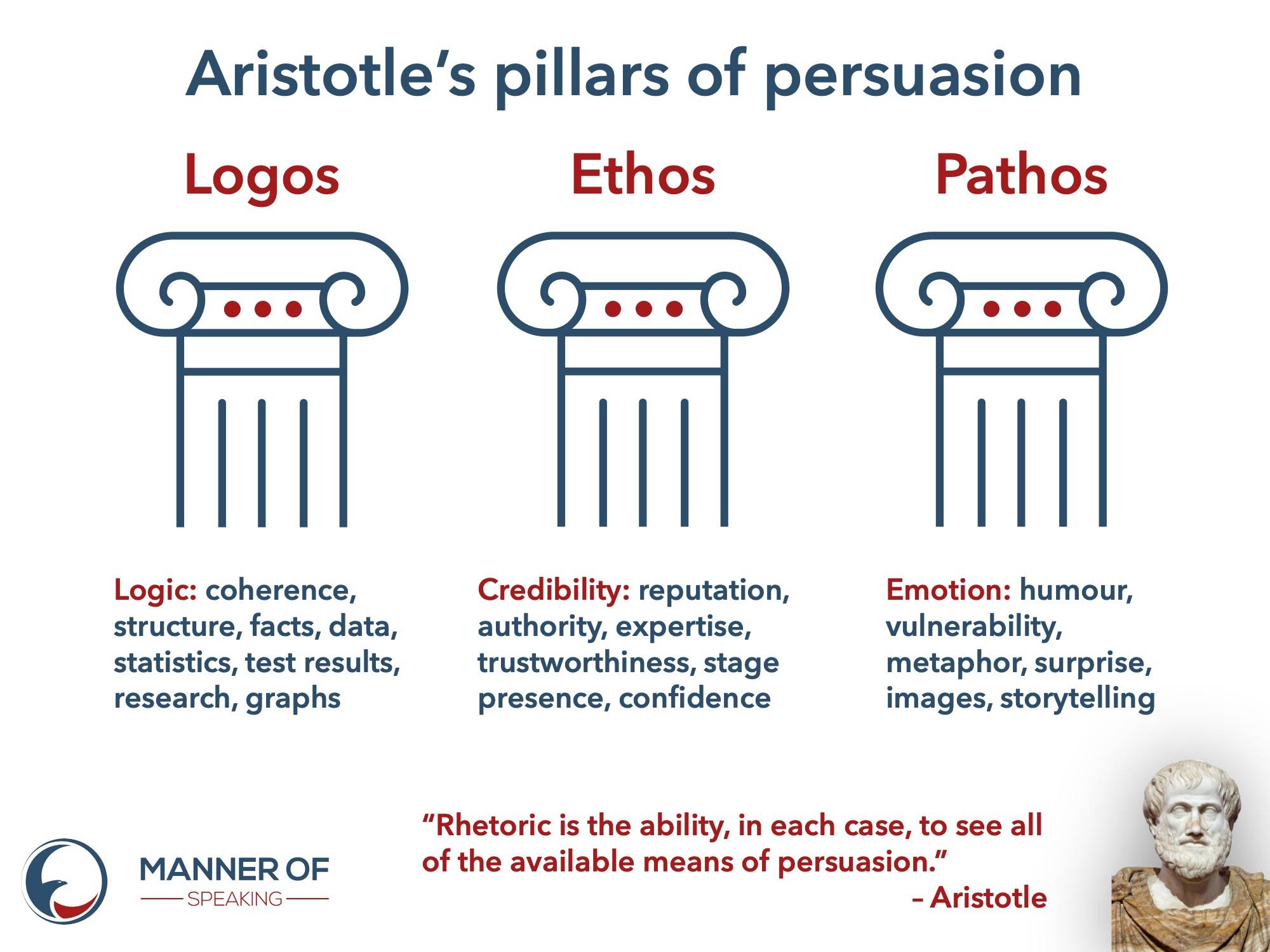
Let's break them down further, focusing on how you can use them.
Ethos: The Appeal to Credibility
Ethos is about establishing your authority, credibility, and character. It's the reason an audience should trust and listen to you in the first place. Without ethos, even the most logical argument may fall flat. Think of it as your conversational or persuasive capital.
You can establish ethos through:
- Authority: Your formal position or title (e.g., team leader, subject matter expert).
- Expertise: Your demonstrated knowledge and experience on the topic.
- Trustworthiness: Your perceived honesty, integrity, and good intentions.
- Similarity: A sense of shared values, experiences, or identity with the audience.
This is directly linked to the "power" component of charisma we discussed in the last module. By building your ethos, you project a credible power that makes people want to listen.
Pathos: The Appeal to Emotion
Pathos is the art of connecting with your audience on an emotional level. People are not purely rational beings; emotions are powerful motivators for belief and action. Your background in economics shows that while models assume rational actors, behavioral economics proves that emotional and psychological factors are huge drivers of decisions.
You can evoke pathos through:
- Storytelling: Personal anecdotes or case studies that create an emotional arc.
- Vivid Language: Using sensory details that help the audience feel an experience.
- Analogies and Metaphors: Connecting your idea to something the audience already feels strongly about.
- Humor: Creating a positive emotional state and building rapport.
This appeal is closely tied to the "warmth" aspect of charisma. By genuinely connecting with others' emotions, you build the rapport needed for deeper bonds.
Logos: The Appeal to Logic
Logos is the appeal to reason. It involves structuring your argument logically and supporting it with evidence. For you as an Applied Economics major, this is likely the most familiar and comfortable mode of persuasion. It's about building a case that is coherent, rational, and difficult to refute.
You can strengthen your logos by using:
- Facts and Statistics: Hard data from credible sources.
- Clear Reasoning: Ensuring your claims follow logically from your evidence (using deductive or inductive reasoning).
- Precedent and Examples: Citing historical examples or case studies that prove your point.
To get a deeper, more practical understanding of how to cultivate these appeals, the following article is an excellent resource.
Ethos, Pathos, Logos: 3 Pillars of Public Speaking and ...
The article 'Ethos, Pathos, Logos: 3 Pillars of Public Speaking and Persuasion' offers a fantastic breakdown of each appeal, including practical tips for improving them.
Please read the main sections on Ethos, Pathos, and Logos. Start with 'Ethos – The Ethical Appeal' and read until the end of 'Logos – The Logical Appeal'. Pay special attention to the subsections titled 'Improving ethos,' 'Improving pathos,' and 'Improving logos' for actionable advice.
Test your understanding!
Imagine you're trying to convince your university's administration to invest more funds in the public speaking organization you're a member of. How would you frame a short pitch using all three of Aristotle's appeals?
Show answer
Here's one possible approach:
- Ethos (Credibility): "As a member of the debate team for two years and a participant in three regional competitions, I have firsthand experience with the skills this organization develops." (This establishes your expertise and dedication). You could also mention your status as a student in a relevant field like economics, where communication is key.
- Logos (Logic): "Our membership has grown by 40% in the last year, but our budget has remained flat. Increased funding would allow us to serve more students and purchase updated equipment, leading to a demonstrable improvement in student presentation skills, which are critical for job placement. A survey of recent alumni showed that 85% use public speaking skills weekly in their careers." (This uses data and a cause-and-effect argument).
- Pathos (Emotion): "I’ve seen students walk into our first meeting, terrified to speak, and leave at the end of the semester able to command a room. Think of Sarah, a first-year student who told me this club gave her the confidence not just to speak, but to feel like she belongs here. This funding isn’t just for equipment; it's an investment in the confidence and future of students like her." (This uses a personal story to create an emotional connection).
2. The Psychological Levers: Cialdini's Principles of Influence
While Aristotle gave us the "what" of persuasion, modern psychology, led by Dr. Robert Cialdini, has explored the "why"—the automatic, subconscious triggers that cause people to say "yes." These principles are powerful mental shortcuts we all use to make decisions. Understanding them is crucial for ethical persuasion and for recognizing when they are being used on you.
This short video provides a great summary of Cialdini's principles, including a seventh one, "Unity," added more recently.
7 Principles of Psychological Persuasion
The video '7 Principles of Psychological Persuasion' from Sprouts clearly illustrates Cialdini's core concepts with simple animations and a helpful narrative example.
Please watch from the beginning to 02:21. The video will walk you through each of the seven principles: Reciprocity, Scarcity, Authority, Consistency, Liking, Consensus, and Unity.
Now, let's explore the original six principles in more detail using an article Cialdini himself wrote for the Harvard Business Review. This framing will be particularly relevant to your professional goals.

Harnessing the Science of Persuasion by Robert B. Cialdini
This article, 'Harnessing the Science of Persuasion,' is written by Robert Cialdini. It explains his original six principles and how to apply them in a professional context.
Read the sections describing each of the six principles, starting from 'THE PRINCIPLE OF Liking' and ending after 'THE PRINCIPLE OF Scarcity'. For each principle, focus on the 'APPLICATION' Cialdini suggests.
Let's briefly summarize these principles and connect them to our goals:
- Liking: People prefer to say yes to those they know and like. This is built on similarity and genuine praise. It's the foundation of building rapport and deeper bonds.
- Reciprocity: People feel obligated to give back to others the form of behavior, gift, or service that they have received first. This is about being the first to offer help or a concession.
- Social Proof (or Consensus): People will look to the actions and behaviors of others to determine their own, especially when they are uncertain. Testimonials and peer endorsements are powerful.
- Consistency: People want to be consistent with things they have previously said or done. This is why getting a small, initial commitment (active, public, and voluntary) can lead to larger ones later.
- Authority: People defer to experts. This principle is a core component of Aristotle's Ethos. It's about signaling your expertise before you try to persuade.
- Scarcity: People want more of those things they can have less of. From an economics perspective, you know this intimately: when supply is low, demand (and perceived value) increases. Highlighting unique benefits or exclusive information taps into this.
- Unity: This principle, which the video mentioned, is about shared identity. People are more influenced by those they see as part of their "tribe" or group ("one of us"). This is a deeper form of the Liking principle's "similarity."
3. Ethics and Synthesis
It's crucial to remember that this module is about ethical persuasion. These tools are powerful and can be used to manipulate. However, as Cialdini warns in his article, such tactics are not only unethical but also ineffective in the long run. They destroy trust, which is the bedrock of any healthy relationship or organization. The goal is to use these principles to create win-win outcomes and build genuine consensus, not to trick people into compliance.
Notice the overlap between the two frameworks. Cialdini's Authority is a key part of Aristotle's Ethos. Using storytelling to evoke Pathos can also increase Liking. Providing strong data for Logos can enhance your Authority. They are not separate toolkits, but interconnected parts of the same human communication system.
Test your understanding!
You want to organize a "hot seat" impromptu speaking practice session, which many people find intimidating. Which two of Cialdini's principles could you use to encourage members of your public speaking club to sign up? Explain your reasoning.
Show answer
Here are a few strong options:
- Social Proof: You could first get a few respected or popular members of the club to sign up. Then, in your announcement, you can say, "Join Alex and Maria, who are already signed up to sharpen their skills!" When others see that their peers are participating, they will feel more comfortable and confident doing so themselves.
- Consistency: Before asking for sign-ups for the actual event, you could ask for a show of hands at a meeting: "Who here believes that impromptu speaking is a critical skill for success?" Most will agree. Later, when you announce the practice session, you can remind them of this shared belief, making them more likely to act in a way that is consistent with their stated value.
- Scarcity: You could frame the opportunity as limited. For example: "We only have 8 slots available for this intensive practice session to ensure everyone gets personalized feedback. Sign up now to secure your spot!" The fear of missing out can be a powerful motivator.
Conclusion
In this lesson, you've been introduced to two powerhouse frameworks that explain the science and art of persuasion.
Key Takeaways:
- Aristotle's Three Appeals provide a timeless model for structuring persuasive messages: Ethos (credibility), Pathos (emotion), and Logos (logic).
- Cialdini's Principles of Influence reveal the psychological shortcuts that guide human behavior, including Liking, Reciprocity, Social Proof, Consistency, Authority, Scarcity, and Unity.
- These frameworks are not about manipulation. They are tools for understanding human connection and building ethical, effective arguments that lead to mutual benefit.
Preview of the Next Lesson:
Knowing these principles is the first step. The next step is applying them. In our next lesson, we will focus on practice. You will learn how to construct persuasive arguments using the Ethos-Pathos-Logos framework, moving from theory to application to prepare you for your debate, persuasion, and connection goals.