Welcome to your next lesson. In our previous session, we explored the biomechanics of the spinal column, analyzing how its structure supports load while enabling complex movements. Today, we will apply similar principles to another critical and intricate area: the shoulder complex.
This lesson addresses the biomechanics of the shoulder, with a particular focus on scapulohumeral rhythm. Understanding this coordinated motion is not just an academic exercise; it is fundamental to diagnosing and treating a vast range of shoulder pathologies. For your MPT entrance exams, questions on this topic are common, so a firm grasp of the concepts, ratios, and muscles involved is essential. We will deconstruct how the shoulder achieves its unparalleled range of motion through a symphony of moving parts.
1. The Shoulder Complex: A Four-Joint System
When we speak of "shoulder" movement, we are actually referring to the collective, synchronized motion of four distinct articulations. The glenohumeral (GH) joint, often what people think of as the shoulder joint, is only part of the story. The full complex includes:
- Glenohumeral (GH) Joint: The ball-and-socket joint between the humeral head and the glenoid fossa of the scapula.
- Scapulothoracic (ST) Joint: Not a true anatomical joint, but a functional articulation between the anterior surface of the scapula and the posterior thoracic wall.
- Acromioclavicular (AC) Joint: The plane joint between the acromion of the scapula and the lateral end of the clavicle.
- Sternoclavicular (SC) Joint: The saddle joint between the manubrium of the sternum and the medial end of the clavicle. This is the only bony link between the upper extremity and the axial skeleton.
Successful arm elevation depends on the integrated movement of all four joints.
2. Scapulohumeral Rhythm: The 2:1 Ratio
The cornerstone of shoulder biomechanics is the concept of scapulohumeral rhythm. It describes the timing and relationship between the movement of the humerus (at the GH joint) and the scapula (at the ST joint) during arm elevation.
Scapulohumeral Rhythm - Physiopedia
This Physiopedia article provides a concise and clear definition of scapulohumeral rhythm and its primary purposes.
Start with the introduction to get the formal definition. Then, move to the section "Scapulohumeral Rhythm" and read about the "setting phase" and the overall ratio. Finally, review the two main purposes of this rhythm.
As you've just read, after an initial "setting phase" of 0-30 degrees where motion is primarily at the GH joint, a consistent pattern emerges. For the remainder of arm elevation, the glenohumeral and scapulothoracic joints move simultaneously in an overall 2:1 ratio.
This means for every 3 degrees of total shoulder abduction:
- 2 degrees of movement occurs at the glenohumeral joint.
- 1 degree of movement occurs at the scapulothoracic joint (as upward rotation).
So, for a full 180 degrees of shoulder abduction, the approximate contribution is:
- 120 degrees from the glenohumeral joint.
- 60 degrees from the scapulothoracic joint.
What is Scapulo-Humeral Rhythm 2:1 ratio
The presenter, John Gibbons, offers a straightforward verbal and visual explanation of this 2:1 ratio.
Watch this short segment from the video to solidify your understanding of how the 180-degree range is divided between the two joints.
3. The Three Phases of Abduction
To analyze the movement more closely, we can break down the 180 degrees of abduction into three phases. The following image provides a clear visual breakdown of the angular contributions at different stages of abduction.

The Physiotutors channel provides a very detailed, exam-oriented breakdown of these phases, incorporating the often-overlooked but critical movements of the clavicle.
This video by Physiotutors dissects shoulder abduction into three distinct phases, detailing the specific motions at the humerus, scapula, and clavicle.
Watch the segment from this point carefully. Pay close attention to the degrees of motion and the specific movements (e.g., clavicular posterior rotation, humeral lateral rotation) in each phase.
Here is a summary of those phases, which is high-yield information for your exams:
-
Phase 1 (0-30°): The Setting Phase
- Movement is primarily at the GH joint.
- The scapula shows minimal movement, essentially "setting" itself for the larger motion to come.
- The clavicle elevates slightly (0-5°).
-
Phase 2 (30-90°)
- The 2:1 rhythm is now in full effect.
- The humerus abducts another 40° at the GH joint.
- The scapula upwardly rotates 20° at the ST joint.
- The clavicle elevates about 15° at the SC joint.
-
Phase 3 (90-180°)
- The humerus abducts a final 60° and crucially, laterally rotates about 90° to prevent the greater tubercle from impinging on the acromion.
- The scapula contributes a final 30-40° of upward rotation.
- The clavicle completes its elevation and performs a significant posterior rotation (30-50°) to allow the scapula to complete its movement.
4. The "Why": Force Couples and Functional Advantages
This rhythm is not arbitrary; it's a sophisticated solution to several biomechanical challenges. As you read in the Physiopedia article, it serves two main purposes:
- Preserves Muscle Length-Tension: By rotating the scapula, the origin of muscles like the deltoid moves along with the humerus. This prevents the muscle from shortening too quickly, allowing it to maintain effective force production throughout the entire range of motion.
- Prevents Subacromial Impingement: Upward rotation of the scapula, combined with external rotation of the humerus, lifts the acromion and moves the greater tubercle posteriorly, respectively. This maintains the subacromial space and prevents soft tissues from being compressed.
This coordinated scapular rotation is driven by a force couple, where different muscles pull in different directions to produce a pure rotation.
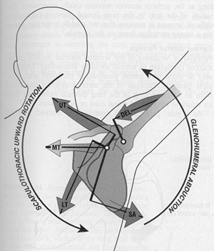
The muscles responsible for this force couple are:
- Upper Trapezius
- Lower Trapezius
- Serratus Anterior
Weakness or imbalance in any of these muscles can lead to abnormal scapulohumeral rhythm, known as scapular dyskinesis, which is a common source of shoulder pain and dysfunction.
5. Claviculoscapulohumeral Rhythm
As you saw in the Physiotutors video, the clavicle's movement is indispensable. In fact, some experts argue the term "scapulohumeral rhythm" is incomplete.
This article from ABMP makes a compelling case for a more inclusive term and explains the functional importance of the plane of the scapula.
Read the section Humerus Coupling with the Scapula to understand how scapular rotation is driven by clavicular elevation. Then, read the sidebar on Scaption, which describes the natural plane of shoulder motion.
The 60 degrees of scapular upward rotation is a composite motion enabled by the clavicle:
- Elevation at the SC joint accounts for roughly half the motion.
- Upward rotation at the AC joint allows the scapula to "fine-tune" its position relative to the clavicle.
- Posterior rotation of the clavicle in the late phase is essential; without it, the acromion would block the final degrees of scapular rotation.
This highlights why assessing and treating the SC and AC joints is often crucial for restoring full, pain-free shoulder elevation. The term claviculoscapulohumeral rhythm more accurately reflects this reality.
Finally, the concept of scaption is clinically vital. This refers to movement in the plane of the scapula, which is angled about 30-35 degrees anterior to the frontal plane. This is the most functional and least impingement-prone plane for arm elevation and is often the preferred plane for therapeutic exercises.
Conclusion
We have moved from a simple view of the shoulder to appreciating it as a complex, four-joint system governed by the precise coordination of scapulohumeral rhythm. A fault in this rhythm is a key diagnostic clue for many shoulder conditions.
Key Takeaways for Exam Revision:
- Shoulder Complex: Comprises the GH, ST, AC, and SC joints. All are required for full elevation.
- Scapulohumeral Rhythm: A coordinated 2:1 ratio of GH to ST motion after an initial 30° setting phase. Total motion: ~120° GH, ~60° ST.
- Phases of Abduction: Know the contributions of the humerus, scapula, and clavicle in each phase, especially the late-phase humeral external rotation and clavicular posterior rotation.
- Purpose: The rhythm optimizes muscle function and prevents subacromial impingement.
- Force Couple: Upward rotation is driven by the Upper Trapezius, Lower Trapezius, and Serratus Anterior.
- Clavicle is Key: Clavicular elevation and posterior rotation are essential for full scapular motion.
- Clinical Concepts: Scapular Dyskinesis is altered rhythm. Reverse Scapulohumeral Rhythm (more scapular than humeral motion) is seen in conditions like adhesive capsulitis. Scaption is the functional plane of the shoulder.
In our next lesson, we will transition from the upper limb to analyzing a full-body functional task as we describe the phases and temporal-spatial parameters of the normal gait cycle.