In our last session, we established a detailed blueprint of the normal gait cycle, covering its phases and key measurable parameters. This foundation is essential, because in clinical practice and for your MPT exams, your primary task is often to spot the deviations from this norm.
This lesson builds directly on that foundation. We will now explore how to identify common gait deviations and correlate them with their underlying biomechanical or neurological causes. Understanding these connections is the essence of diagnostic physiotherapy. As you are keen to deepen your knowledge in neurological physiotherapy, you will find this lesson particularly relevant, as many distinctive gait patterns are pathognomonic for specific neurological conditions.
1. A Framework for Observation: The Analyst's Eye
Before we jump into specific named gaits, it's crucial to adopt a systematic approach to observation. Simply watching someone walk is not enough; you need to know what to look for and when. The Rancho Los Amigos (RLA) observational gait analysis system provides an excellent framework for this. It encourages you to assess movement at each body segment (trunk, pelvis, hip, knee, ankle, toes) during each phase of the gait cycle.
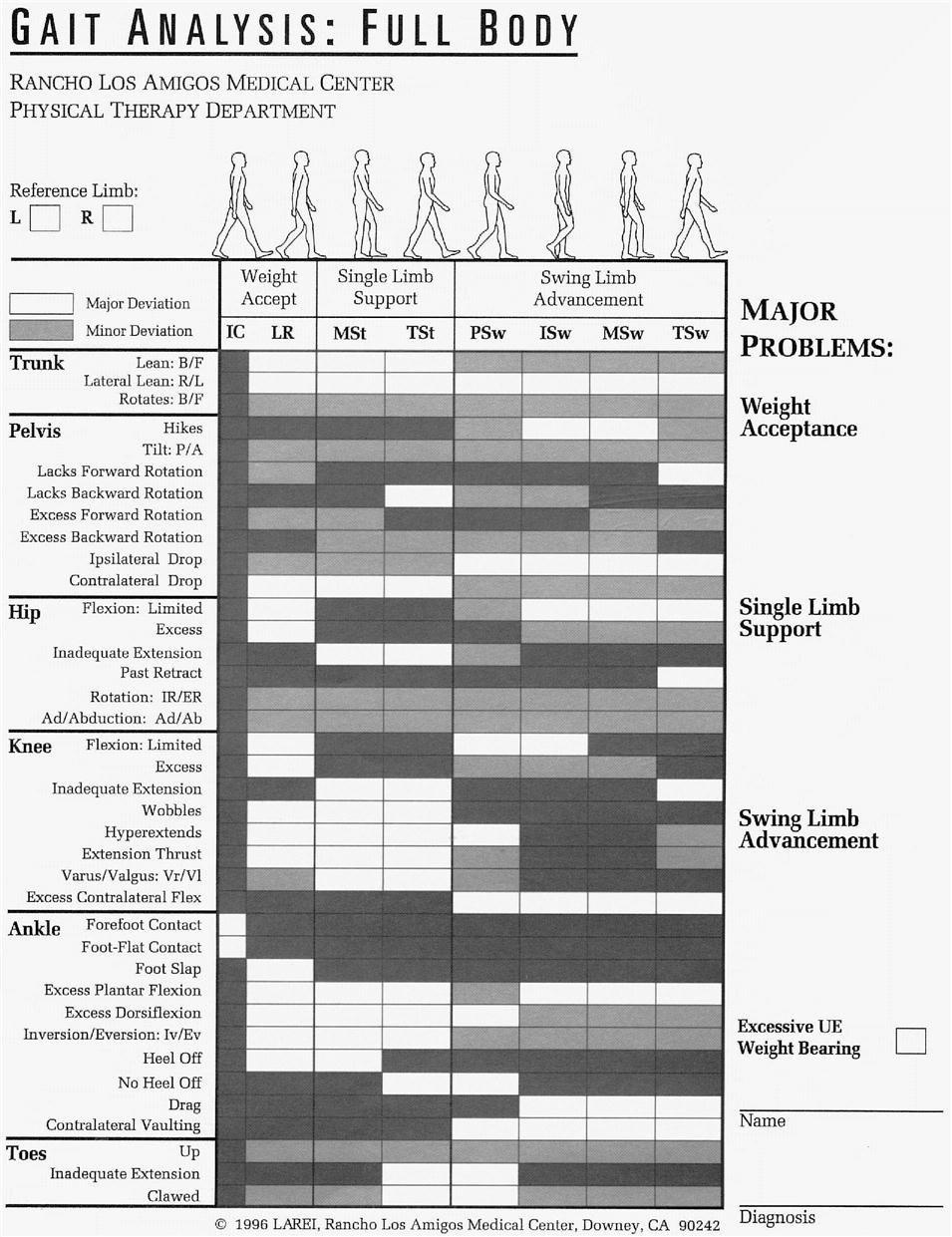
Look at how the chart is structured. The columns represent the phases of gait we discussed previously (Initial Contact, Loading Response, etc.), and the rows represent body segments and common deviations. A clinician would shade in the box where a specific deviation occurs. This structured method prevents you from missing key details and helps in forming a clear clinical picture. For your exams, internalizing this "grid" mindset will help you quickly deconstruct any gait-related question.
2. Common Gait Deviations: Causes and Characteristics
Gait deviations arise from an underlying impairment. While the causes can be multifactorial, they generally fall into two broad categories:
- Musculoskeletal: Caused by pain, muscle weakness, joint range of motion limitations (contractures), or structural issues like leg length discrepancies.
- Neurological: Caused by central or peripheral nervous system lesions leading to weakness/paralysis, spasticity, loss of coordination (ataxia), or sensory deficits.
Let's explore the most common patterns you need to know. For each one, we'll identify the deviation, its cause, and the phase of gait it affects most.
The Physiopedia articles on "Gait" and "Gait Deviations" are excellent, comprehensive references for this entire topic.
This article provides detailed descriptions of gait abnormalities, categorizing them by cause and presenting a summary table.
First, read the section on musculoskeletal causes to understand how weakness and contractures affect gait. Next, review the list of named gaits, as these are frequently tested. Finally, and most importantly, study the Summary of Gait Deviations table. This table is a high-yield revision tool that directly links observations to impairments.
Now, let's bring these descriptions to life with video demonstrations. We will use two excellent videos that showcase these gaits.
Pathological Gait | Exercise Therapy | Types Explained | physiotherapy
This video from Physio's Healing Touch provides clear demonstrations of the most common pathological gaits. We will refer back to it throughout this section.
We will watch specific segments as we discuss each gait pattern below.
This video from Ninja Nerd offers another set of demonstrations from a clinical examination perspective. It's a great way to see the gaits in a different context.
We will also use clips from this video to reinforce your understanding.
A. Gaits Driven by Pain and Musculoskeletal Weakness
These gaits are typically compensatory strategies to offload a painful structure or make up for a weak muscle.
-
Antalgic Gait (Painful Gait):
- Description: A limp adopted to minimize pain. The most prominent feature is a shortened stance phase on the painful side. The patient tries to get off the affected leg as quickly as possible.
- Cause: Pain from any pathology in a weight-bearing joint or structure of the lower limb (e.g., osteoarthritis, fracture, ligament sprain).
- Watch: See a demonstration in the Physio's Healing Touch video from
this segment .
-
Trendelenburg Gait (Gluteus Medius Gait):
- Description: During the stance phase on the affected side, the pelvis drops on the opposite (swinging) side. This is due to the inability of the stance leg's hip abductors (gluteus medius) to hold the pelvis level. A "compensated" Trendelenburg involves the patient lurching their trunk towards the weak side to maintain balance.
- Cause: Weakness of the gluteus medius muscle, often due to superior gluteal nerve injury or hip pathology.
- Watch: Observe the pelvic drop and compensation in the Physio's Healing Touch video from
this point .
-
Gluteus Maximus Gait (Posterior Lurch):
- Description: At initial contact, the trunk lurches backward to shift the body's center of gravity posterior to the hip joint.
- Cause: Weakness of the gluteus maximus, which is the primary hip extensor needed to control the hip at heel strike. The backward lurch uses the Y-ligament of Bigelow to create passive hip extension, preventing the trunk from falling forward.
- Watch: A demonstration can be seen in the Physio's Healing Touch video from
this segment .
B. Gaits Driven by Neurological Impairment
These patterns are often more complex and are classic signs of specific neurological conditions.
-
Steppage Gait / Foot Drop Gait:
- Description: The foot hangs in plantarflexion during swing phase due to dorsiflexor weakness. To prevent the toes from dragging, the patient uses excessive hip and knee flexion to lift the foot higher, as if walking up stairs. At initial contact, the foot "slaps" down on the floor instead of landing on the heel.
- Cause: Weakness or paralysis of the ankle dorsiflexors (e.g., tibialis anterior), commonly from a common peroneal nerve lesion or L5 radiculopathy.
- Watch: See this distinctive high step and foot slap in the Ninja Nerd video (
neuropathic gait ) and the Physio's Healing Touch video (foot drop ).
-
Hemiplegic Gait (Circumductory Gait):
- Description: This gait is characteristic of a patient with hemiplegia (e.g., post-stroke). The affected upper limb is typically in a flexor synergy (adducted, flexed), and the lower limb is in an extensor synergy (stiffly extended, adducted, and plantarflexed). To advance the stiff leg forward during swing phase, the patient has to swing it in a semicircle (circumduction).
- Cause: Upper Motor Neuron (UMN) lesion, such as a stroke.
- Watch: Observe the classic synergy pattern and circumduction in the Ninja Nerd video from
this segment .
-
Spastic Diplegic Gait (Scissoring Gait):
- Description: Bilateral lower limb spasticity, most pronounced in the hip adductors. This results in the knees and thighs being pressed together or even crossing in a "scissoring" motion. The hips and knees are often flexed, and the patient may walk on their toes (equinus).
- Cause: Commonly seen in cerebral palsy.
- Watch: The Ninja Nerd video demonstrates this from
this point .
-
Parkinsonian Gait (Festinating Gait):
- Description: The patient has a stooped posture with head and neck forward. Gait initiation is difficult (bradykinesia). The steps are short and shuffling. Once started, the steps may become progressively faster and shorter (festination), as if the patient is trying to "catch up" with their center of gravity. Arm swing is markedly reduced or absent.
- Cause: Dysfunction of the basal ganglia, classic for Parkinson's disease.
- Watch: See the stooped posture and shuffling steps in the Ninja Nerd video from
this segment .
-
Ataxic Gait (Cerebellar):
- Description: A wide base of support, with staggering, unsteady, and uncoordinated movements, often described as a "drunken" walk. Movements are exaggerated and unpredictable.
- Cause: Lesion of the cerebellum. The patient is unsteady with eyes open or closed.
- Watch: Observe the wide base and unsteadiness in the Ninja Nerd video from
this clip .
-
Sensory Ataxic Gait:
- Description: Also a wide base of support, but the cause is different. The patient lifts their feet high and then slaps them down hard on the ground ("stomping gait"). This is an attempt to get sensory feedback from the ground due to loss of proprioception. Critically, the unsteadiness becomes much worse when the eyes are closed (a positive Romberg's test).
- Cause: Loss of proprioception from dorsal column pathology (e.g., tabes dorsalis) or severe peripheral neuropathy.
- Watch: The Ninja Nerd video explains and demonstrates this well from
this point .
The following article from Physiopedia provides another excellent summary of these deviations, which you can use as a quick reference.
This article offers concise definitions for the most common gait deviations, organized by cause.
Please read the sections on Musculoskeletal deviations and Neurological deviations. This will help solidify the definitions and causes of the patterns we've just watched.
Conclusion
In this lesson, we transitioned from the "what" of normal gait to the "why" of abnormal gait. By learning to systematically observe and recognize key pathological patterns, you can develop powerful diagnostic skills. Correlating a visual sign like a "foot slap" to a potential common peroneal nerve lesion, or a "shuffling gait" to Parkinson's disease, is a critical competency for your MPT exams and clinical career.
Key Takeaways for Exam Revision:
| Gait Deviation | Key Feature(s) | Common Cause(s) |
|---|---|---|
| Antalgic | Shortened stance phase on painful side | Pain (arthritis, fracture) |
| Trendelenburg | Contralateral pelvic drop during stance | Gluteus medius weakness |
| Steppage | High step, foot slap | Dorsiflexor weakness (e.g., common peroneal nerve) |
| Hemiplegic | Circumduction of a stiff, extended leg | UMN lesion (e.g., stroke) |
| Scissoring | Legs cross midline, high adductor tone | Cerebral palsy |
| Parkinsonian | Shuffling, festinating steps, stooped posture | Basal ganglia lesion (Parkinson's disease) |
| Cerebellar Ataxic | Wide base, "drunken" stagger, unsteady | Cerebellum lesion |
| Sensory Ataxic | Wide base, high "stomping" steps, worse with eyes closed | Loss of proprioception (dorsal column lesion) |
This lesson concludes our module on Musculoskeletal Foundations. We've journeyed from individual muscles and joints to the complex, integrated function of walking. The neurological gaits we discussed today serve as a perfect bridge to our next module, Foundations of Neuroscience. We will begin by exploring the functional areas of the brain, giving you the anatomical knowledge to understand precisely why lesions in the cerebellum, basal ganglia, and motor cortex result in the gait deviations we've just identified.