Hello! Welcome to the final lesson of our first module, "Foundations of Affiliate Marketing."
In our last lesson, we put together the blueprint for an affiliate business by identifying its four essential pillars: the Offer, Traffic, the Presell Page, and Tracking. You now have a solid mental model of how the business operates.
Before we roll up our sleeves and start building, there’s one last, critical piece of the foundation we must put in place: understanding the rules of the road. Building a profitable business is great, but building a sustainable and legal one is the real goal.
Today's learning outcome is to describe key legal and ethical requirements for affiliate marketers, including FTC disclosure and anti-spam compliance. We’ll cover the two most important sets of regulations that will govern your work. Mastering them isn’t about memorizing complex laws; it's about understanding the principles of transparency and respect for your audience.
Part 1: Transparency and Trust - The FTC Disclosure
The first and most frequent legal requirement you'll encounter involves disclosure. The Federal Trade Commission (FTC), a U.S. government agency, mandates that you must be transparent about any financial relationships you have when you endorse a product.
In simple terms: If you stand to earn money when someone clicks your link and buys something, you must tell your audience.
Why is this so important? The article below breaks down the key reasons.
FTC Affiliate Disclosure: Rules, Examples, and a 2025 ...
This article, 'FTC Affiliate Disclosure,' from ReferralCandy provides an excellent overview of why disclosures are non-negotiable.
Please read the introduction and the sections 'What is the FTC affiliate disclosure?', 'Who needs to use affiliate disclosure?', and 'Why do you need an FTC affiliate disclosure?'. Focus on the four main reasons listed for why disclosures are necessary.
As you just read, this isn't just about avoiding fines. It's about fundamental business ethics. Disclosing your affiliate status builds transparency and trust, which are the cornerstones of a long-term relationship with your audience.
The "Clear and Conspicuous" Standard
The FTC's guiding principle is that your disclosure must be "clear and conspicuous." This means an average visitor should be able to easily find it, read it, and understand it. Hiding it in the fine print or using confusing language doesn't count.
To get a feel for what the FTC is looking for and why these rules have been updated for the modern social media landscape, the following video offers a great summary.
New FTC Guidelines For Affiliate & Influencer MarketerS Must Watch Before Making Your Next Video
In this video, 'New FTC Guidelines For Affiliate & Influencer Marketers,' Alston Godbolt discusses the FTC's recent focus on online marketing. It will give you a practical sense of what's expected from creators today.
Please watch from 02:15 to 06:13. Pay close attention to the discussion of 'clear and conspicuous disclosures' and the specific advice for affiliate marketers, including the exact phrases you can use.
How to Create a Compliant Disclosure
Now for the practical application. How do you actually write and place a disclosure?
1. Placement is Key
The disclosure must appear before a user engages with your affiliate link. The best practice is to place it at the very top of your content (e.g., a blog post) or right next to the link itself. Placing it only in the footer of your website or on a separate "legal" page is not sufficient.
This image provides a perfect visual summary of where your disclosure should (and should not) go.

2. Use Simple Language
Your disclosure should be in plain English. Avoid legalese. Here are a few widely-used examples that work well:
- "This post contains affiliate links. If you use these links to buy something, we may earn a commission."
- "As a ClickBank Associate, I earn from qualifying purchases."
- Simply labeling a link with
(affiliate link)can also work in some contexts.
The goal is immediate clarity, not a complicated legal statement.
3. Apply it Everywhere
This rule applies to all your marketing channels:
- On your website/blog: At the top of any article that contains affiliate links.
- In YouTube videos: Mention it verbally and include it in the video description.
- On social media: Use hashtags like
#ador#sponsored, or include a statement in the caption before the "read more" cutoff. - In emails: A clear statement at the beginning or end of the email.
The ReferralCandy article we looked at earlier has a great section with real-world examples. Take a few minutes to scroll through them to see how established brands do it.
FTC Affiliate Disclosure: Rules, Examples, and a 2025 ...
Let's revisit the 'FTC Affiliate Disclosure' article to see these principles in action.
Please read the section 'How to create an FTC affiliate disclosure?' and then skim through the '7 FTC affiliate disclosure examples' and the 'FAQ' section. Notice the different ways disclosures are presented on blogs, in newsletters, and on social media.
The key takeaway is straightforward: be honest and upfront with your audience. It's the law, and it's good business.
Part 2: Email Marketing and the CAN-SPAM Act
Later in this course (Module 7), we will focus on building an email list, which is one of the most powerful assets for an affiliate marketer. However, sending commercial emails is a regulated activity. The main law governing this is the CAN-SPAM Act.
Even though you won't be sending emails right away, understanding these rules is a foundational requirement.
The official FTC channel has a short video that explains the core rules you must follow.
Complying with the CAN SPAM Act - Business Tips | Federal Trade Commission
This video, 'Complying with the CAN SPAM Act,' is from the FTC itself. It's a direct and authoritative summary of your obligations.
Watch the entire video. It clearly outlines the seven main requirements for any commercial email you send.
The 7 Rules of CAN-SPAM
As the video explained, all commercial emails must follow these seven rules. Let's list them out so they're crystal clear:
- Don’t use false or misleading header information: Your "From," "To," and "Reply-To" fields must accurately identify you or your business.
- Don’t use deceptive subject lines: The subject line must accurately reflect the content of the message.
- Identify the message as an advertisement: You must disclose clearly and conspicuously that your message is an ad.
- Tell recipients where you’re located: Your message must include your valid physical postal address. This can be a post office box.
- Tell recipients how to opt out of future emails: You must include a clear and conspicuous explanation of how the recipient can unsubscribe.
- Honor opt-out requests promptly: You must process unsubscribe requests within 10 business days. You cannot charge a fee or require any personal information beyond an email address.
- Monitor what others are doing on your behalf: Even if you hire an email marketing service, you are legally responsible for ensuring compliance.
This checklist provides a great visual summary of the compliance process.
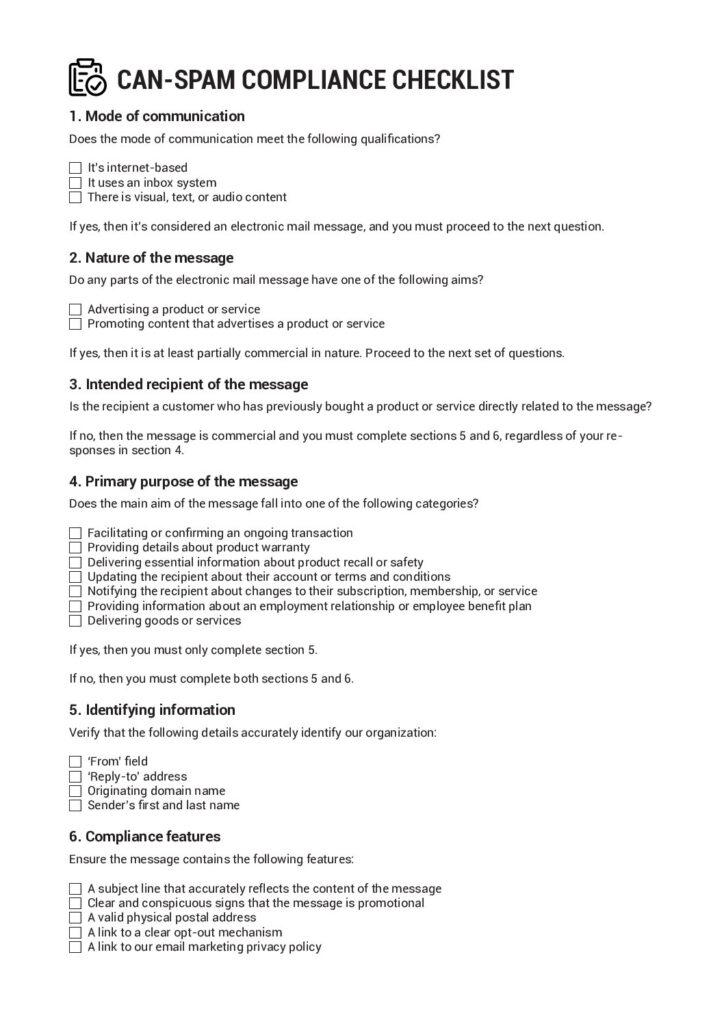
For a more detailed breakdown of these rules and the penalties for non-compliance (which can be over $50,000 per email), the following article is an excellent reference.
CAN-SPAM Act Laws and Requirements - Termly
The article 'CAN-SPAM Act Laws and Requirements' from Termly provides a deeper dive into the rules we just learned, including examples of compliant and non-compliant emails.
Please read the sections 'How to Comply With the FTC’s CAN-SPAM Rules' and 'What Are the Penalties of Noncompliance?'. Then, review the 'What Do Compliant and Noncompliant Emails Look Like?' section to see a practical comparison.
The core principle of CAN-SPAM is to give the recipient control. They must know who is emailing them, where they are, and have an easy way to stop future emails.
Conclusion
Congratulations on completing the first module! You now have a complete conceptual framework for building an affiliate marketing business—from the key players and business components to the rules that govern your conduct.
Here are your key takeaways from this lesson:
- FTC Disclosure: You must always disclose any "material connection" (like an affiliate relationship) in a clear and conspicuous way. Place the disclosure at the top of your content where it can't be missed.
- CAN-SPAM Act: When sending commercial emails, you must be truthful in your headers, identify the message as an ad, and provide your physical address and a clear opt-out mechanism.
- The Golden Rule: The common thread in these regulations is transparency. Your goal is to build a business based on trust, not to trick people. Following these rules is the first step in building a respectable and sustainable online brand.
We've laid the groundwork. Now, it's time to start building.
In our next lesson, we will kick off Module 2: Getting Started with ClickBank. We'll move from theory to action as you create your own ClickBank account and learn to navigate the platform where you'll find products to promote.