Hello! Welcome to the third lesson in our course on the fundamentals of electrochemistry.
In our last lesson, we established the crucial difference between galvanic cells, which generate electricity from spontaneous reactions (), and electrolytic cells, which use electricity to drive non-spontaneous reactions (). This naturally leads to a question: how do we determine the value of without building the cell and measuring it?
Introduction
Today, we will answer that question. Our learning outcome is to calculate standard electrode potentials using tabulated reduction potentials. This skill forms the predictive backbone of electrochemistry, allowing you to assess the thermodynamic feasibility of a redox reaction simply by looking up values in a table.
By the end of this lesson, you will be able to:
- Understand how electrode potentials are measured relative to a universal standard.
- Use the formula correctly.
- Determine the standard cell potential for any given redox reaction and for a galvanic cell constructed from two half-cells.
- Apply this calculation to water electrolysis, connecting theory directly to your research focus.
1. A Universal Reference: The Standard Hydrogen Electrode (SHE)
It's impossible to measure the absolute potential of a single half-reaction. We can only measure the potential difference between two half-reactions. To create a standardized system, electrochemists agreed on a universal reference point: the Standard Hydrogen Electrode (SHE).
The SHE involves the reduction of protons to hydrogen gas:
By universal convention, this half-reaction is assigned a standard potential of exactly 0 volts. Every other electrode potential is then measured relative to the SHE.
Let's begin with a video that explains this concept and introduces the tables we will be using.
Calculating Standard Cell Potential | Examples and Pitfalls (19.4) | General Chemistry
This video from Chad's Prep clearly explains the role of the SHE as a reference and how tables of standard reduction potentials are constructed.
Please watch from 00:23 to 03:25. Focus on: Why a reference electrode is necessary. The specific reaction and conditions for the SHE. The convention of tabulating potentials as reductions and how to find the potential for the reverse (oxidation) reaction.
2. Calculating the Standard Cell Potential ()
Now that we have a table of standard reduction potentials (), we can calculate the potential of a full cell. The most reliable formula is:
Where:
- is the standard cell potential.
- is the standard reduction potential for the half-reaction occurring at the cathode.
- is the standard reduction potential for the half-reaction involving the species at the anode.
This is a critical point: You use the reduction potential values directly from the table for both the cathode and anode. The minus sign in the formula automatically accounts for the fact that the anode is undergoing oxidation (the reverse of the tabulated reaction).
A common mistake is to reverse the sign of the anode potential and subtract it. This is incorrect and effectively subtracts a negative, leading to addition.
The following resource provides a textual explanation of this formula and its derivation.
Standard Electrode Potentials - Chemistry LibreTexts
This section from Chemistry LibreTexts offers a solid written explanation of the concepts we're discussing.
Please read the first two subsections, 'Measuring Standard Electrode Potentials' and 'Standard Electrode Potentials'. Pay close attention to the formula E°_{ ext{cell}} = E°_{ ext{cathode}} − E°_{ ext{anode}} and the explanation that electrode potentials are intensive properties (independent of stoichiometry).
Now, let's watch a detailed walkthrough of how to apply this. The video also clarifies an alternative calculation method and highlights the importance of not changing the potential value when balancing the electrons in the half-reactions.
Calculating Standard Cell Potential | Examples and Pitfalls (19.4) | General Chemistry
This segment of the Chad's Prep video provides excellent worked examples and clarifies common points of confusion.
Please watch from 03:25 to 12:47. Note: The two valid ways to calculate E°_{ ext{cell}} and the pitfall of mixing them. The first example where a reaction is given, and the potential is calculated to be negative (non-spontaneous). The second example, which explains why stoichiometric coefficients do not affect the potential value—this is because potential (Volts = Joules/Coulomb) is an intensive property. Doubling the reaction doubles the energy (Joules) but also doubles the charge transferred (Coulombs), so the ratio remains the same.
3. Two Types of Problems
There are two main ways you'll be asked to calculate .
Case 1: Calculating for a Given Reaction
Here, the reaction is provided, and you simply need to find its potential. The result can be positive or negative.
Steps:
- Separate the overall reaction into oxidation and reduction half-reactions.
- Identify the cathode (reduction) and anode (oxidation).
- Find the standard reduction potentials () for both half-reactions from a table like the one below.
- Apply the formula: .
- Interpret the result: If , the reaction is spontaneous (galvanic). If , it is non-spontaneous (electrolytic).
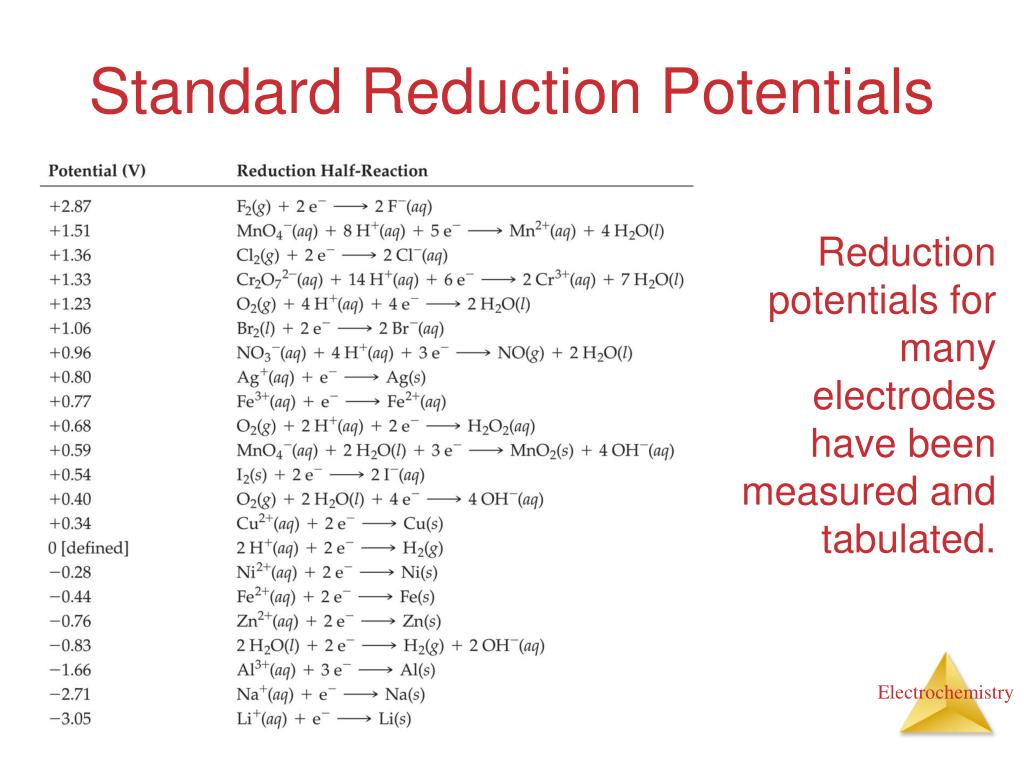
Case 2: Finding the Potential of a Galvanic Cell
Here, you are given two half-cells and told to make a galvanic cell. By definition, a galvanic cell must be spontaneous, so must be positive.
Steps:
- Find the standard reduction potentials for both half-cells.
- To ensure is positive, the half-reaction with the more positive (or less negative) value will be the cathode (reduction).
- The other half-reaction must be the anode (oxidation). You will need to write it in the reverse direction to show the full balanced equation.
- Apply the formula to find the cell potential.
Let's watch a video demonstrating this second case.
Calculating Standard Cell Potential | Examples and Pitfalls (19.4) | General Chemistry
This final segment from Chad's Prep shows how to approach a problem where you must construct a spontaneous (galvanic) cell.
Watch from 12:47 to 17:42. The key takeaway is the logic of choosing which half-reaction to reverse to guarantee a positive E°_{ ext{cell}}.
Here is a static, worked example of this process for you to review.

4. Application: The Thermodynamic Potential of Water Electrolysis
Let's apply this directly to your field of research. We can calculate the minimum theoretical voltage required to split water under standard conditions. Water splitting is an electrolytic process, so we expect a negative .
The overall reaction is:
The half-reactions in an acidic medium are:
- Anode (Oxidation):
- Cathode (Reduction):
Now, we find the relevant reduction potentials from our table:
- For the oxygen reaction: , V
- For the hydrogen reaction: , V
The oxidation of water occurs at the anode, and the reduction of protons occurs at the cathode.
- (for H⁺ reduction) = 0.00 V
- (for the O₂/H₂O couple) = +1.23 V
Now, we calculate the standard cell potential:
The result is negative, confirming that the reaction is non-spontaneous. This value, V, tells us that a minimum external voltage of 1.23 V must be applied to overcome the thermodynamic barrier and initiate water splitting under standard conditions. In practice, due to kinetic barriers (overpotentials) and ohmic losses, the required voltage is always higher. Your work in developing better catalysts is aimed at reducing these kinetic barriers.
Conclusion
In this lesson, we moved from the qualitative distinction between cell types to a quantitative, predictive framework. You can now calculate the thermodynamic driving force for any redox reaction under standard conditions.
Key Takeaways:
- Standard electrode potentials () are measured relative to the Standard Hydrogen Electrode (SHE), which is assigned a potential of 0 V.
- The standard cell potential is calculated using , where both potentials are taken directly from a table of reduction potentials.
- A positive indicates a spontaneous reaction (galvanic cell), while a negative indicates a non-spontaneous reaction requiring external energy (electrolytic cell).
- Electrode potentials are intensive properties; they are not multiplied by stoichiometric coefficients when balancing reactions.
- For water electrolysis, the standard thermodynamic potential is V, meaning a minimum of 1.23 V must be externally applied.
Preview of the Next Lesson:
Our calculations today were all for "standard conditions" (1 M concentration, 1 atm pressure). But real-world electrochemical systems, including your electrolyzer, rarely operate under these exact conditions. In the next lesson, we will learn how to apply the Nernst equation to determine cell potential under non-standard conditions, which will allow us to account for the effects of concentration and pressure on cell voltage.