Hello! Welcome back to your course on the fundamentals of electrochemistry.
In our first lesson, we established the crucial link between the thermodynamic spontaneity of a reaction, represented by Gibbs free energy (), and its electrical potential, , through the equation . We saw that a spontaneous reaction has a negative and a positive , while a non-spontaneous reaction, like water electrolysis, has a positive and requires a minimum energy input corresponding to a negative .
Introduction
Today, we will formalize this distinction. Our goal is to distinguish between galvanic and electrolytic cells in terms of energy conversion and spontaneity.
You are already intimately familiar with one of these: your research on electrocatalysts for green hydrogen production involves designing and optimizing electrolytic cells. By the end of this lesson, you will be able to clearly articulate how these cells differ from galvanic cells (like batteries) in their fundamental purpose, operation, and thermodynamic basis. This distinction is foundational to all of electrochemistry.
1. Two Sides of the Same Coin: Spontaneity and Energy Conversion
As we touched upon last time, electrochemistry broadly involves two types of processes:
- Using a spontaneous chemical reaction to generate electricity.
- Using electricity to drive a non-spontaneous chemical reaction.
These two processes occur in galvanic and electrolytic cells, respectively. Let's start with a clear video introduction that contrasts them, using a zinc-copper reaction for the former and water splitting for the latter—a perfect parallel for our discussion.
Introduction to Electrochemistry
This video from Tyler DeWitt provides an excellent high-level introduction to the two main types of electrochemical cells.
Please watch the segments from 00:00-01:01, 04:09-10:51, and 11:09-15:30. As you watch, focus on: Galvanic cells: How a spontaneous reaction (Zn + Cu²⁺) is harnessed to make electrons flow through a wire, creating electricity. Electrolytic cells: How an external power source is needed to force a non-spontaneous reaction (splitting water) to occur. The concept of spontaneity as the key differentiator.
This video sets the stage perfectly. Now, let's break down the characteristics of each cell type in more detail.
2. The Galvanic (Voltaic) Cell: Generating Electricity
A galvanic cell, also known as a voltaic cell, is a device that converts chemical energy into electrical energy by harnessing a spontaneous redox reaction.
- Spontaneity: The overall reaction is spontaneous, meaning and .
- Energy Conversion: Chemical energy → Electrical energy.
- Operation: Electrons are released at the anode (oxidation) and flow spontaneously through an external circuit to the cathode (reduction).
- Electrode Polarity:
- Anode: The source of electrons, making it the negative (–) terminal.
- Cathode: The destination for electrons, making it the positive (+) terminal.
- Example: A standard battery, or the zinc-copper cell discussed in the video.
3. The Electrolytic Cell: Driving Chemistry
An electrolytic cell is the reverse. It uses an external power source to drive a non-spontaneous reaction. This is precisely what an electrolyzer does.
- Spontaneity: The overall reaction is non-spontaneous, meaning and .
- Energy Conversion: Electrical energy → Chemical energy.
- Operation: An external voltage (e.g., from a power supply) is applied to force electrons to move against their natural direction. This external source pulls electrons from the anode and pushes them to the cathode.
- Electrode Polarity:
- Anode: Oxidation still occurs here, but because electrons are being forcibly removed by the positive terminal of the power supply, the anode is the positive (+) terminal.
- Cathode: Reduction still occurs here, but because electrons are being forced onto it by the negative terminal of the power supply, the cathode is the negative (–) terminal.
- Example: Your water electrolyzer, electroplating processes, or recharging a rechargeable battery.
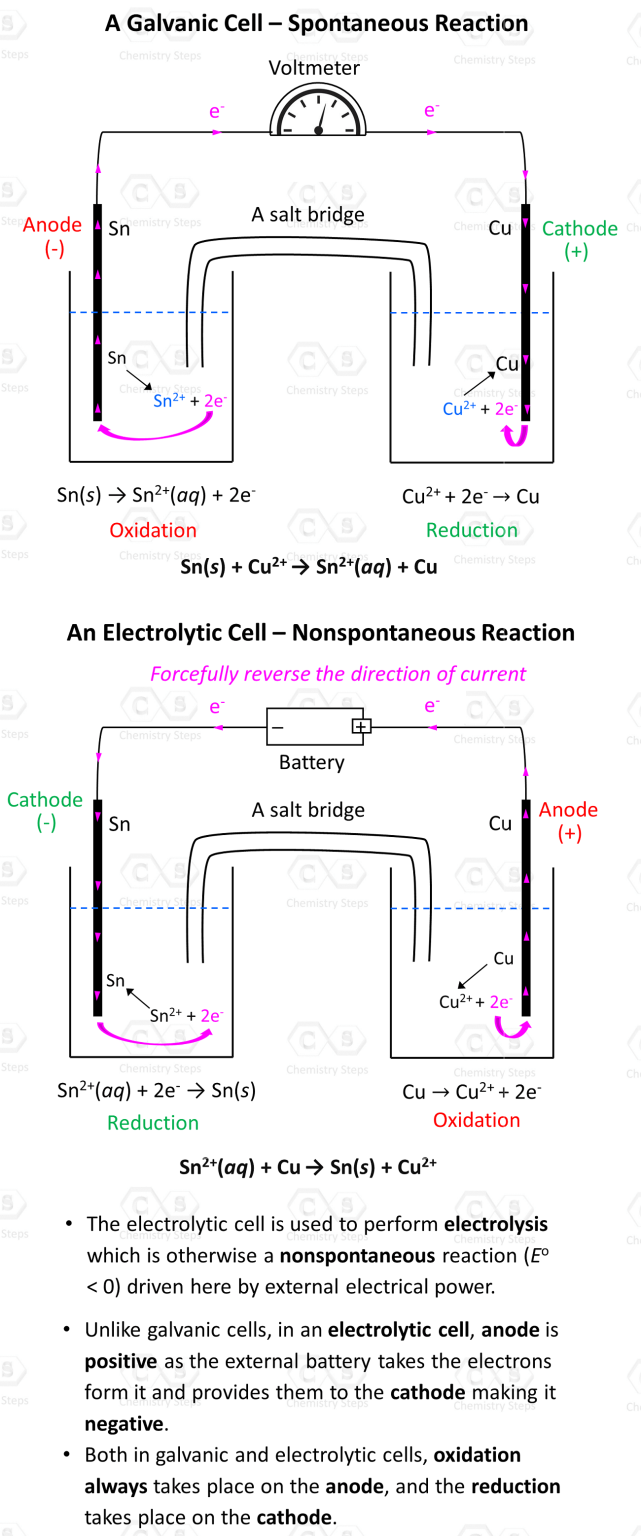
Notice the crucial point: oxidation always occurs at the anode, and reduction always occurs at the cathode, regardless of the cell type. What changes is the polarity of these electrodes and the direction of energy conversion.
The following diagram provides a clear visual comparison of the two cell types using a copper-tin system.
To solidify the role of the external power source, the next video masterfully illustrates how the same chemical system can be switched from a galvanic cell to an electrolytic cell simply by applying an opposing voltage.
Introduction to electrolysis | Redox reactions and electrochemistry | Chemistry | Khan Academy
This Khan Academy video provides a direct comparison by showing how the spontaneous Zn/Cu reaction is reversed in an electrolytic cell.
Please watch from the beginning to 06:54. Pay special attention to: How the standard cell potential becomes negative for the non-spontaneous reaction. The necessity of an external battery with a voltage greater than the cell's natural potential to reverse the reaction. The resulting reversal of electrode polarities (e.g., the anode is now positive).
4. A Deeper Thermodynamic View
Your chemical engineering background provides a strong foundation for appreciating the more formal thermodynamic descriptions of these cells. The following text delves into the concepts of reversible and irreversible processes as they apply to cell operation.
Thermodynamics of Electrochemical Cells
This chapter from a hydrometallurgy textbook offers a more rigorous look at the thermodynamics differentiating cell types. It connects the practical operation of cells to the core principles of Gibbs free energy, work, and heat flow.
Please read the section titled 'Types of Electrochemical Cells' (it starts after the 'Definitions' subsection). Focus on the descriptions for the Galvanic cell and the Electrolytic cell. Note how the discussion ties back to ΔG, work (w'), and the potential (ΔE).
This reading reinforces that a galvanic cell extracts useful work () from a spontaneous process, while an electrolytic cell requires work input () to overcome a thermodynamic barrier. The efficiency of these processes is dictated by how close they operate to the ideal, reversible limit. In your work, minimizing the "extra" work needed above the thermodynamic minimum () is the key to improving electrolyzer efficiency.
5. Summary of Key Distinctions
Let's consolidate everything into a single, comprehensive table. This is a useful reference for the key differences we've discussed.

Conclusion
In this lesson, we have thoroughly contrasted the two fundamental types of electrochemical cells based on their relationship with spontaneity and energy flow.
Key Takeaways:
- Galvanic (Voltaic) Cells use spontaneous reactions () to convert chemical energy into electrical energy. The anode is negative, and the cathode is positive.
- Electrolytic Cells use electrical energy to drive non-spontaneous reactions (), converting electrical energy into chemical energy. The anode is positive, and the cathode is negative.
- In both cell types, oxidation occurs at the anode and reduction occurs at the cathode. The sign conventions change, but the fundamental processes at each electrode do not.
- Your work on water electrolysis is a quintessential example of an electrolytic process, where the goal is to supply electrical energy as efficiently as possible to create chemical products (H₂ and O₂).
Preview of the Next Lesson:
We now know that a positive signifies a spontaneous reaction, while a negative one signifies a non-spontaneous reaction. But how do we determine the value of for a given pair of reactants without measuring it? In the next lesson, you will learn to calculate standard electrode potentials using tabulated reduction potentials, giving you a powerful predictive tool to assess the thermodynamic feasibility of any redox reaction.