Hello! Welcome to the first lesson of your course on the fundamentals of electrochemistry.
Given your extensive practical experience in developing electrocatalysts, our goal is to build a solid theoretical framework that will empower you to understand the "why" behind your experiments and help you design even more effective ones.
Introduction
Today's lesson focuses on the most fundamental principle connecting chemistry and electricity. We will answer the question: How are the chemical energy of a reaction and the electrical potential of a cell related?
By the end of this lesson, you will be able to explain the relationship between Gibbs free energy change () and the cell potential () for an electrochemical reaction.
This concept is the bedrock of electrochemistry. It explains why some reactions, like those in a battery, produce energy, while others, like the water electrolysis you work on, require an energy input to proceed. Understanding this will be crucial as we later explore electrolysis efficiency, overpotential, and catalyst performance.
1. Spontaneity in Chemistry and Electrochemistry
From your background in chemical engineering, you'll be familiar with Gibbs free energy change () as the key indicator of a reaction's spontaneity.
- If , the reaction is spontaneous (product-favored).
- If , the reaction is non-spontaneous (reactant-favored) and requires energy input.
- If , the system is at equilibrium.
In electrochemistry, the cell potential (), or voltage, provides a parallel way to determine spontaneity.
- If , the reaction is spontaneous (a galvanic or voltaic cell, like a battery).
- If , the reaction is non-spontaneous (an electrolytic cell, like your electrolyzer).
- If , the system is at equilibrium.
Let's watch a brief video that introduces this crucial parallel.
Cell Voltage and Gibbs Free Energy
This video provides a clear overview of how both Gibbs free energy and cell potential act as indicators of reaction spontaneity.
Starting just after the beginning of the video up to about a minute and twenty seconds in, please watch cell voltage spontaneity. Focus on how the sign of the cell voltage (+ or -) corresponds to a product-favored (spontaneous) or reactant-favored (non-spontaneous) reaction, mirroring the role of \Delta G.
2. Linking and Through Electrical Work
The connection between and isn't just conceptual; it's a precise mathematical relationship.
The key is to think about work. represents the maximum amount of non-expansion work that a chemical reaction can perform. In an electrochemical cell, this useful work is electrical work ().
Electrical work is the work done by moving a certain amount of charge () across a potential difference ():
In a redox reaction, the total charge transferred depends on:
- n: The number of moles of electrons transferred in the balanced reaction.
- F: Faraday's constant, the charge of one mole of electrons ( Coulombs/mol e⁻).
So, the total charge transferred is . The maximum electrical work is therefore:
By convention, is the energy available in the system, while work is energy leaving the system. This gives us the fundamental equation:
Combining these gives us the central equation of this lesson:
The following video segment walks through this derivation in detail.
Cell Voltage and Gibbs Free Energy
Now, let's formalize this relationship. This segment derives the core equation by defining electrical work in terms of moles of electrons and Faraday's constant, then linking it directly to Gibbs free energy.
Starting about a minute and 20 seconds into the video, watch the mathematical derivation for about five minutes. Pay close attention to: How total charge is calculated using n and Faraday's constant F. Why Gibbs free energy is set equal to the negative of the maximum electrical work. The final derived equation and what each term represents.
3. Application: From Spontaneous Cells to Water Electrolysis
Let's put this equation to use in two contrasting scenarios.
Case 1: A Spontaneous Reaction (Galvanic Cell)
First, consider a classic zinc-copper battery, which runs spontaneously. We can use its known standard cell potential () to calculate the standard Gibbs free energy change ().
Electrochemistry Review - Cell Potential & Notation, Redox Half Reactions, Nernst Equation
Let's see this equation in action for a spontaneous reaction. This video provides a very clear, step-by-step calculation of \Delta G^\circ for a standard zinc-copper cell.
Starting around 12 minutes and 45 seconds, watch the segment on calculating Delta G. Notice how the number of electrons n=2 is determined from the balanced half-reactions and how the units (Volts = Joules/Coulomb) work out to give an answer in Joules/mol.
As you saw, a positive of +1.10 V results in a large, negative , confirming the reaction is spontaneous and releases energy.
Case 2: A Non-Spontaneous Reaction (Your Focus Area)
Now, let's apply this to the reaction at the heart of your research: water electrolysis.
This process is non-spontaneous and requires energy. The following reading selection uses thermodynamics to quantify exactly how much.
[PDF] Fundamentals of Water Electrolysis
This text from a book chapter on water electrolysis directly applies our core concepts to your field. It shows how the positive Gibbs free energy for water splitting determines the minimum voltage needed to drive the reaction.
Please read sections 2.1.1 ('Thermodynamic Functions of State') and 2.1.3 ('Electrochemical Water Splitting Thermodynamics'), found on pages 33-37. Focus on: The standard Gibbs free energy change for water splitting (\Delta G^\circ) and its positive sign, which confirms it is non-spontaneous. How the equation \Delta G = nFE is rearranged to calculate the theoretical minimum voltage (E) required. The resulting value, E^\circ \approx 1.23 V.
This is a critical insight: the standard Gibbs free energy change for splitting water, kJ/mol, directly translates into a theoretical minimum decomposition voltage of 1.23 V. This is the thermodynamic barrier you must overcome with an external power source. Any voltage required above this is due to kinetic and resistive losses (overpotentials), topics we will explore in great detail later in the course.
4. Synthesizing the Concepts
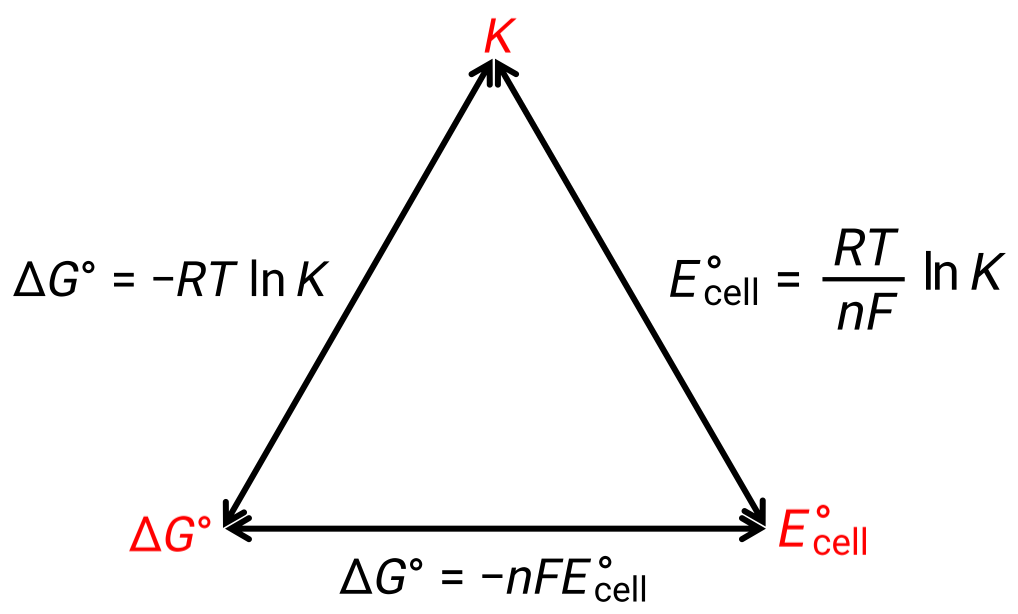
The relationships between Gibbs free energy (), cell potential (), and the equilibrium constant () form the thermodynamic triangle of electrochemistry. We have focused on one side of this triangle today.
Conclusion
In this lesson, we established the fundamental bridge between thermodynamics and electrochemistry.
Key Takeaways:
- The relationship quantitatively links the chemical energy of a reaction to its electrical potential.
- The signs of and are opposite but both indicate spontaneity: a spontaneous reaction has a negative and a positive .
- For non-spontaneous reactions like water electrolysis, the positive determines the minimum theoretical voltage required to drive the reaction ( V). This value is a crucial benchmark in your field.
Preview of the Next Lesson:
We've introduced the terms galvanic and electrolytic cells. In our next lesson, we will formally distinguish between these two types of cells, examining their components, energy flow, and the sign conventions for their electrodes. This will further solidify the concepts we've discussed today and prepare us to analyze complete electrochemical systems.