Hello! Welcome to the fourth lesson in our course.
Introduction
In our previous lesson, you learned how to calculate the standard cell potential () for a redox reaction. We used this to determine that a minimum of 1.23 V is required to split water under standard conditions (1 M concentration, 1 atm pressure, 25 °C).
However, real-world electrochemical processes, especially industrial water electrolysis, rarely operate under these ideal conditions. Your work with Ni-Fe/MXene catalysts for alkaline seawater electrolysis is a prime example of a non-standard environment (high pH, varying ion concentrations, different temperatures). This raises a critical question: how does the cell potential change when we move away from standard conditions?
Today, we will answer that question. The learning outcome for this lesson is to apply the Nernst equation to determine cell potential under non-standard conditions. This equation is one of the most important relationships in electrochemistry, as it connects the thermodynamic potential of a reaction to the actual concentrations of reactants and products.
By the end of this lesson, you will be able to:
- Understand the origin of the Nernst equation from fundamental thermodynamic principles.
- Write and interpret the Nernst equation.
- Calculate the cell potential for any redox reaction under specified non-standard conditions of concentration and pressure.
- Begin to apply this concept to water electrolysis half-reactions, understanding how pH affects individual electrode potentials.
1. From Gibbs Energy to Cell Potential
The Nernst equation isn't arbitrary; it's derived from the fundamental relationship between Gibbs free energy () and the reaction quotient (). You'll recall from your chemistry background that for a reaction not at standard conditions:
We also know from our first lesson that Gibbs free energy is related to cell potential by:
where is the number of moles of electrons transferred and is the Faraday constant.
By substituting the electrochemical expressions for and into the first equation, we can derive the Nernst equation. The following video provides a concise walkthrough of this derivation.
Electrochemistry: Nernst equation derivation
This video, 'Electrochemistry: Nernst equation derivation' from lseinjr1, clearly shows how the Nernst equation is derived by combining the thermodynamic relationship for Gibbs free energy with the definition of cell potential.
Please watch the entire video (around 5 minutes). Focus on how the relationships \Delta G = -nFE_{ ext{cell}} and \Delta G = \Delta G° + RT \ln Q are combined to arrive at the Nernst equation.
2. The Nernst Equation and the Reaction Quotient (Q)
As derived in the video, the Nernst equation is:
At a standard temperature of 25 °C (298.15 K), and by converting the natural logarithm (ln) to a base-10 logarithm (log), the equation simplifies to a more common form:
Let's break down the key terms:
- : The cell potential under non-standard conditions (what we want to find).
- : The standard cell potential (what we learned to calculate in the last lesson).
- : The number of moles of electrons transferred in the balanced redox reaction.
- : The reaction quotient. This is the key term that accounts for non-standard conditions.
The reaction quotient has the same form as the equilibrium constant , but it uses the current concentrations and partial pressures, not the equilibrium ones. For a general reaction :
Remember that pure solids and liquids (like the electrode material or liquid water) have an activity of 1 and are omitted from the expression. Gaseous species are included as their partial pressures in atmospheres.
The value of tells us how the cell potential will shift:
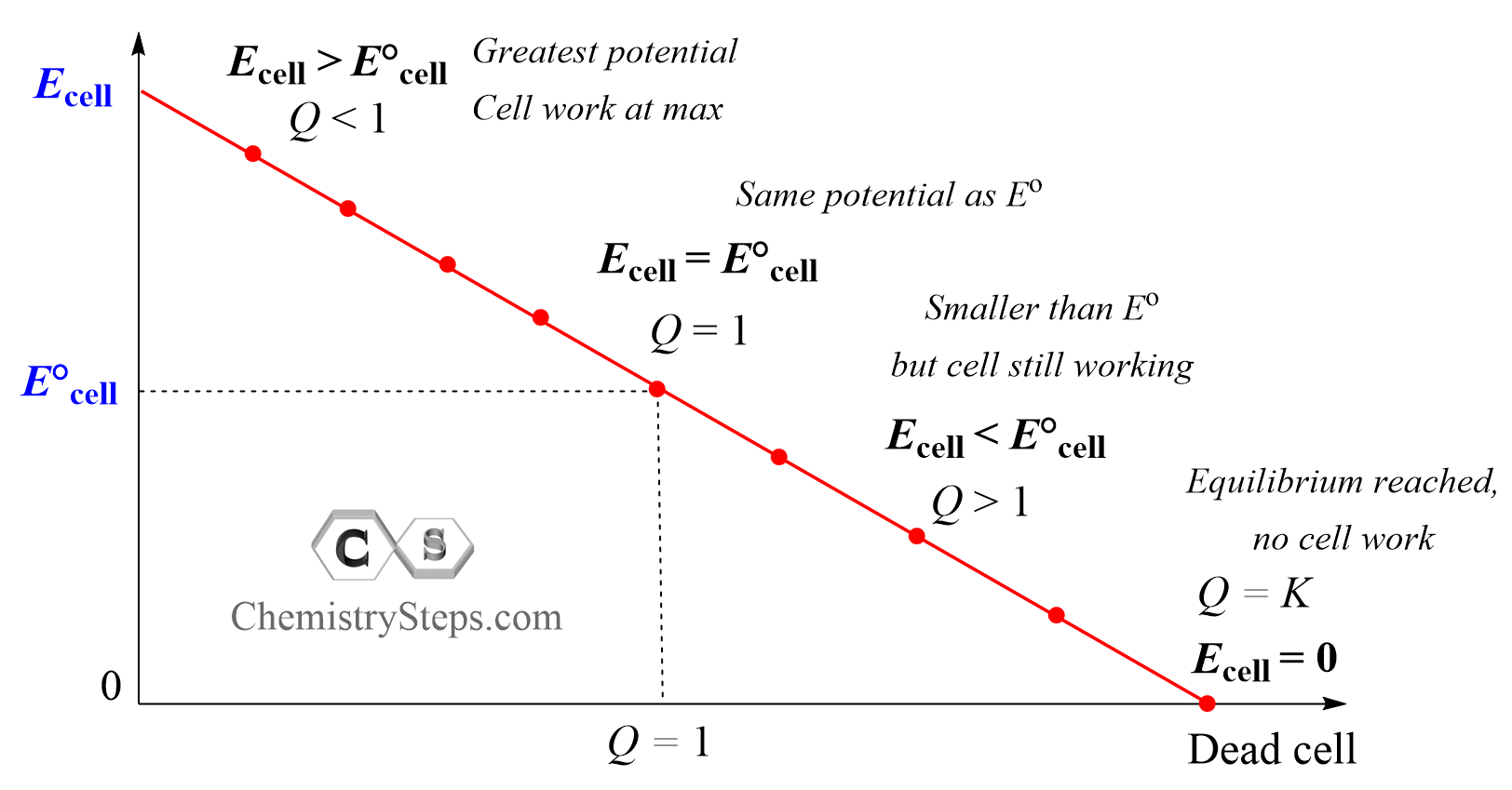
3. Calculating Cell Potential Under Non-Standard Conditions
Let's walk through the process with a practical example. The following reading from Chemistry LibreTexts provides a great explanation and a worked example.
20.6: Cell Potential Under Nonstandard Conditions
This resource provides a clear textual explanation of the Nernst equation and its application. It includes a step-by-step example problem that we will follow.
Please read the first two parts of this article: 'The Effect of Concentration on Cell Potential: The Nernst Equation' and the worked 'Example 1'. This will solidify your understanding of the equation and how to apply it.
Steps to Apply the Nernst Equation:
- Determine : Separate the reaction into half-reactions, identify the cathode and anode, and use tabulated standard reduction potentials to calculate .
- Determine : Find the number of electrons transferred in the balanced overall reaction.
- Determine : Write the expression for the reaction quotient , then substitute the given non-standard concentrations and pressures.
- Calculate : Plug , , and into the Nernst equation.
Let's try one yourself.
Practice Problem:
Consider the galvanic cell based on the reaction:
Calculate the cell potential, , at 25 °C when M and M.
Standard reduction potentials: V, V.
Click to see the solution
1. Balance the reaction and find and :
- Oxidation (Anode):
- Reduction (Cathode):
- Overall:
- The number of electrons transferred, , is 6.
2. Determine Q:
3. Calculate :
Since , the cell potential is higher than the standard potential, as expected.
4. Application to Water Electrolysis: The Effect of pH and Pressure
Now, let's connect this directly to your research. The Nernst equation is crucial for understanding how the potentials for the Hydrogen Evolution Reaction (HER) and Oxygen Evolution Reaction (OER) shift with operating conditions.
The Effect of pH
The concentration of (or ) is a key non-standard condition. A change in pH is a change in , which appears in the reaction quotient for both half-reactions.
Let's watch a video that introduces this concept graphically.
Electrochemical Stability of Water
The video 'Electrochemical Stability of Water' provides an excellent visual representation of how the potentials for hydrogen and oxygen evolution change as a function of pH.
Please watch from 02:17 to 05:52. Pay attention to how the Nernst equation is used to derive the linear relationship between potential and pH for both the hydrogen and oxygen half-reactions.
The video shows that both the OER and HER potentials shift by approximately -0.059 V per pH unit. To see the math behind this, let's turn to a key resource for your field.
[PDF] Fundamentals of Water Electrolysis
This document, 'Fundamentals of Water Electrolysis', is a valuable resource that we will refer to often. This section specifically derives the pH dependence for the half-cell potentials in both acidic and alkaline media using the Nernst equation.
Please read Section 2.1.4, 'pH Dependence of Water Dissociation Voltage' (pages 37-39). Focus on how Equations 2.12 and 2.14 are simplified to show the '-0.06pH' dependence (note: 0.06 is a rounded value for 0.0591). Also, note the conclusion in Equation 2.16 that the overall cell voltage of 1.23 V is pH-independent.
This is a critical insight for an electrocatalyst developer. While the overall thermodynamic barrier for water splitting (1.23 V) doesn't change with pH, the potentials at which the individual HER and OER must occur do change. Your Ni-Fe/MXene catalyst is designed to work in alkaline media, where the OER occurs at a much lower absolute potential ( V vs. NHE) compared to acidic media ( V vs. NHE). This has enormous implications for catalyst material stability, which we will explore in a later module.
The Effect of Pressure
Similarly, electrolyzers are often operated under pressure to produce compressed hydrogen directly. This non-standard pressure also affects the required cell voltage.
[PDF] Fundamentals of Water Electrolysis
Let's return to the 'Fundamentals of Water Electrolysis' PDF to see how pressure is handled by the Nernst equation.
Please read the first part of Section 2.1.6, titled 'General Pressure Dependence' (pages 42-43). Focus on how Equation 2.34 is a direct application of the Nernst equation, where Q is a function of the partial pressures of the product gases.
As shown in Equation 2.37 from the reading, increasing the operating pressure increases the required thermodynamic cell voltage. This is the energy "cost" of performing electrochemical compression.
Conclusion
In this lesson, we bridged the gap between idealized standard conditions and the variable conditions of real-world electrochemistry. The Nernst equation is the tool that makes this possible.
Key Takeaways:
- The Nernst equation () allows us to calculate cell potential under non-standard conditions.
- The reaction quotient, , captures the effect of current concentrations and pressures.
- If (reactants dominate), . If (products dominate), .
- For water electrolysis, the Nernst equation shows that while the overall thermodynamic voltage (1.23 V) is pH-independent, the potentials of the individual HER and OER half-reactions shift linearly with pH.
- Operating pressure also affects the required cell voltage, a factor that can be quantified with the Nernst equation.
Preview of the Next Lesson:
We've now established all the thermodynamic principles needed to analyze a water electrolysis cell. In the next lesson, we will synthesize these concepts to calculate the thermodynamic minimum voltage required for water electrolysis under various standard and non-standard conditions. We will work through practical examples, considering different temperatures, pressures, and pH levels, giving you a complete picture of the thermodynamic landscape in which your catalysts operate.