Hello! Welcome back to our grammar module.
In our last lesson, we explored the present perfect tense and how it creates a bridge from the past to the present. Today, we'll journey deeper into the past to look at events that happened before other past events. Our learning outcome is to use the past perfect tense to sequence past events.
This is a key skill for the IELTS. In the Speaking and Writing tests, it allows you to tell stories and explain background situations with clarity and sophistication. In the Listening and Reading sections, understanding the past perfect is often crucial for correctly following the timeline of events.
This lesson is designed for about 60 minutes. A good place to pause if you're studying for 30 minutes a day would be after the "How to Form the Past Perfect" section.
What is the Past Perfect Tense? Going Back in Time
While the present perfect connects the past to the present, the past perfect connects a past event to an earlier past event. Think of it as a way to "jump back in time" from a point in the past to explain what had happened before.
For example:
- Past Simple: I arrived at the clinic at 9 am.
- Past Perfect: The first patient had arrived even earlier.
Combining them: When I arrived at the clinic, the first patient had already arrived.
The main purpose is to make the order of events clear. Let's watch a video that explains this concept with a simple analogy and a very helpful visual graph.
English Grammar—The Past Perfect Tense
This video from Write to the Top will introduce you to the basic idea of the past perfect. Pay close attention to the timeline graph and the idea of going 'backward' in time.
Watch from the beginning to 04:36. Focus on the structure (had + past participle), the function of sequencing, and how the timeline graph shows the relationship between the past simple (later action) and past perfect (earlier action).
How to Form the Past Perfect
As you just saw, the structure of the past perfect is consistent and quite simple.
Structure: Subject + had + past participle
The auxiliary verb is always had (or hadn't for negative), regardless of the subject. You then add the past participle, which is the third form of the verb (e.g., go -> went -> gone; study -> studied -> studied).
For a clear summary of the affirmative, negative, and question forms, please review this table from IDP, an official IELTS partner.
This guide from IDP provides a clear, structured table showing how to form the past perfect in all its forms.
Please read section '2. Structure of the Past Perfect tense'. Look at the table with examples for affirmative, negative, and question sentences.
Test your understanding!
Complete these sentences by putting the verb in brackets into the past perfect tense.
- She couldn't find the file because her colleague ______ (take) it home.
- I ______ (not finish) editing the video when my computer crashed.
- ______ (you / ever / play) a video game that difficult before you tried that one?
Show answer
- She couldn't find the file because her colleague had taken it home.
- I hadn't finished editing the video when my computer crashed.
- Had you ever played a video game that difficult before you tried that one?
(This is a good point to pause if you are studying for 30 minutes today.)
Sequencing Events: Past Perfect + Past Simple
The true power of the past perfect is unlocked when you use it together with the past simple to tell a story or explain a situation.
- The Past Perfect describes the earlier action.
- The Past Simple describes the later action.
This visual exercise helps to illustrate the concept of jumping back and forth in time.
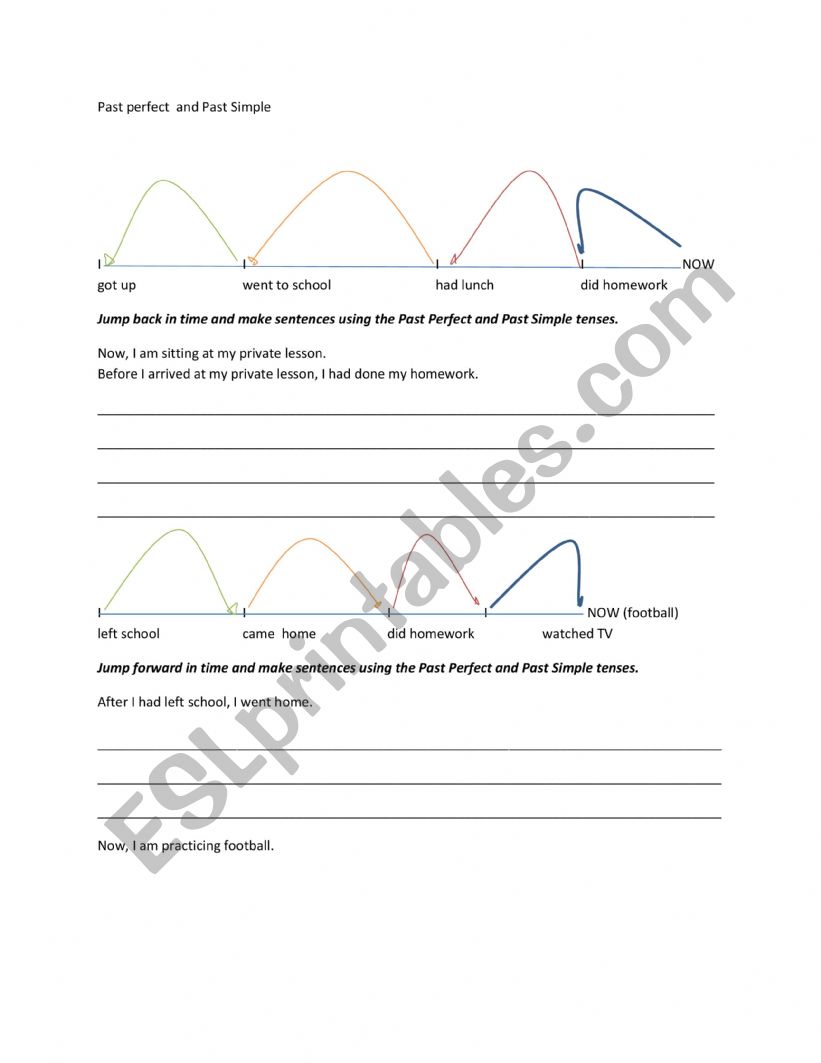
Let's look at an example from the image:
- Earlier Action: I did my homework. (Past Perfect: I had done my homework)
- Later Action: I watched TV. (Past Simple: I watched TV)
Combined sentence: "I watched TV after I had done my homework." or "Before I watched TV, I had done my homework."
No matter the order of the clauses in the sentence, the tense makes the sequence of events clear.
Signal Words
We often use time words and conjunctions to connect the two clauses. The article from IDP that you looked at earlier has a great list of these.
Let's refer back to the IDP guide to see the common signal words used with the past perfect.
Review section '3. Signal words for the Past Perfect tense'. Pay special attention to 'before', 'after', 'when', and 'by the time' as these are very common in academic English.
Examples:
- By the time I graduated from dental school, I had already decided on my specialization.
- After the patient had explained his symptoms, the dentist began the examination.
- The game started when we had finished our dinner.
Important Note: With before and after, the sequence is already clear, so using the past perfect is often optional. Both sentences below are correct, but using the past perfect can add emphasis.
- I checked the patient's history before I started the treatment. (Correct)
- I checked the patient's history before I had started the treatment. (Also correct, more formal)
Test your understanding!
Combine the two sentences into one sentence using the past perfect and the word in brackets.
- The lecture started. Then, I arrived. (when)
- I reviewed my notes. Then, I took the exam. (before)
- The company launched the new product. First, they did a lot of research. (after)
Show answer
- The lecture had already started when I arrived.
- I had reviewed my notes before I took the exam. (Or: I reviewed my notes before I took the exam.)
- After the company had done a lot of research, they launched the new product.
Pronunciation and Listening
In natural, spoken English, the auxiliary verb 'had' is often contracted to 'd and is unstressed. This is very important for both your listening comprehension and your speaking fluency. As a native Arabic speaker, practicing these unstressed sounds and contractions is especially useful.
I HAD LEARNED... The Past Perfect Tense | English Grammar Lesson with Pronunciation & Examples
The mmmEnglish channel has an excellent explanation of how to pronounce these contractions and how to distinguish 'I'd' (I had) from 'I'd' (I would).
Watch from 03:59 to 06:48. Listen carefully to the pronunciation of 'I'd', 'she'd', 'hadn't'. Practice saying them out loud. Notice the key tip: 'I'd' + past participle = 'I had'. 'I'd' + infinitive = 'I would'.
- "I**'d** finished." (I had finished)
- "She**'d** left." (She had left)
- "They hadn't seen it."
Practice Exercises
Now it's time to put your knowledge into practice. The IDP article contains some excellent exercises to test your understanding.
Let's return one last time to the IDP guide for some practice.
Go to section '5. Past Perfect tense exercises'. Complete 'Exercise 1' and 'Exercise 3'. Check your work using the 'Answer Key' at the bottom. This will help you identify any areas you need to review.
Conclusion
Well done! You've successfully navigated the timeline of past events using the past perfect tense. This is a big step toward the grammatical accuracy needed for a high IELTS score.
Key Takeaways:
- The past perfect (had + past participle) describes an action that happened before another action in the past.
- It works with the past simple to establish a clear sequence of events.
- Common signal words like when, after, before, and by the time help connect the events.
- In speaking, 'had' is often contracted to 'd (e.g., I'd seen it before), and this is important for fluency and listening.
In our next lesson, we will shift our focus from the past to the future. We will explore the different forms we use to talk about predictions, plans, and arrangements, such as will, be going to, and the present continuous.