Hello! Welcome back to our course.
In our last two lessons, we traveled through time, looking at the present perfect to connect past and present, and the past perfect to sequence events within the past. Today, we're shifting our gaze forward. Our learning outcome is to select appropriate future forms (will, be going to, present continuous) for predictions, plans, and arrangements.
Mastering these forms is vital for your IELTS goal. In the Speaking test, you'll use them to talk about your future studies, career plans, and personal arrangements. In Writing Task 2, you might use them to predict future trends. Understanding them is also key to following conversations and texts in the Listening and Reading sections.
This lesson will take about 60 minutes. If you are studying for 30 minutes, a good place to pause is after the first practice exercise.
Three Ways to Talk About the Future
English uses several forms to discuss the future, and the choice depends on the context: is it a spontaneous decision, a prior intention, or a fixed arrangement?
Let's start with a clear written explanation from the British Council. This will give you a solid foundation for the basic rules.
Future forms: 'will', 'be going to' and present continuous
This guide from the British Council introduces the basic rules for using 'will', 'be going to', and the present continuous for future plans.
Read the 'Grammar explanation' section. Focus on the key difference for each form: 'will' for spontaneous plans, 'going to' for pre-decided plans, and 'present continuous' for arrangements.
Now that you have the basic rules, let's see them in action. Watching and listening to how these forms are used in conversation will help you understand the nuances.
🔥 EXPLAINED! Will v Be Going To v Present Continuous
This video from 'English with Greg' explains these rules in more detail with lots of examples. Pay attention to how the speaker explains the reason for choosing each form in a given situation.
Watch the following parts: 'will' for spontaneous decisions: from 00:32 to 02:40. 'be going to' for intentions: from 04:04 to 05:07. 'present continuous' for arrangements: from 07:13 to 08:13. Take a note of one key example for each form.
To summarize the key ideas so far:
will: For spontaneous decisions made at the moment of speaking. Also for offers and promises.- “The patient seems anxious. I’ll explain the procedure again to reassure them.” (A decision made right now)
be going to: For intentions or plans you decided on before speaking.- “I’m going to review my notes on dental anatomy tonight.” (A pre-existing plan)
present continuous: For fixed arrangements, especially with other people at a set time/place. Think of it as something in your calendar.- “I can’t make it; I’m assisting in a surgery on Friday morning.” (A fixed appointment)
Test your understanding!
Choose the best future form for each situation.
- A: "This textbook is very heavy." B: "Don't worry, I ______ (carry) it for you."
- I've already decided. I ______ (apply) for a master's program in public health after my dental degree.
- A: "Can you meet for coffee this week?" B: "Sorry, I can't. I ______ (visit) my family in another city."
Show answer
- 'll carry (or will carry). This is a spontaneous offer made at the moment of speaking.
- am going to apply. This is a pre-existing intention or plan.
- am visiting. This implies a fixed arrangement or plan, like having bought tickets or made firm plans with family.
(This is a good point to pause if you are studying for 30 minutes today.)
A Special Case: Making Predictions
One of the trickiest areas is making predictions. Both will and be going to can be used, but there's a key difference that is very relevant for academic contexts.
- Use
be going towhen your prediction is based on present evidence—something you can see, hear, or know now. - Use
willwhen your prediction is based on your opinion, belief, or general knowledge, with no immediate, specific evidence.
Let's see this explained clearly in the video.
🔥 EXPLAINED! Will v Be Going To v Present Continuous
A very important distinction for the IELTS is using 'will' and 'be going to' for predictions. Let's return to the 'English with Greg' video to focus on this rule.
Watch from 05:49 to 07:13. Focus on the key difference: 'be going to' is for predictions based on something you can see now (evidence), while 'will' is for predictions based on opinion or feeling.
Examples in a dental context:
- (Looking at a patient's gums that are red and swollen) "If this isn't treated, it's going to cause serious problems." (Prediction based on clear evidence)
- "I think 3D printing will completely change how we create dental crowns in the future." (Prediction based on opinion or general belief about technology)
Summary and IELTS Focus
This chart provides a great visual summary of the main differences between the three forms.
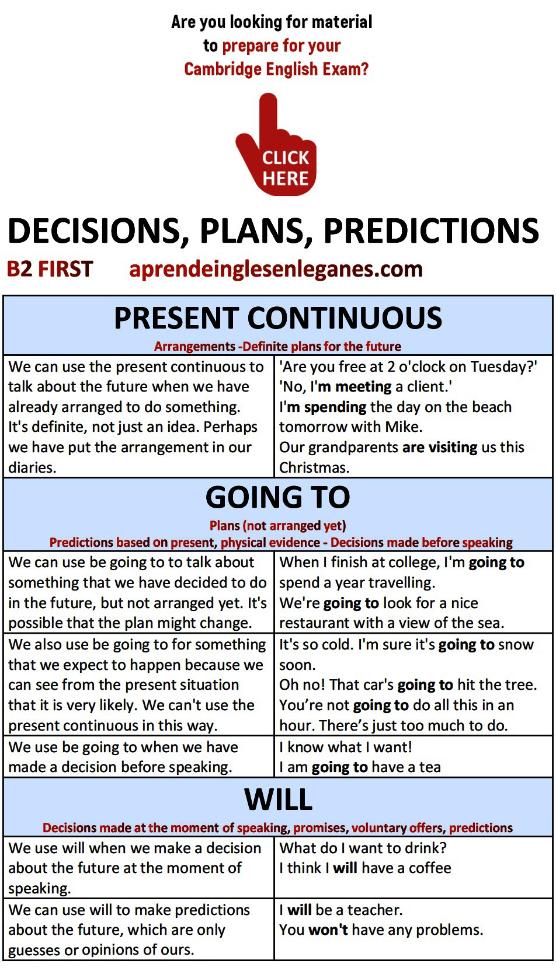
For your IELTS exam, getting this right shows grammatical range and accuracy. Using be going to for a prediction based on data in Writing Task 1, for example, is more precise than using will.
This short article from an IELTS preparation site reinforces why this distinction is useful.
A Complete Guide to the Future Tenses (for IELTS)
To connect this directly to your IELTS preparation, let's read a short guide from TED-IELTS. It explains why these distinctions, especially for predictions, are important for the exam.
Read the section titled 'A Final Note on the Future Tenses'. Pay attention to the advice about using 'going to' for predictions with evidence, which is a common feature in IELTS tasks.
Test your understanding!
Read the scenarios and choose the most appropriate future form.
- You have just looked at the weekly weather forecast, which shows sun every day. You say to a friend: "It looks like it ______ (be) a beautiful week."
- You are in a meeting. Your boss asks, "Who can write the report on our latest patient survey?" You raise your hand and say: "I ______ (do) it."
- You and a friend have booked tickets to attend a dental conference next month. You tell another colleague: "We ______ (attend) the national dental conference in June."
Show answer
- is going to be. You are making a prediction based on current evidence (the weather forecast).
- will do (or 'll do). You are making a spontaneous decision to volunteer at the moment of speaking.
- are attending. This is a fixed arrangement. You have tickets and a set date.
Conclusion
Great work today! You have learned to distinguish between the three main forms for talking about the future in English. This skill will make your speaking and writing much more precise and natural.
Key Takeaways:
- Use
willfor spontaneous decisions, offers, and predictions based on opinion. - Use
be going tofor prior intentions and predictions based on clear evidence. - Use the
present continuousfor fixed arrangements and appointments.
In our next lesson, we will continue building your grammatical toolkit by learning how to construct sentences using relative clauses (who, which, that) to add information. This is another essential skill for creating more complex and academic sentences for the IELTS.