Hello! Welcome to your first lesson in this course designed to help you achieve your goal of a band 7 score on the IELTS Academic exam.
Today, we'll start with a fundamental piece of English grammar that is essential for showing a sophisticated command of the language: the present perfect tense. Our learning outcome is to use the present perfect tense to connect past events with the present.
Mastering this tense is crucial for the IELTS exam. You will use it in the Speaking test to talk about your experiences, in the Writing test to introduce background information and trends, and you will need to understand it in the Listening and Reading sections.
This lesson is designed for about 60 minutes of study. Since you prefer to study for 30 minutes a day, you can complete the first two sections, "What is the Present Perfect?" and "Use 1", on your first day, and the rest of the lesson on the second day.
What is the Present Perfect Tense? The "What" and "How"
Think of the present perfect tense as a bridge. It connects something that happened in the past to the present moment. The exact time of the past event is often not important; what matters is its relevance or connection to now.
This is different from the past simple tense (e.g., "I went to London in 2020"), which talks about an action that finished at a specific, known time in the past. With the present perfect, the connection to the present is key.
This infographic provides an excellent visual summary of the tense. Notice the timeline showing how the past action relates to "Now."
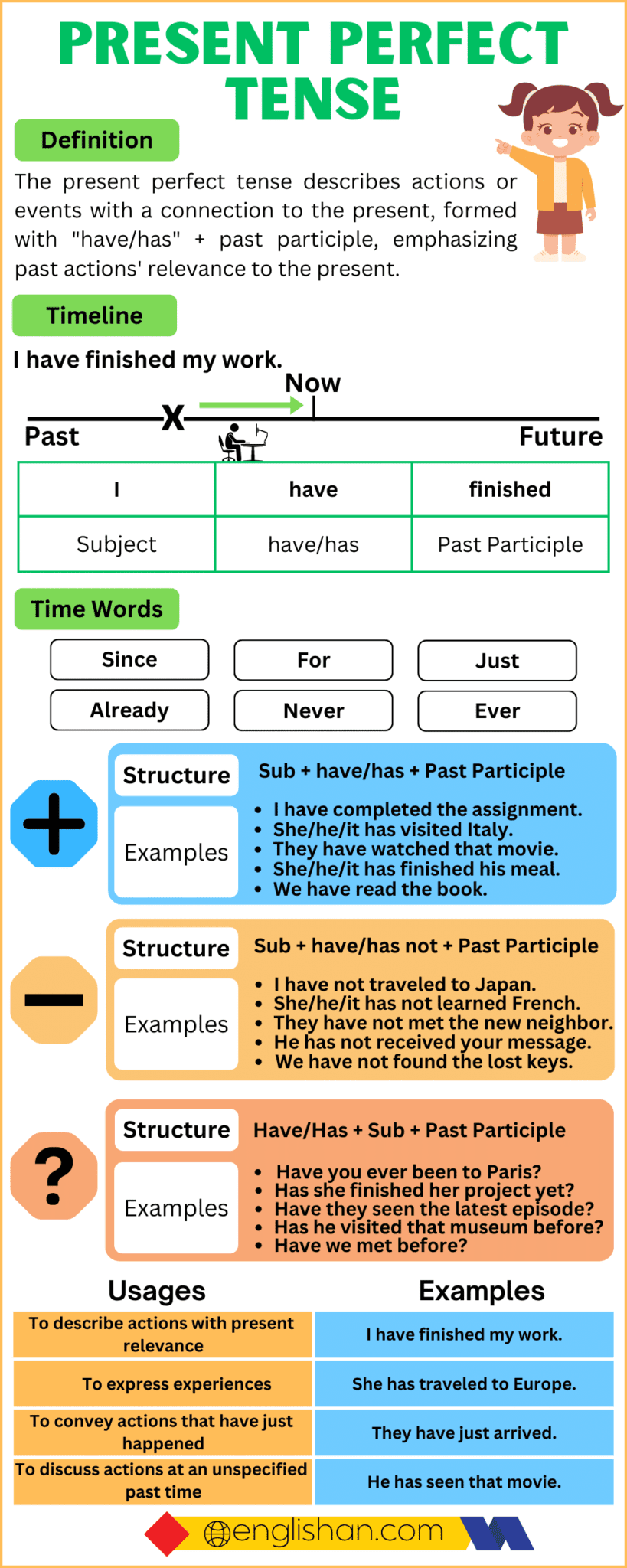
How to Form the Present Perfect
The structure is straightforward:
Subject + have/has + past participle
The past participle is often called the "third form" of a verb. For regular verbs, it's the same as the past simple (it ends in -ed). For irregular verbs, the form changes and must be memorized (e.g., go -> went -> gone; see -> saw -> seen).
To learn the structure and see some clear examples, please review the first part of this guide.
IELTS Grammar: The Present Perfect Complete Guide
This guide from 'IELTS with Fiona' provides a clear breakdown of the present perfect. It's a great reference page for your studies.
Read the first part of the article, from the beginning down to the section titled 'Key points to remember'. Study the introductory overview, and focus on the tables showing the positive (👍), negative (👎), and question (❓) forms for regular and irregular verbs.
Here's a quick summary of the structure:
- Positive:
I/you/we/theyhavefinished. |He/she/ithasfinished. - Negative:
I/you/we/theyhaven'tfinished. |He/she/ithasn'tfinished. - Question: Have
youfinished? | Hashefinished?
Test your understanding!
Change the following verbs into the present perfect tense to complete the sentences.
- I ______________ (study) dentistry for three years.
- She ______________ (not visit) an English-speaking country before.
- ______________ (you / see) the latest vlog from your favorite creator?
Show answer
- I have studied dentistry for three years.
- She has not visited (or hasn't visited) an English-speaking country before.
- Have you seen the latest vlog from your favorite creator?
When to Use the Present Perfect: The 4 Main Uses
Now that we know how to form the present perfect, let's focus on when to use it. There are four main situations where this tense is perfect.
Tips for using PRESENT PERFECT Tense in IELTS Speaking | Keith's Grammar Guides
To understand these uses in an IELTS context, let's watch a video from Keith at English Speaking Success. First, he'll give a quick overview of the four main uses.
Starting a little over a minute into the video, watch the introductory section. Make a note of the four main uses he introduces: 1) how long, 2) present result, 3) life experiences, and 4) unfinished time.
Let's explore each of these four uses one by one.
Use 1: Actions Continuing from the Past to the Present
We use the present perfect to talk about an action or situation that started in the past and is still happening or true now.
Tips for using PRESENT PERFECT Tense in IELTS Speaking | Keith's Grammar Guides
Let's continue with Keith's video as he explains this first use, focusing on 'how long' you have done something.
Watch the initial examples starting around two minutes in, and then skip to the detailed breakdown at five and a half minutes. Pay close attention to how he uses 'for' and 'since' and the difference between them.
As Keith explained, we use for and since to say how long the action has been happening:
- For is used with a period of time (e.g., for two years, for ten minutes, for a long time).
- Since is used with a specific point in time (e.g., since 2022, since I was a child, since last month).
Examples:
- I have lived in this city for five years. (I still live here).
- He has been interested in video games since he was a teenager.
- We haven't seen each other since the semester started.
Use 2: Past Actions with a Present Result
We use the present perfect for a past action when the important thing is its result in the present. The action is finished, but we can see or feel the consequence now.
Tips for using PRESENT PERFECT Tense in IELTS Speaking | Keith's Grammar Guides
Now let's look at the second use: talking about a past action that has a result in the present. Keith explains this very clearly.
Starting at six and a half minutes in, watch the present result section. Notice his important rule: when you use the present perfect to show a present result, you do not say when the action happened. For example, you say 'I've broken my leg,' not 'I've broken my leg yesterday.'
Examples:
- "I have lost my keys." (The result is that I can't open the door now).
- "The government has announced a new policy." (The result is that rules are different now).
- "It has rained." (The result is that the ground is wet).
Test your understanding!
Imagine you are talking to a friend. Look at the present situation and create a sentence using the present perfect to explain a possible past cause.
- Situation: Your friend looks very tired.
- Your sentence: You look tired! ____________________? (you / sleep / well)
Show answer
You look tired! Haven't you slept well? (Or: Have you slept badly?)
The focus is on the present result (your friend looks tired).
Use 3: Life Experiences
We use the present perfect to talk about our life experiences. It tells someone that an action happened at some point in our life, without specifying when. The adverbs ever (in questions) and never (for negatives) are very common here. This is extremely useful for IELTS Speaking Part 1.
Tips for using PRESENT PERFECT Tense in IELTS Speaking | Keith's Grammar Guides
Let's watch the next part of the video, where Keith discusses using the present perfect for life experiences.
About 9 minutes into the video, watch discussing experiences. Pay attention to how questions like 'Have you ever...?' are answered and how this tense is used to talk about things you have or haven't done.
Examples:
- A: "Have you ever traveled abroad?"
B: "Yes, I have been to Turkey and the UAE." - I love watching vlogs, but I have never edited a video myself.
- She has read many books about fashion design.
Use 4: Unfinished Time Periods and Recent Events
Finally, we use the present perfect to talk about actions in a period of time that is not yet finished (e.g., today, this week, this year). It is also used with words like just, already, yet, and recently to talk about the recent past.
Tips for using PRESENT PERFECT Tense in IELTS Speaking | Keith's Grammar Guides
For our final use, let's see how the present perfect is used for unfinished time periods.
About ten and a half minutes in, watch unfinished time examples. Notice the time phrases he uses, like 'this month', 'this summer', and 'in the last three months'.
Examples:
- I have drunk three cups of coffee today. (Today is not over).
- She hasn't finished her assignment yet.
- Recently, AI has become a very popular topic.
Common Mistakes to Avoid
As you practice, be careful to avoid these common errors.
-
Confusing with Past Simple: Don't use a specific past time with the present perfect.
- ❌ I have seen that film yesterday.
- ✅ I saw that film yesterday. (Past Simple)
- ✅ I have seen that film. (Present Perfect - no specific time)
-
Forgetting 'have' or 'has': The auxiliary verb is essential.
- ❌ I lived here for ten years.
- ✅ I have lived here for ten years.
-
Using the wrong verb form: Always use the past participle (3rd form).
- ❌ I have wrote two essays this week.
- ✅ I have written two essays this week.
Conclusion
Great work today! We have covered a lot of ground on one of the most important tenses in English.
Key Takeaways:
- The present perfect forms a bridge between the past and the present.
- Its structure is Subject + have/has + Past Participle.
- It has four main uses: unfinished actions, past actions with present results, life experiences, and actions in unfinished time periods.
- It is crucial for adding precision and a higher level of grammatical range to your English, which is vital for the IELTS.
In our next lesson, we will move on to the past perfect tense. This will build on what you've learned today by allowing you to sequence two different events that happened in the past. Keep practicing the present perfect, and I'll see you next time