Hello! Welcome to your next lesson in the "Essential Grammar for Academic English" module.
In our last lesson, we focused on the zero and first conditionals, which we use to talk about real and possible situations based on facts and future likelihoods. Today, we'll build on that by exploring how to discuss things that are not real—the world of imagination, hypotheticals, and regrets.
Our goal is to apply second and third conditional structures to discuss hypothetical situations. This is a powerful skill for the IELTS exam, especially in the Speaking test where you might be asked to speculate, and in the Writing test for developing arguments.
1. The Second Conditional: Imagining a Different Present or Future
We use the second conditional to talk about situations that are impossible in the present or very unlikely in the future. Think of it as a way to explore a different reality or a fantasy. It's also very common for giving advice.
To understand its uses, let's watch a short video.
Second Conditional Sentences + Examples | English Grammar Lesson
This video from mmmEnglish introduces the second conditional. It will show you the main reasons we use this structure in conversation.
Watch from 01:29 to 03:15. Pay attention to the four main uses mentioned: imagining a different life, asking hypothetical questions, giving advice, and giving reasons.
Structure and Use
The structure for the second conditional is:
If + past simple, ... would + base verb.
It's important to remember that even though we use the past simple tense in the 'if' clause, we are talking about a hypothetical present or future, not the past. The past tense here signals that the situation is unreal.
- Hypothetical Present: If I had more free time, I would learn video editing. (The reality is: I don't have more free time now.)
- Unlikely Future: If I won the lottery, I would travel the world. (The reality is: It's very unlikely I will win.)
- Giving Advice: If I were you, I would get that tooth checked by a dentist. (The reality is: I am not you, but this is my advice.)
The phrase "If I were you..." is extremely useful for politely giving advice in both formal and informal situations.
Now, let's watch a more detailed explanation of the structure and its use for giving advice.
Second Conditional Sentences + Examples | English Grammar Lesson
This next clip from mmmEnglish explains the grammatical structure in detail and shows how to use it for giving advice.
Watch from 03:15 to 08:09. Focus on the structure (if + past simple, would + infinitive) and the examples for giving advice ('If I were you...').
Note on was vs. were: As the video mentioned, in formal and academic English (including the IELTS), it is standard to use were for all subjects (I, he, she, it) in the 'if' clause of the second conditional. For example: If he were more careful, he wouldn't make so many mistakes.
Test your understanding!
Imagine you are answering these questions in an IELTS Speaking test. Complete the sentences using the second conditional.
- What would you change about your city if you were the mayor?
- If I were the mayor, I _______ (build) more parks and green spaces.
- A friend says, "I'm always tired." What advice would you give?
- If I _______ (be) you, I _______ (try) to go to bed earlier.
- What would you do if you had a year to travel anywhere?
- If I _______ (have) a year to travel, I _______ (visit) countries in South America.
Show answer
- If I were the mayor, I would build more parks and green spaces.
- If I were you, I would try to go to bed earlier.
- If I had a year to travel, I would visit countries in South America.
2. The Third Conditional: Imagining a Different Past
While the second conditional imagines a different present or future, the third conditional looks back at the past and imagines a different outcome. We use it to talk about things that did not happen and their imaginary results. It's often used to express regret or criticism.
Structure and Use
The structure for the third conditional is:
If + past perfect, ... would have + past participle.
Let's watch a quick explanation.
THE CONDITIONALS - 0,1,2 & 3 Conditionals& QUIZ - English Grammar Lesson (+ Free PDF & Quiz)
This short clip from English with Lucy provides a clear and direct explanation of the third conditional.
Watch from 08:22 to 09:20. Focus on the structure and how it describes a past situation that did not happen and its imaginary result.
Here are some examples:
- Regret: If I had studied harder, I would have gotten a better grade. (The reality is: I didn't study hard, so I didn't get a better grade.)
- Criticism: You wouldn't have missed your appointment if you had left home earlier. (The reality is: You left late, so you missed it.)
- Exploring a different past: If the internet hadn't been invented, the world would have developed very differently. (The reality is: The internet was invented.)
As with the second conditional, you can also use could have or might have in the main clause to express different levels of possibility.
Example: If the patient had come in sooner, we could have saved the tooth.
3. Summary: Second vs. Third Conditional
The key to choosing the correct conditional is the time you are imagining.
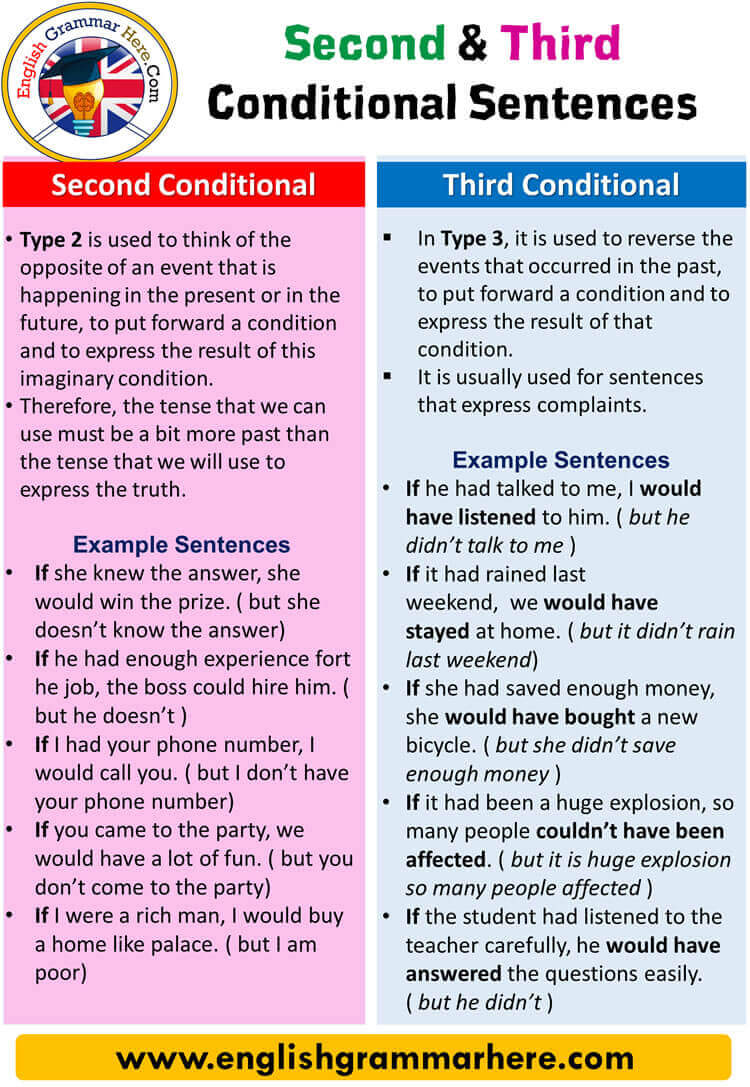
Let's look at them side-by-side:
-
Second Conditional (Unreal Present/Future):
- If I spoke Japanese, I would work in Tokyo.
- (I don't speak Japanese now, so I don't work in Tokyo.)
-
Third Conditional (Unreal Past):
- If I had spoken to him, I would have known about the meeting.
- (I didn't speak to him in the past, so I didn't know.)
Advanced Note: Mixed Conditionals
It's also possible to mix these conditionals. For example, you can have a past condition with a present result: If I had taken that job in London (past), I would be living there now (present). We won't focus on these today, but it's useful to know they exist.
Test your understanding!
Choose between the second and third conditional to complete these sentences.
- I didn't know you were in the hospital. If I _______ (know), I _______ (visit) you.
- If I _______ (have) more money, I _______ (buy) a new laptop. My current one is very old.
- He's late. If he _______ (miss) the bus, he _______ (not arrive) on time for the presentation.
Show answer
- Third Conditional. The situation is in the past. If I had known, I would have visited you.
- Second Conditional. This is a hypothetical present situation. If I had more money, I would buy a new laptop.
- Third Conditional. This is about a past event (missing the bus) that has a past result (not arriving on time). If he had missed the bus, he would not have arrived on time for the presentation.
Conclusion
Great job today! You have now learned the complete set of basic conditional structures. Being able to talk about hypothetical situations in the present and past will add a lot of sophistication to your English, helping you achieve a higher band score in your IELTS exam.
Key Takeaways:
- Second Conditional (
If + past simple, ... would + verb): Used for hypothetical situations in the present or future. - Third Conditional (
If + past perfect, ... would have + past participle): Used for hypothetical situations in the past, often to express regret. - The choice depends on whether you are imagining a different present/future or a different past.
In our next lesson, we will move away from conditionals and learn about another essential structure for academic English: using the passive voice appropriately in academic contexts. This will help you write with a more formal and objective tone.