Hello! Welcome to your next lesson in the "Essential Grammar for Academic English" module.
In our last session, we learned how to use adverbial clauses to express time, reason, and contrast. Today, we'll focus on a very important type of adverbial clause: the conditional clause. Our goal is to apply zero and first conditional structures to describe real and possible situations. Mastering these is crucial for discussing cause and effect in your IELTS Writing and Speaking tests.
Just like the clauses we studied last time, conditional sentences have two parts: the condition (the 'if' clause) and the result (the main clause). The comma rule is also the same: if the 'if' clause comes first, use a comma. If it comes second, no comma is needed.
1. Zero vs. First Conditional: An Overview
We use conditional sentences to talk about the result of a certain condition. The zero and first conditionals are used for real and possible situations, but they have a key difference.
- Zero Conditional: For things that are always true, like scientific facts, general truths, and habits.
- First Conditional: For things that are possible in the future, like predictions, plans, or warnings.

2. The Zero Conditional: Facts and General Truths
We use the zero conditional to talk about results that are certain and always happen if the condition is met. Think of it as "cause and effect" for general rules.
The structure is:
If + Present Simple, ... Present Simple.
Let's watch a video to understand this better.
When To Use ZERO + FIRST Conditional Sentences | Accurate English Grammar
This video from mmmEnglish gives a clear explanation of the zero conditional. Pay attention to how it's used for facts, rules, and habits.
Watch from 02:17 to 05:08. Focus on the structure (present simple in both clauses) and the examples used for facts, rules, and habits.
As the video explained, the result in a zero conditional sentence is a certainty.
- Fact: If you heat water to 100 degrees Celsius, it boils.
- Rule: If a patient has a severe toothache, they need to see a dentist immediately.
- Habit: If I have an exam, I feel nervous.
Notice that in the zero conditional, you can often replace 'if' with 'when' and the meaning stays almost the same, because the condition is sure to lead to the result.
3. The First Conditional: Possible Future Events
We use the first conditional to talk about a specific situation in the future that we believe is real or possible. It's great for making predictions, plans, promises, or giving warnings.
The structure is:
If + Present Simple, ... will + base verb.
Now, let's learn about this structure from the same video.
When To Use ZERO + FIRST Conditional Sentences | Accurate English Grammar
The next part of the mmmEnglish video explains the first conditional. Notice how the conversation shifts from general facts to specific future possibilities.
Watch from 06:25 to 08:35. Pay close attention to the structure and how it's used to talk about predictions and plans.
Here, the result is not a general fact, but a likely outcome in a specific future situation.
- Prediction: If this new treatment is successful, it will help many patients.
- Plan: If I finish studying early tonight, I will watch a movie.
- Warning: If you don't wear your retainer, your teeth will move back to their old position.
4. The Key Difference: General Truth vs. Specific Possibility
Choosing between the zero and first conditional changes the meaning of your sentence. This is the most important concept in today's lesson. One expresses a general truth, while the other gives a warning or prediction about a specific, present situation.
The next clip from the video explains this difference perfectly.
When To Use ZERO + FIRST Conditional Sentences | Accurate English Grammar
This is a crucial section. The presenter uses excellent examples to show how changing from zero to first conditional alters the meaning from a general life lesson to specific advice or a warning.
Watch carefully from 09:12 to 12:20. Focus on the two milk examples and the two 'sun sets' examples. Understand why one is a general fact (zero) and the other is a specific warning (first).
Let's summarize that key point with a new example:
- Zero Conditional: If I drink coffee after 5 PM, I don't sleep well.
- Meaning: This is a general truth about me. It's my habit. Every time I do this, this is the result.
- First Conditional: If I drink this coffee now, I won't sleep well tonight.
- Meaning: I'm talking about a specific situation (this cup of coffee, right now) and its possible result in the future (tonight).
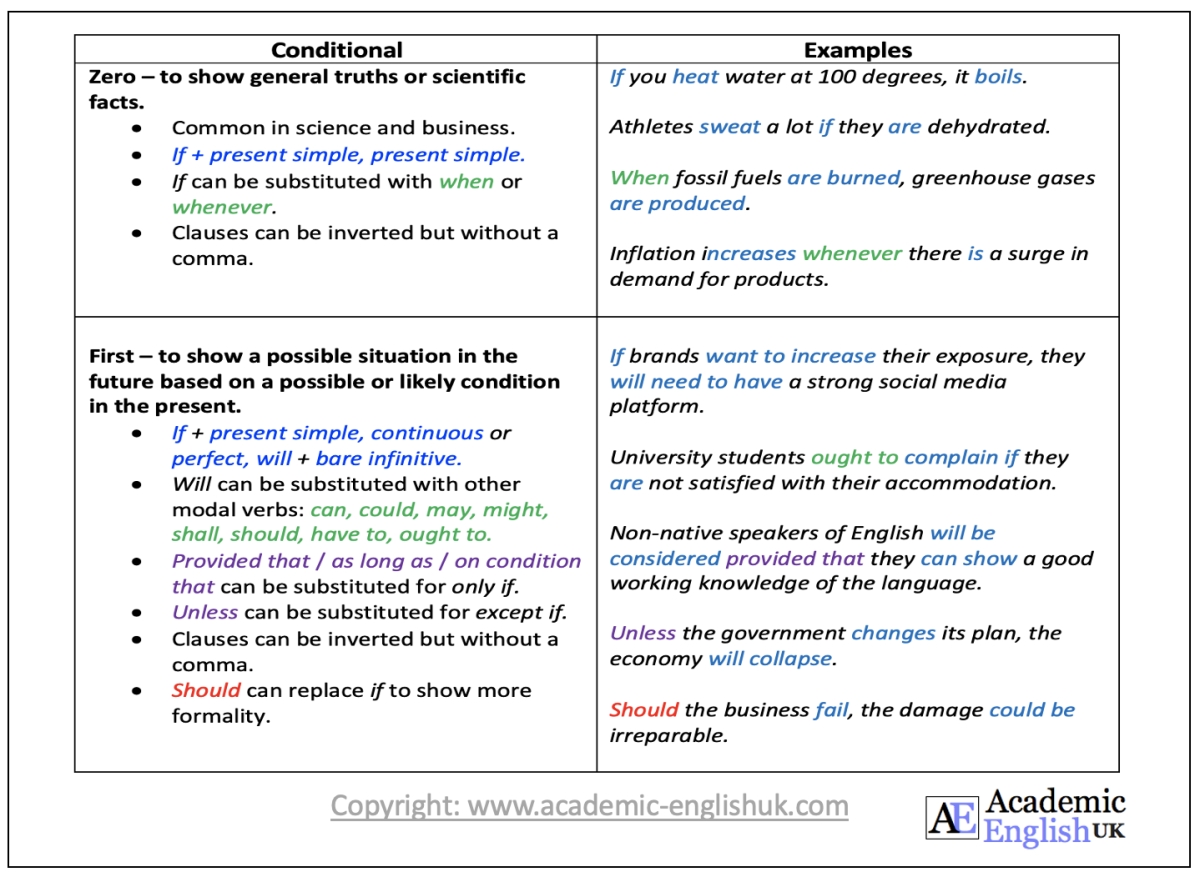
This table provides a great summary of everything we've covered.
Test your understanding!
For each situation, choose whether you should use the zero or first conditional, and then write the sentence.
- You are explaining a basic scientific fact about metals to a friend. (metal / expand / if / you / heat / it)
- You are making plans with a friend for tomorrow. It might rain. (if / it / rain / we / watch / a film at home)
- You are explaining a rule in a library to a new student. (if / you / talk / loudly / the librarian / ask / you to leave)
Show answer
- Zero Conditional. This is a scientific fact that is always true.
- If you heat metal, it expands. (Or: Metal expands if you heat it.)
- First Conditional. This is a possible plan for a specific future situation (tomorrow).
- If it rains, we will watch a film at home.
- Zero Conditional. This is a general rule of the library that is always enforced.
- If you talk loudly, the librarian asks you to leave.
Conclusion
Excellent work today! You have learned how to use two essential conditional structures to discuss real-world situations clearly and accurately. This skill will allow you to express cause-and-effect relationships and discuss future possibilities, both of which are very common in the IELTS exam.
Key Takeaways:
- Zero Conditional (
If + present, ... present): Used for general truths, facts, rules, and habits that are always true. - First Conditional (
If + present, ... will + verb): Used for specific, possible situations in the future, such as plans, predictions, and warnings. - The choice between them depends entirely on your meaning: are you stating a general rule or a specific future possibility?
In our next lesson, we will move from the real and possible to the imaginary. You will learn to apply second and third conditional structures to discuss hypothetical situations in the present and past.