Welcome to your second lesson. In our previous session, we established a framework for evaluating product ideas to ensure they are viable for a home-based business. Now that you have a method for choosing what to sell, our focus shifts to who you're selling to. This step is fundamental to all your future marketing efforts.
Today, you will learn how to develop a detailed target buyer persona for your chosen product. This isn't just about listing demographics; it's about creating a rich, semi-fictional profile of your ideal customer that will serve as your guide for everything from writing product descriptions to targeting social media ads. Your experience in B2B client relations involved understanding the specific needs of institutional clients. A buyer persona is the B2C equivalent of that deep understanding, applied to an entire customer segment rather than a single organization.
1. From Target Audience to Buyer Persona
In marketing, the terms "target audience" and "buyer persona" are often used, but they represent different levels of detail. A target audience is broad, while a buyer persona is specific and personal. Understanding this distinction is the first step toward truly knowing your customer.
Buyer Persona Template: A Guide + Examples For 2026
This article from monday.com provides a very clear breakdown of the difference between a target audience and a buyer persona.
Please read the section titled What’s the difference and pay close attention to the comparison table and the sneaker company example that follows. This will clarify why we need to go deeper than a general audience description.
As you can see, a buyer persona gives a name, a face, and a story to your ideal customer. It transforms a faceless group ("women ages 25-40") into a relatable individual ("Emma, a 32-year-old working mom"). This makes it infinitely easier to make decisions because you can simply ask, "Would Emma find this useful?" or "How would Emma react to this ad?"
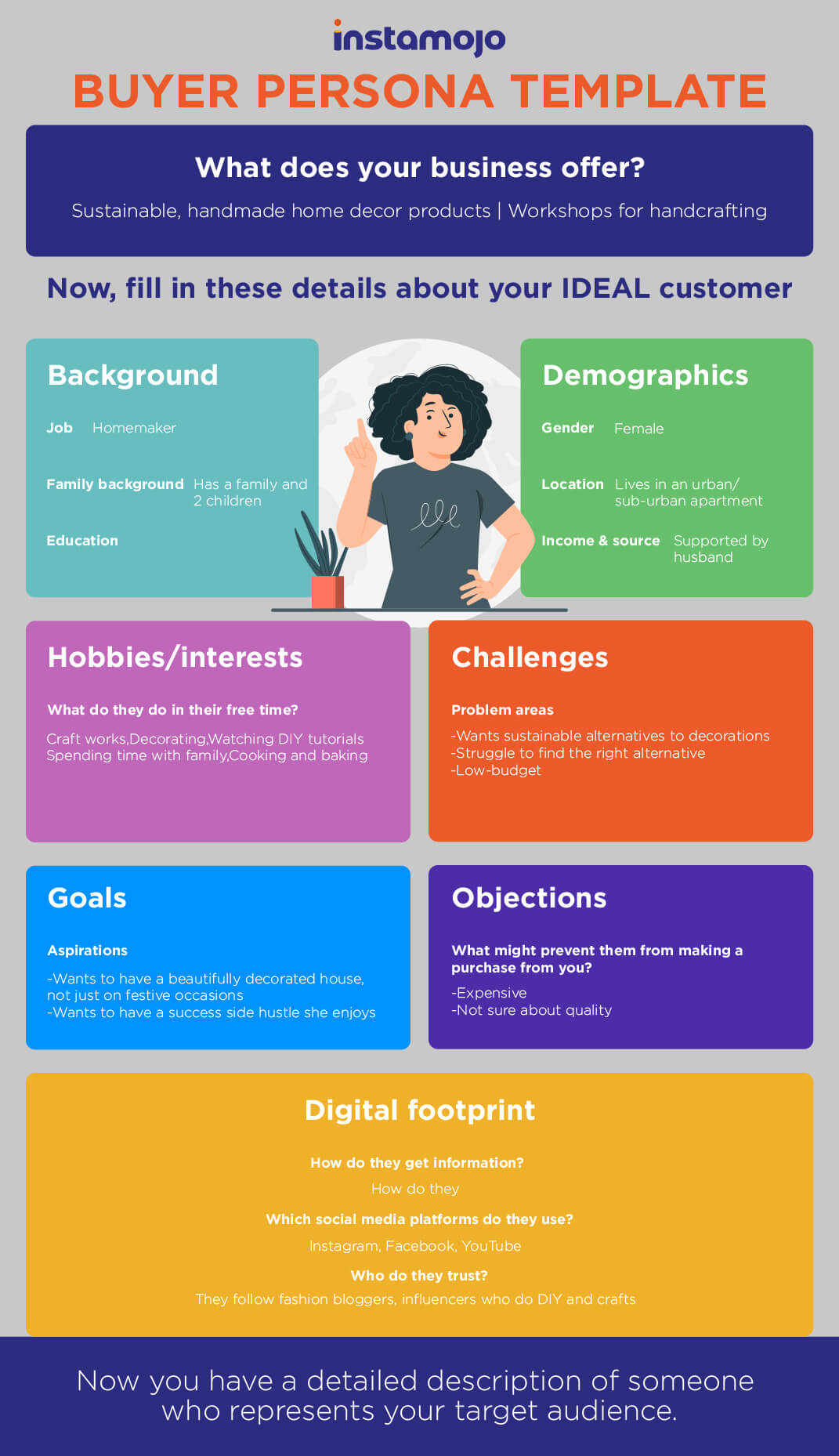
Here is an example of what a detailed buyer persona can look like. It captures not just demographics but also the customer's inner world—their goals, challenges, and motivations.
2. Adapting Your Skills: From B2B to B2C Personas
Your background in B2B business development gives you a significant advantage, as you're already skilled at identifying client needs. However, the focus of a B2C persona is different. In B2B, your persona might be a "Purchasing Manager" whose motivations are tied to company ROI and efficiency. In B2C, your persona is an individual whose motivations are personal, emotional, and rooted in their own life.
The following resource breaks down these key differences.
Buyer Persona Template: A Guide + Examples For 2026
This section of the monday.com article directly compares B2B and B2C personas.
Review the comparison table. Focus on how the Primary focus, Motivations, and Pain points differ between the two. This will help you mentally shift your approach from a corporate to a consumer context.
This transition is key. Instead of focusing on professional objectives like "increasing departmental efficiency," you'll be focusing on personal goals like "finding a sustainable product that makes my home beautiful" or "saving time on my morning routine."
3. How to Build Your Buyer Persona
Creating a persona is a research-driven process. It's about finding real data and insights, not inventing a character from scratch. The "Learn With Shopify" channel has an excellent video that walks through both the data gathering process and the construction of a persona.
How to Build Buyer Personas For Your Online Store That Boost Sales & Conversions
This video provides a practical guide to building and using buyer personas for an online store.
First, watch the segment on building the persona. The presenter uses a fictional company, "Sally's Dog Foods," to create a persona for "Chloe the veterinarian," filling out her demographics, professional traits, problems, and goals. This demonstrates the thought process. Next, watch the section on gathering information. This covers how to find the data for your persona, even if you don't have existing customers. Pay attention to the distinction between using existing data (from analytics) and market research (like surveys and social media).
To summarize the video and provide a clear framework, here are the key steps and components:
Step 1: Gather Data
Even without sales, you can gather valuable data from:
- Competitor Analysis: Read the reviews (both positive and negative) on your competitors' product pages and social media. Who are their customers? What do they love? What do they complain about?
- Social Media & Forums: Find Facebook groups, subreddits, or Instagram hashtags related to your product. Observe the language people use, the questions they ask, and the frustrations they share.
- Surveys & Interviews: If you have an existing network (even friends or family who fit the profile), ask them targeted questions about their habits, goals, and challenges related to your product category.
Step 2: Structure Your Persona
Organize your research into these essential components. A good persona goes far beyond the basics.
How To Create and Use Buyer Personas for Ecommerce
This section from a Shopwired article details the specific elements that make up a comprehensive persona.
Read the subsection Detail the Profiles. It outlines the five key areas to build out: Demographics, Psychographics, Behavioral Patterns, Visual Elements, and Challenges and Goals.
The most crucial elements for your marketing will be the Challenges and Goals (the "pain points") and the Behavioral Patterns (where they get information). These tell you what to say in your marketing and where to say it.
For instance, the "Jake the deal hunter" persona below is very specific to e-commerce. Notice how his pain points (distrusts poor design, frustrated by shipping costs) and motivators (free shipping, easy returns) give you a clear roadmap for how to design your store and structure your offers.

Your Actionable Task
Now it's time to create your first buyer persona. Think about the product you evaluated in the last lesson. Using the simple template below (adapted from the monday.com article), draft a persona for your ideal customer.
Since you don't have real customer data yet, this will be a "proto-persona"—an initial hypothesis based on your research and educated assumptions. The goal is to create a clear, specific character.
Copy and paste this template and fill it out:
- Persona Name: (Give them an alliterative name, e.g., "Sustainable Sarah")
- Photo: (Find a stock photo online that represents them)
- Quote that captures their mindset: (e.g., "I want my home to be a reflection of my values, without sacrificing style.")
- Demographics:
- Age:
- Gender:
- Location: (Urban, suburban, rural)
- Occupation:
- Income Level: (Approximate household income)
- Family Status: (Single, married, kids, etc.)
- Goals: (What are they trying to achieve that relates to your product?)
- 1.
-
- Top 3 Pain Points/Challenges: (What frustrates them in their search for a solution?)
- 1.
-
-
- Behavioral Traits / Information Sources: (How do they research products? Which social media platforms do they use? Who do they trust for recommendations?)
- Common Objections: (What might prevent them from buying your product? e.g., "It's too expensive," "I'm not sure about the quality.")
Spend about 20-30 minutes on this. Don't strive for perfection; aim for a clear and specific first draft. This persona will be a living document that you will refine as you learn more about your customers.
Conclusion
In this lesson, you've learned how to move from a vague "target audience" to a specific, actionable buyer persona. We've distinguished between B2B and B2C personas to help you adapt your existing skills, and we've walked through the process of gathering data and structuring it into a detailed profile. The persona you've just started building is the single most important tool for guiding your marketing strategy.
Key Takeaways:
- A buyer persona is a detailed, semi-fictional representation of your ideal customer, based on data and research.
- Personas help you empathize with your customers, enabling you to tailor your products, messaging, and marketing channels effectively.
- For a B2C business, personas focus on personal goals, lifestyle, and emotional triggers, rather than professional ROI.
- The most critical components of a persona for marketing are their goals, pain points, and information sources.
In our next lesson, we will explore different product sourcing models, such as dropshipping, wholesale, and private labeling. Your buyer persona will be crucial here, as their expectations for price, quality, and shipping speed will heavily influence which sourcing model is the best fit for your business.