Welcome to the first lesson of your course! We're kicking things off by building the most critical foundation for your home-based e-commerce business: choosing the right product. Your goal is to sell physical products online, and this lesson will equip you with a structured way to evaluate any product idea to see if it's truly viable before you invest your time and money.
Today, you will learn how to apply a framework to assess a product's potential for success. We'll move beyond just having a "good idea" and into a more analytical process of gauging market demand, competition, and logistical feasibility. This is the essential first step before you can even think about marketing and selling.
1. The "Why" and "What" of Product Viability
Jumping into a business with an unvetted product idea is one of the quickest ways to lose money and motivation. You could end up with a garage full of products nobody wants (deadstock) or waste your marketing budget trying to sell something that was never destined to succeed. To avoid this, successful entrepreneurs perform a viability analysis.
This analysis is about answering two fundamental questions. To understand them, please read the short definitions in the following article from BigCommerce.
How to Evaluate Market Viability of Product Ideas (Updated for 2021) | BigCommerce
In this article, please focus on the section "What is Market and Product Viability?".
Read the two definitions provided for Market viability and Product viability. These two concepts form the basis of our evaluation.
As you've just read, we need to assess both the market (is there a playing field for you?) and the product (is it the right 'ball' to play with?).
A great mental model for evaluating a home-based business idea is the CENTS framework. It helps ensure your idea makes sense not just as a product, but as a business that can provide you with income and freedom.
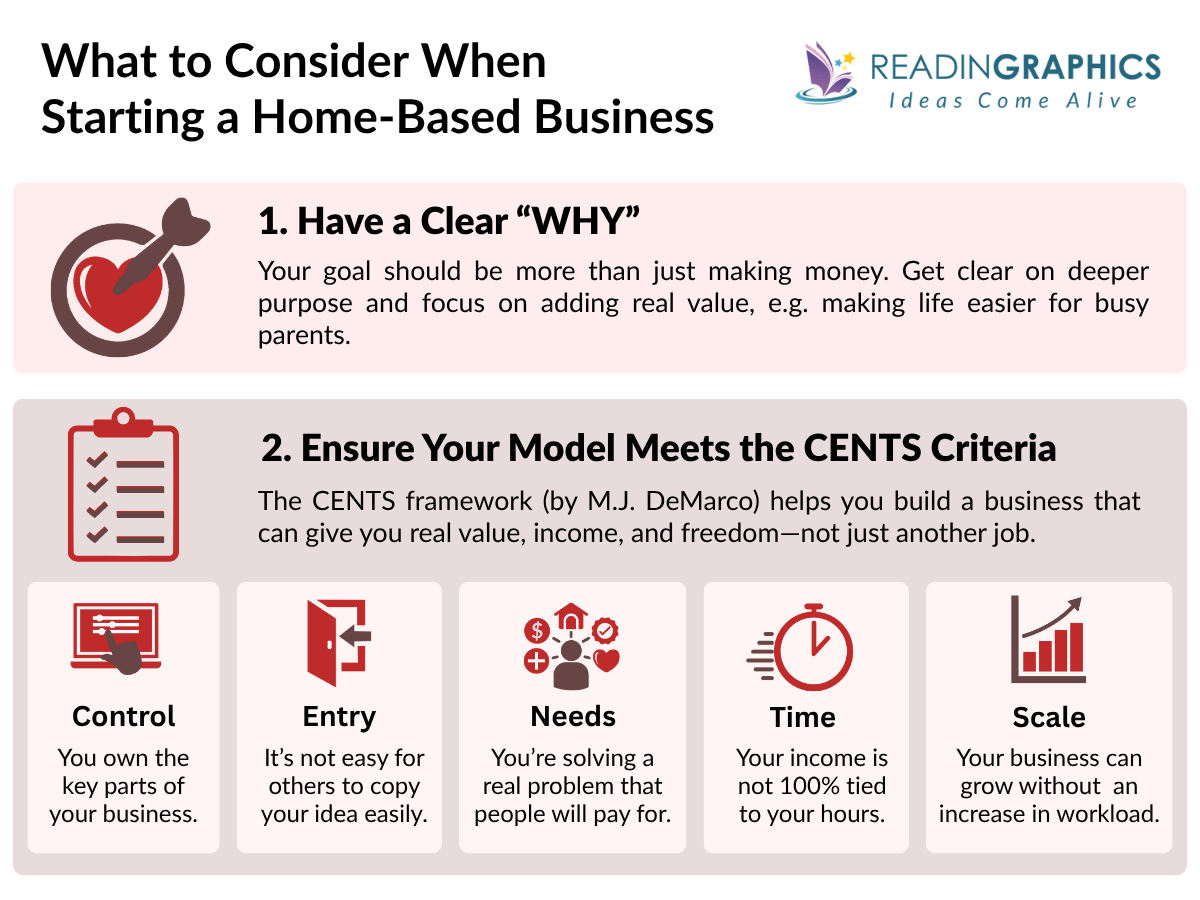
Let's break down what CENTS means for a physical product business:
- Control: You own the key parts of your business. For an e-commerce store, this means you control your brand, your customer list, and your website—assets you don't have if you're only selling on a third-party marketplace.
- Entry: It’s not easy for others to copy your idea. If anyone can find and sell the exact same product from the same supplier with minimal effort, you'll be in a constant price war. The barrier to entry should be reasonably high.
- Needs: You're solving a real problem or serving a genuine passion that people will pay to address. This is the core of demand.
- Time: Your income is not 100% tied to your hours worked. Selling physical products excels here, unlike consulting or freelance services. You can make sales while you sleep.
- Scale: Your business can grow without a proportional increase in your workload. A product that is simple to store, pack, and ship is more scalable for a solopreneur than something large, complex, or customized for every order.
Keep the CENTS framework in mind as we now move to a more detailed, practical checklist for applying these principles.
2. A 16-Question Framework for Product Validation
The Shopify team has created an excellent video that walks through a 16-question framework for validating a product idea. It’s a pragmatic checklist that covers both market and product viability in detail. The video uses a "coconut hair mask" as a running example, which makes the concepts easy to grasp.
Please watch the following segments, which cover the entire framework.
How To Find And Validate WINNING PRODUCTS: The 16 Step Product Research Guide
This video from the "Learn With Shopify" channel provides a step-by-step guide to validating a product idea.
Watch from the introduction of the framework at the market analysis questions. Pay close attention to the tools mentioned, like Google Trends and BuzzSumo, for gauging demand. Then, continue watching as the presenter details the product-based criteria, which cover everything from pricing and markup to durability and seasonality. Finally, watch the summary of the example product's evaluation.
3. Synthesizing the Data: Key Criteria for Your Home Business
The 16-point framework from the video gives you a comprehensive checklist. Now, let's layer in some more specific, strategic advice from other experts that is particularly relevant for a new, home-based solo enterprise.
Pricing, Profit, and Risk
You likely noticed a difference in pricing advice between the resources.
- The Shopify video suggests a $50 - $150 "sweet spot" to encourage online purchases without needing high-touch sales support.
- Another perspective, popular in the dropshipping community, recommends an average product price of $200 or more.
The rationale for the higher price point is straightforward: the time it takes to process an order, handle a customer query, or manage a return is roughly the same whether the product is $20 or $500. A higher price point means a larger gross profit per sale, making each transaction more valuable and helping you reach profitability faster. Given your goal is to build a sustainable business, not just a hobby, aiming for higher-margin products can make your efforts more rewarding.
To manage your initial investment risk, another expert advises keeping your "landed cost" (the total cost to get one unit of your product from the supplier to your door, including shipping) under $5 for your very first product. This allows you to learn the process without a massive financial commitment.
Target Audience: A Strategic Choice
Your background in B2B development has given you experience in understanding the needs of specific, high-value clients. In B2C, a similar principle applies: you don't have to sell to everyone.
One powerful strategy for a small e-commerce business is to target the upper-middle class. The article below explains this approach.
Tips For Choosing The Best and Most Profitable eCommerce Niches
This article from Dropship Lifestyle offers a focused strategy for niche selection.
Start by reading Tip #2 to understand the rationale for targeting a specific demographic. Then, read Tip #3, which discusses a crucial factor for new sellers. Finally, look at the concrete examples provided (stand-up paddleboards and chandeliers) and the recap at the end.
As the article suggests, targeting customers with more disposable income can lead to fewer customer service issues and a smoother sales process. These customers are often more comfortable making larger purchases online and are less likely to dispute small issues.
Competition and Differentiation
The resources consistently highlight the need to avoid highly competitive markets. A key aspect of this is brand loyalty. If you try to sell smartphones, laptops, or high-end headphones, you are competing against giants like Apple, Dell, and Sony. Customers already know which brand they want, and as a new seller, you won't get favorable terms from those brands.
Instead, focus on niches where the brand is less important than the product's features, style, or function—like the chandelier example. Your path to success lies in differentiation. You must offer something your competitors don't.
A powerful and simple way to discover differentiation opportunities is to read your potential competitors' negative reviews.
How to Pick the Perfect Product to Sell on Amazon FBA | Private Label
This video focuses on Amazon FBA, but its advice on differentiation is universally applicable.
Watch the segment from differentiating your products. The speaker explains why you must set your product apart and offers a brilliant, practical tip on how to use competitor reviews to find ideas for improvement.
Logistics: Keep it Simple
Finally, always remember the realities of running a business from home. For your first product, it's wise to avoid items that introduce logistical headaches. The ideal product is:
- Small and lightweight: This keeps shipping costs low for both you and your customer.
- Durable: Avoid fragile items (like glass) that can break in transit, leading to losses and unhappy customers.
- Not Perishable: Food or certain cosmetics come with an expiry date, creating a risk of spoilage and lost inventory.
- Not Seasonal: An "evergreen" product that has stable, year-round demand provides a more predictable cash flow than one that only sells for a few months of the year.
Your Actionable Task
To solidify your understanding, create a simple evaluation checklist. Think of a product you might be interested in selling (it can be purely hypothetical). Use your checklist to do a quick, initial viability assessment. Your checklist should answer these key questions:
- Need: What problem does it solve or passion does it serve? (CENTS)
- Market Demand: Is there evidence people are searching for it? (Use Google Trends)
- Competition: Who are the main competitors? Is there strong brand loyalty in this niche? (CENTS: Entry)
- Target Audience: Who is the ideal customer? Do they have disposable income?
- Price & Profit: What is a realistic selling price? Aim for a range between $50 and $700. Can you source it for a low initial cost?
- Logistics: Is it small, lightweight, durable, and not seasonal? (CENTS: Scale)
- Differentiation: How could you make your product better than the competition? (e.g., bundle, better material, new feature).
Jot down a few bullet points for each question. This exercise will help you internalize the evaluation process.
Conclusion
In this lesson, you've learned that a successful product is born from careful evaluation, not just a flash of inspiration. We've established the importance of assessing both market and product viability and introduced the CENTS framework as a guiding model for a home-based business. You now have a practical, multi-point checklist to systematically analyze any product idea, focusing on critical factors like pricing, target audience, competition, and logistics.
Key Takeaways:
- Always validate a product idea before investing to minimize financial risk.
- A viable business idea satisfies the CENTS framework: Control, Entry, Needs, Time, and Scale.
- Ideal products for a new home business often have a higher price point (e.g., $50+), target customers with disposable income, exist in niches with low brand loyalty, and are simple to manage logistically.
- Differentiation is not optional; you must find a way to stand out from the competition.
In our next lesson, we will build directly on this foundation. Once you have a potentially viable product category, the next step is to get laser-focused on your ideal customer. You will learn how to develop a detailed target buyer persona, a tool that will guide all your future marketing and sales decisions.