Last lesson established how to interpret the outcomes you can see in Insights: reach, watch time, saves, shares, clicks, and conversions. This lesson explains the other side of that relationship: how Instagram decides which people may see a post, where it may appear, and which observed behaviours are likely to influence later distribution.
The essential correction is that Instagram does not have one master “algorithm.” It operates several recommendation and ranking systems, designed for different user situations. Feed is largely about keeping up with chosen accounts; Explore is built for discovery; Reels is discovery with a strong entertainment focus.
By the end of this lesson, you should be able to explain Instagram’s distribution process clearly in an interview without resorting to myths such as “the algorithm tests every post with followers first” or “likes are all that matter.”
1. The core model: select, predict, rank, learn
Instagram cannot carefully compare every possible post against every user whenever someone opens the app. There are far too many possible combinations, and people expect their Feed or Reels feed to load almost immediately.
Instead, recommendation systems work as a funnel:
- Candidate selection: gather a manageable set of posts that might be relevant to this particular viewer.
- Signals: inspect available information about the viewer, post, creator, and context.
- Predicted actions: estimate what the viewer is likely to do with each candidate.
- Ranking: assign candidates a relevance or value score, then order them.
- Feedback: use actual behaviour—watching, skipping, saving, sharing, and so on—to improve future personalization and model training.
A useful shorthand is:
This is not a simple rule such as “more likes equals more reach.” It is a personalized prediction problem: Which item is this person most likely to find valuable right now, in this part of the app?
Instagram Ranking Explained | Instagram Blog
Read “Instagram Ranking Explained” from the Instagram Blog, by Adam Mosseri. This is the core official explanation of why Feed, Explore, and Reels use different ranking systems—and which actions and signals matter in each.
Start with the opening section, “Ranking on Instagram.” Read the explanation of multiple systems to establish why there is no single Instagram algorithm. Then read “How we rank Feed,” from the Feed process. Focus on the distinction between signals and predictions. Continue with “How we rank Explore.” Read the Explore explanation, paying close attention to why post popularity and the speed of interactions matter more here than in Feed. Finally, read “How we rank Reels,” from the Reels section. Notice the predicted actions Instagram emphasizes: reshares, completion, likes, and visits to the audio page.
Signals are inputs; predictions are the model’s outputs
This distinction is central and useful in an interview.
A ranking signal is information the system can use as evidence. It may concern:
- The viewer: accounts they follow, posts they previously watched, topics they saved, formats they usually engage with.
- The viewer–creator relationship: whether they have interacted with the creator recently, commented on one another’s posts, or exchanged messages.
- The content: recency, format, audio, visual features, location, and observed popularity.
- The creator: recent engagement with that creator or broader indicators of audience interest.
- Context and integrity: whether the content is eligible for recommendation, whether it is repetitive, and whether the resulting experience would lack variety.
A prediction is the system’s estimate of a future action. For example:
- How likely is this viewer to spend several seconds on this Feed post?
- How likely are they to share it in a direct message?
- How likely are they to save it?
- How likely are they to complete this Reel?
- How likely are they to skip it?
Conceptually, the system may estimate probabilities such as:
Those predictions can be combined into a ranking value. The actual formula and weights are proprietary and change over time, but the idea looks roughly like this:
The weights are not publicly fixed. More importantly, they differ by surface. A prediction of Reel completion is naturally more relevant in the Reels feed than in a photo-heavy Feed experience.
Interview-safe phrasing: “Instagram uses signals about the viewer, the post, and the viewer’s relationship with the creator to predict likely actions. It then ranks candidates according to estimated value for that person and surface. The exact weights are not public and should not be treated as fixed rules.”
2. Candidate selection: being considered is not the same as ranking first
Before a post can rank highly, it must first enter the candidate set: the collection of items the system is willing to consider for a particular viewer.
Think of candidate selection as building a shortlist before conducting interviews. A post that is absent from the shortlist cannot win the top position, regardless of its theoretical quality.
For a viewer opening Instagram, candidate sources might include:
- Recent posts from accounts they follow.
- Content similar to posts they have liked, shared, saved, or watched.
- Content associated with topics or formats they engage with.
- Recommended content from accounts they do not follow.
- Popular or promising content that appears relevant to their recent or longer-term interests.
The precise sources differ by product surface. Feed includes much more followed-account content, while Explore and Reels lean heavily toward content from people the viewer does not follow.
Read Meta Transparency’s “Instagram Feed AI System” overview for a concrete four-step description of candidate gathering, signal use, prediction, and final ranking. The exact implementation can change, but this gives you a reliable technical mental model.
In “Overview of Instagram Feed,” begin with the system overview. Then follow the numbered process from candidate gathering through final ranking. Focus on the distinction between the system first narrowing the pool and later calculating a more detailed relevance score. Do not treat the specific candidate counts in this description as permanent public rules; they illustrate why large-scale systems rank in stages.
Why ranking happens in stages
A large recommendation system must balance two competing needs:
- Speed: the user should not wait for recommendations.
- Precision: the best content should not be buried among thousands of weak matches.
The system therefore begins with faster, broader filtering and applies more costly, detailed evaluation only to a much smaller set of candidates.
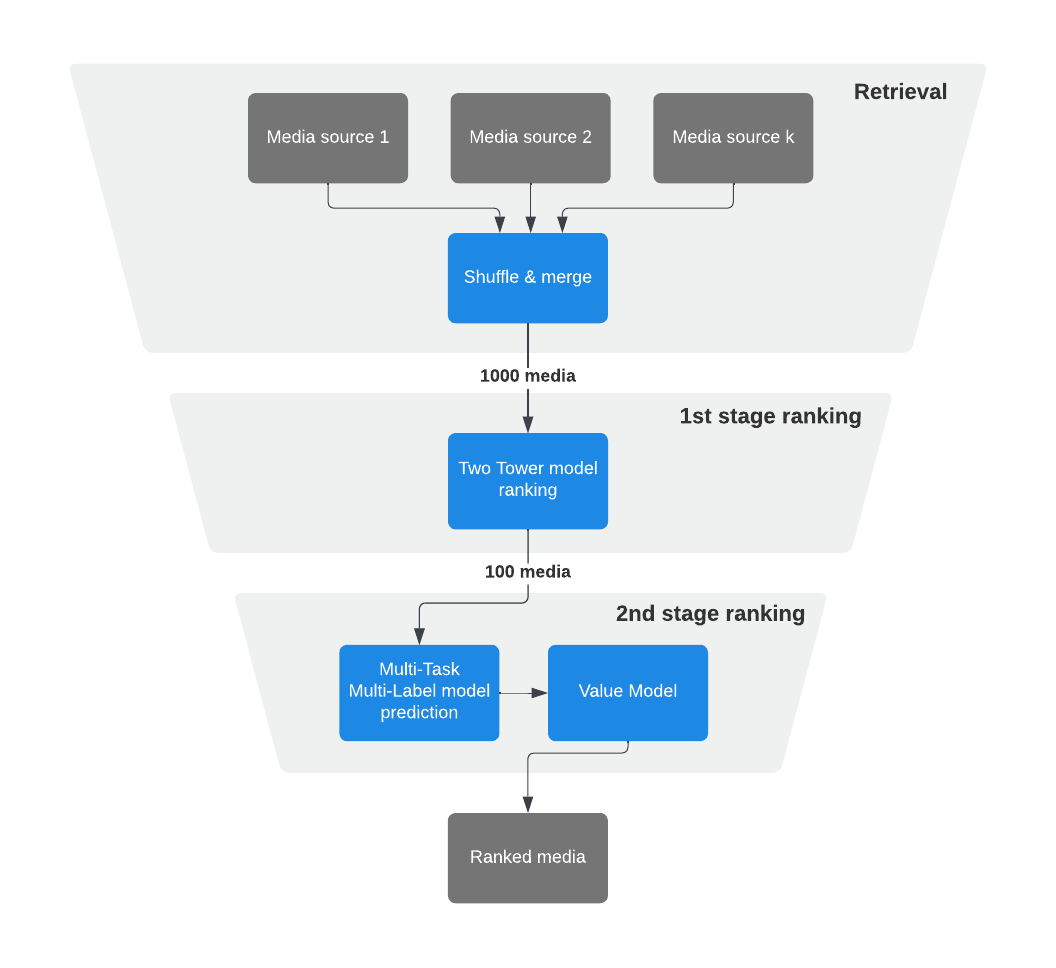
The Explore ranking flowchart shows this staged logic:
| Stage | Plain-English question | Why it exists |
|---|---|---|
| Retrieval | “Which few thousand items might this person plausibly like?” | Avoids comparing every user with every post on Instagram |
| First-stage ranking | “Which smaller group is promising enough for detailed analysis?” | Removes weak candidates quickly |
| Second-stage ranking | “What actions is this viewer likely to take on each remaining item?” | Makes more precise multi-action predictions |
| Value model / final ranking | “How should we combine these action predictions into an order?” | Produces a final sequence aligned with product goals |
| Re-ranking and safeguards | “Is this final list safe, varied, and not overly repetitive?” | Prevents a feed from becoming repetitive or recommending problematic content |
The model names in the diagram—such as “two-tower model” or “multi-task model”—are not the key interview point for a social-media strategist. What matters is understanding the product logic:
- Broad retrieval seeks relevance efficiently.
- Later stages estimate several possible behaviours, not just likes.
- Final ordering must reflect user value, variety, and integrity, not only raw engagement.
Lessons from Instagram's Cutting-Edge Explore Recommendation System | Retrieval to Reranking | Meta
Watch “Lessons from Instagram’s Cutting-Edge Explore Recommendation System | Retrieval to Reranking” from DataTrek for a technical visual explanation of why large recommendation systems narrow candidates in stages. You do not need to memorize neural-network terminology; focus on the purpose of each stage.
Watch the pipeline overview to connect the flowchart to the sequence retrieval, first-stage ranking, second-stage ranking, and re-ranking. Then watch the ranking stages. Focus on the trade-off: early ranking must be fast because it processes many candidates, while later ranking can be more detailed because only a smaller number of posts remain.
A valuable nuance: the specific Explore architecture in the diagram should not be presented as a complete explanation of every Feed or Reels decision. It illustrates a general recommendation-system pattern. Instagram’s public explanations describe each surface separately because the goals and predicted actions differ.
3. Feed: personalized catch-up, relationships, and relevance
The main Feed is a personalized home base. Its candidate set includes recent content from accounts a person follows, along with recommended content from accounts they may enjoy and advertising.
The important point is that Feed is not purely chronological and not purely follower-based. It balances:
- Content from people a user deliberately follows.
- Recommendations from accounts they do not follow.
- Different formats: photos, carousels, and videos.
- A varied experience rather than repeated posts from the same account.
Key Feed signals
According to Instagram’s explanation, important Feed signals include:
-
Viewer activity
What the viewer has recently liked, shared, saved, or commented on. -
Information about the post
Its recency, content characteristics, and observed popularity—including how quickly people interact with it. -
Information about the creator
Signals that help estimate whether this creator may be interesting to the viewer. -
Viewer–creator interaction history
Whether the viewer has previously interacted with that creator.
Feed predicts actions such as whether a person will:
- Spend time on a post.
- Like it.
- Comment on it.
- Share it.
- Tap the creator’s profile.
The relationship component is particularly important for accounts trying to serve existing followers. If a person regularly interacts with a creator, Instagram has stronger evidence that the creator’s next post may be relevant to them.
That does not mean every follower receives every post, and it does not mean direct messages are a magic ranking tactic. It means repeated, genuine interaction provides evidence of a relationship and audience relevance.
4. Explore: discovery driven by personalized relevance and post momentum
Explore is designed to introduce viewers to content and creators they do not already follow. Its grid is therefore dominated by recommendations.
Because the user did not choose to follow these accounts, Instagram needs stronger evidence that the content may be worthwhile. It builds candidates from the viewer’s past activity: posts they have liked, commented on, saved, or shared.
What differs in Explore?
Explore places relatively greater importance on post-level popularity signals:
- How many people interact with a post.
- How rapidly those interactions accumulate.
- Whether interactions include actions such as saves and shares.
- Whether the post appears relevant to the viewer’s previous activity in Explore.
This explains why a post can receive discovery reach despite coming from a small account. The system does not only ask, “Is this creator famous?” It can also ask, “Does this post appear compelling to people with interests similar to this viewer?”
However, avoid overstating this. Fast engagement is a useful signal, not a publicly known trigger that guarantees virality. A post may gain early interactions for many reasons: existing audience composition, timing, collaboration, paid distribution, topic demand, or content quality. Instagram’s system still personalizes the decision viewer by viewer.
Explore’s key predicted actions
Instagram has publicly highlighted predictions such as:
- Likelihood of a like.
- Likelihood of a save.
- Likelihood of a share.
For strategy, this makes saves and shares particularly meaningful. They often indicate more than momentary approval:
- A save can imply lasting utility or future intent.
- A share can imply social relevance, identity expression, usefulness, or a desire to start a conversation.
They are still not proof of why distribution happened. They are evidence consistent with a post being valuable to viewers.
5. Reels: entertainment, attention, and re-sharing
The Reels feed is also primarily a discovery environment: much of what a person sees comes from accounts they do not follow. Its goal is strongly tied to entertainment and continued viewing.
Instagram has described key Reels predictions as the likelihood that a user will:
- Reshare a Reel.
- Watch it all the way through.
- Like it.
- Visit the audio page, which can indicate inspiration to create or explore further.
That is why the metrics from the previous lesson matter so much for Reels:
| Insight metric | What it may reflect in a Reels context |
|---|---|
| Average watch time | How much attention the Reel held on average |
| Retention curve | Whether viewers remained interested through different moments |
| Completion rate | Whether viewers reached the end |
| Shares | Whether viewers considered it worth sending to someone else |
| Saves | Whether it had useful or repeatable value |
| Follows from Reel | Whether discovery led to audience growth |
Reels signals also include the viewer’s recent Reel activity, past interaction with the creator, visual and audio information, and broader popularity indicators.
Instagram also applies recommendation eligibility and integrity considerations. The official explanation notes that certain Reels may be less visible in recommendations—for example, low-resolution content, externally watermarked content, muted content, bordered content, text-dominated Reels, or content that has already been posted on Instagram.
This should be described carefully in an interview:
“Recommendation eligibility is a separate layer from content quality. A Reel may have a strong idea but still be a weaker candidate for recommendations if its format or integrity characteristics make it less suitable for the Reels experience.”
6. One framework, three different surfaces
Here is the comparison worth remembering.
| Surface | Main user intent | Typical candidate emphasis | Important predicted actions | Especially useful strategic focus |
|---|---|---|---|---|
| Feed | Catch up with people and interests | Followed accounts plus recommendations | Time spent, likes, comments, shares, profile visits | Audience relevance, relationships, consistency |
| Explore | Discover new content and creators | Mostly accounts not followed, matched to prior activity | Likes, saves, shares | Useful, distinctive, shareable content with broad relevance |
| Reels | Be entertained and discover | Mostly accounts not followed, matched to entertainment interests | Reshares, completion, likes, audio-page visits | Strong opening, sustained payoff, attention and re-share value |
The common structure is the same: candidates, signals, predictions, ranking. What changes is the user intent and therefore the model’s definition of likely value.
7. Feedback loops: how behaviour changes later distribution
A feedback loop occurs when the output of a system creates new input for future decisions.
On Instagram, user behaviour generates feedback at several levels.
1. The individual-personalization loop
Imagine that a viewer repeatedly watches, saves, and shares short tutorials about home-office setup.
Instagram can use those interactions as evidence that this viewer may value similar content. Later candidate selection and ranking may include more workspace, productivity, or design-related posts.
This is why a person’s Explore and Reels feeds can look radically different from someone else’s.
2. The post-popularity loop
A post’s observed interactions can become signals about the post itself. On discovery surfaces, growing saves, shares, comments, and viewing behaviour may make the post look more promising for additional viewers with similar interests.
But use cautious language:
- It is reasonable to say that early positive behaviour may support further distribution.
- It is not justified to say that Instagram always sends a post to a fixed “test group,” then automatically unlocks wider reach after a known engagement threshold.
- Public information does not reveal a universal test-group size, score, or threshold.
This distinction is important for diagnosing performance. A Reel with weak early retention may have less evidence that it will satisfy similar viewers; a Reel with strong retention and re-sharing may have more evidence. Neither observation alone proves the full cause of distribution.
3. The model-improvement loop
Recommendation models can also be updated using large volumes of behaviour data. If users consistently skip a format or engage deeply with another, the system can learn patterns that improve future predictions.
This does not mean every action instantly retrains Instagram’s entire system. It is more accurate to say that current behaviour informs personalization, while aggregated historical behaviour can inform model development and updates over time.
4. The creator-strategy loop
There is also a human feedback loop:
This is the loop a social-media strategist should manage. Your job is not to “beat the algorithm.” It is to make evidence-based decisions about audience fit, packaging, format, and content value.
For example:
“The Reel had strong non-follower reach but weak retention after the first few seconds. This suggests the topic or packaging earned an initial view, but the opening may not have delivered the expected payoff. I would keep the topic constant and test two more direct hooks, then compare early retention, completion, shares, and saves.”
That is much stronger than saying, “Instagram shadow-banned the post.”
8. What metrics can—and cannot—tell you about ranking
Your Insights metrics are valuable, but they are not a direct window into Instagram’s internal score.
| What you can observe | What you can reasonably infer | What you should not claim |
|---|---|---|
| High completion and average watch time | The Reel held attention relatively well | Completion alone caused distribution |
| High saves and shares | Viewers found content useful, referable, or socially relevant | Saves automatically trigger Explore reach |
| Strong non-follower reach | The content was distributed beyond the current audience | One exact signal caused discovery |
| Low Feed reach among followers | The post was not shown to or acted on by as many followers as expected | The account was definitely penalized |
| Sudden reach drop | Distribution, relevance, competitive content, timing, eligibility, or audience conditions may have changed | “Shadow banning” is the only explanation |
A professional diagnosis separates observation, hypothesis, and test:
- Observation: Reels A and B had similar reach, but A retained viewers longer and generated more shares.
- Hypothesis: A’s opening and practical payoff may have been clearer for the target audience.
- Test: Reuse B’s topic with A’s hook structure while keeping video length and call to action similar.
An interview-ready explanation
If asked, “How does Instagram decide what content to distribute?” you can answer:
“Instagram does not use one universal algorithm. Feed, Explore, and Reels have different ranking systems because users have different intentions in each space. The system first retrieves candidate posts that may be relevant to a particular viewer, then uses signals about the viewer’s activity, the content, the creator, and their relationship to predict actions such as watching, saving, sharing, commenting, or visiting a profile. It combines those predictions into a ranking order, while also applying diversity, integrity, and recommendation-eligibility considerations. Actual user behaviour then becomes feedback that can shape future personalization and model improvement. For a strategist, the practical implication is to optimize for genuine audience value and objective-aligned behaviours, rather than chase a supposed universal algorithm hack.”
Key takeaways
- Instagram uses multiple ranking systems, not one algorithm.
- Candidate selection creates a shortlist of content that may fit a specific viewer; it is distinct from final ranking.
- Signals are input data about viewers, posts, creators, relationships, and context.
- Predicted actions—such as watching, sharing, saving, or completing a Reel—are model estimates that inform ranking.
- Feed prioritizes personalized catch-up and relationships; Explore prioritizes discovery and post-level relevance; Reels prioritizes entertaining, watchable, re-shareable video.
- User behaviour creates feedback loops, but no public evidence supports a universal fixed “test group” or engagement threshold.
- Analytics supports careful hypotheses and experiments; it does not reveal a single hidden cause of performance.
Next, you will use the metrics and distribution logic from these first two lessons to compare two posts properly: selecting objective-aligned evidence, identifying plausible reasons for a performance difference, and proposing a test rather than making unsupported causal claims.