Welcome to the third lesson in our module on the Foundations of Indian Labour Law. In our last session, we created a clear mental map, classifying the numerous labour laws into logical categories and highlighting the new, consolidated structure of the four Labour Codes. We also established that because labour is a concurrent subject, compliance involves navigating both Central Acts and State Rules.
You now have a framework for organising the laws. The next logical and crucial question for any HR professional is: "Which of these laws actually apply to my company?" This lesson will equip you to answer that question precisely. We will move from theory to practice, exploring the specific triggers that make a law applicable to an establishment. By the end of this lesson, you will be able to determine which major labour laws apply to any given company by analysing its industry, employee count, and the wage levels of its staff.
The Myth of Exemption: When Do Laws Apply?
A common misconception among small businesses and startups is that they are "too small" to be covered by labour laws. This is a dangerous assumption. The reality is that almost every business, regardless of size, is subject to some form of labour legislation from day one. The critical law that establishes this baseline is the Code on Wages, 2019.
Your salary will reduce? New Labour Codes
This video from Labour Law Advisor, though created before the final implementation dates, effectively communicates the broad impact of the new codes.
Watch the introductory segment from the beginning to the end. The speaker emphasizes that the new codes will affect everyone, from IT employees to factory workers, which underscores the universal nature of some of these new laws.
As the video highlights, the scope is vast. The Code on Wages, which governs minimum wage, timely payment, and equal remuneration, applies to all establishments and all employees, regardless of their role or salary. This is your first and most important rule of applicability: every employer in India has obligations under the Code on Wages.
The more nuanced question is which additional laws, particularly those related to social security, working conditions, and industrial relations, apply as your company grows and changes. Applicability is not a static checkbox but a dynamic status that evolves with the business. The key triggers for these additional laws fall into three main categories:
- Employee Headcount: The number of people you employ.
- Nature of Establishment: The type of industry you operate in (e.g., factory, office, construction site).
- Wage and Role of the Employee: An individual's monthly salary and job function.
Let's break down each of these triggers.
Trigger 1: The Headcount Threshold
This is the most straightforward and common trigger for labour law applicability. As a company's workforce grows, it crosses specific numerical thresholds that activate new legal obligations. Think of it as levelling up in a game, where each new level brings a new set of rules.
Here is a summary of the most critical headcount thresholds under the new Labour Codes:
-
10+ Employees:
- Employees' State Insurance (ESI): The Code on Social Security mandates ESI registration for establishments with 10 or more employees. It provides medical, sickness, and other benefits to employees earning up to a certain wage ceiling.
- Occupational Safety, Health and Working Conditions (OSH) Code: General provisions and registration requirements under the OSH Code kick in for non-factory, non-mine establishments.
- Inter-State Migrant Workers: Special provisions under the OSH code apply to establishments employing 10 or more inter-state migrant workers.
-
20+ Employees:
- Employees' Provident Fund (EPF): The Social Security Code requires establishments with 20 or more employees to register for EPF, a mandatory retirement savings scheme.
- Grievance Redressal Committee (GRC): The Industrial Relations Code requires every establishment with 20 or more workers to set up a GRC to resolve individual disputes.
-
50+ Employees:
- Crèche Facility: The Social Security Code and the OSH Code mandate that any establishment with 50 or more employees must provide a crèche facility.
- Contract Labour: Provisions under the OSH Code for regulating contract labour apply to establishments that engage 50 or more contract workers.
-
100+ Employees:
- Works Committee: The Industrial Relations Code may require establishments with 100 or more workers to constitute a Works Committee to promote harmonious employer-worker relations.
- Canteen: The OSH Code mandates a canteen in establishments with over 100 workers.
-
300+ Employees:
- Standing Orders: The Industrial Relations Code requires industrial establishments with 300 or more workers to have certified Standing Orders, which are formal rules of employment.
- Government Permission for Layoff/Retrenchment/Closure: The IR Code requires prior government permission for these actions in industrial establishments with 300 or more workers.
New Labour Code Compliance Checklist India 2026 | HR Guide
The LawSikho blog provides a very clear, practical guide on how these thresholds affect smaller businesses.
Read the sections titled Minimum Viable Compliance. This part directly addresses how startups and MSMEs should track their growth against the 10, 20, and 300 employee thresholds. Also, pay close attention to the FAQ answer for the question Do the new labour codes apply to startups?
Trigger 2: The Nature of the Establishment
The second major trigger is the type of work your company does. While an IT services firm and a textile manufacturing plant might both have 100 employees, they will be subject to different sets of rules because of their operational nature.
Factories: The OSH Code has specific, stringent rules for "factories." The definition has been expanded:
- Premises with 20 or more workers using power for manufacturing.
- Premises with 40 or more workers manufacturing without power.
This change brings many smaller manufacturing units under the ambit of factory regulations for the first time.
Scheduled Employments: Some laws are triggered not just by numbers but by being in a specific, government-notified industry. A perfect example is the revision of minimum wages.
BIG Minimum Wage Update 2026 | Govt VDA Order Explained | New Daily Wages in 7 Sectors
This video by Judicial Yogi provides an excellent real-world example of industry-specific applicability. It dissects a government order that revised minimum wages for specific sectors.
Watch the segment from this timestamp. The speaker clearly lists the seven "scheduled employments" covered by the new minimum wage order: agriculture, mining, construction, loading/unloading, sweeping/cleaning, security, and stone mines. This demonstrates that for certain regulations, you first have to check if your industry is on the list.
Shops and Commercial Establishments: This is a broad, catch-all category that covers most other businesses like offices, retail stores, restaurants, and IT firms. Each state has its own Shops and Establishments Act, which regulates working hours, holidays, and other conditions of service. This is a prime example of the state-level rules we discussed in the previous lesson.
Gig and Platform Work: The new Social Security Code introduces the concepts of "gig worker," "platform worker," and "aggregator." For the first time, companies like ride-hailing services and food delivery platforms (aggregators) have a legal obligation to contribute to a social security fund for their workers. This is a new and evolving area of applicability.
Trigger 3: The Employee's Wage and Role
Finally, even within an establishment where a law applies, it may not apply to every single employee. Applicability can be further filtered by an individual's salary and their role.
Wage Ceilings:
- ESI: Benefits under the ESI scheme are available only to employees whose monthly wages are below a certain threshold, which is currently ₹21,000 per month. An employee earning ₹25,000 in a company covered by ESI would not be included in the scheme.
- Statutory Bonus: The Payment of Bonus Act (now subsumed under the Code on Wages) has eligibility criteria based on an employee's salary.
Role: Worker vs. Employee
This is a critical distinction for an HR professional. The new codes, particularly the OSH and Industrial Relations codes, differentiate between an "employee" and a "worker".
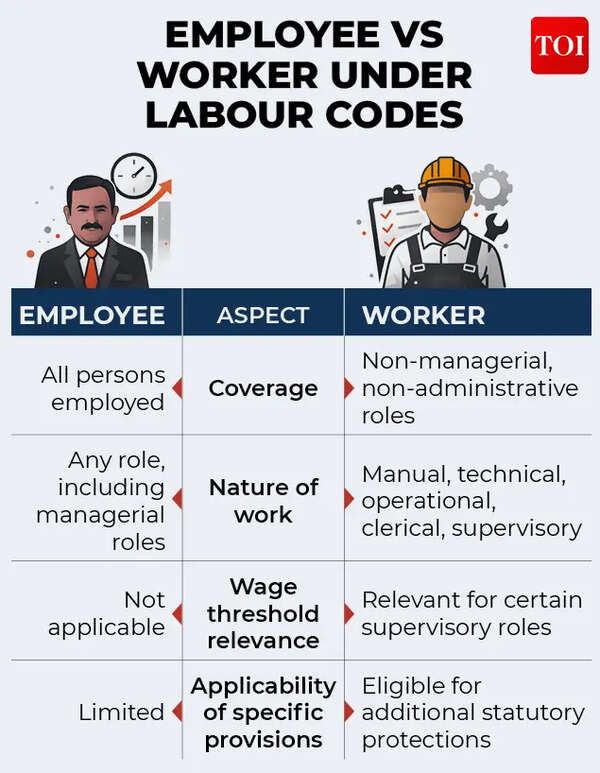
- Employee: This is a broad term covering everyone employed for wages, including those in managerial, administrative, or supervisory roles.
- Worker: This is a more specific term. It generally excludes people in managerial and administrative roles. It also often excludes supervisors earning above a certain threshold (e.g., ₹18,000 per month under the OSH Code).
Why does this matter? Certain key protections, such as regulations on working hours, overtime pay, and annual leave, are granted specifically to "workers," not to all "employees." A senior manager is an employee but not a worker, and thus would typically not be eligible for statutory overtime pay.
Your Practical Applicability Checklist
To bring this all together, here is a simple step-by-step process you can use to assess which laws apply to your organization:
- Start with Universal Laws: Assume the Code on Wages applies. You must pay minimum wages and ensure equal pay for equal work.
- Count Your Heads: What is your total employee count?
- Fewer than 10? You have fewer social security obligations for now.
- 10 or more? ESI is now on your radar.
- 20 or more? EPF is now a requirement.
- Continue checking against the other headcount thresholds (50, 100, 300).
- Define Your Business: What is your industry?
- Are you a "factory" under the new definition (20+/40+ workers)? If so, specific OSH rules apply.
- Are you in construction, mining, or another "scheduled employment"? Look for sector-specific rules.
- If not, you likely fall under your state's Shops and Establishments Act.
- Segment Your Workforce: Look at your employees individually.
- Who earns less than ₹21,000/month? They are likely eligible for ESI.
- Who is a "worker" versus a managerial "employee"? This determines eligibility for overtime and other specific working condition benefits.
To see all these thresholds in one place from an official source, it is useful to review the primary legal text.
[PDF] Compliance Handbook for Employers Under the Four Labour Codes ...
This Compliance Handbook from the Ministry of Labour contains the schedules from the codes themselves. The First Schedule of the Code on Social Security is a master list of applicability thresholds.
Please review Annexure 5, which reproduces The First Schedule of the Code on Social Security, 2020. This table officially lays out the applicability criteria for EPF, ESI, Gratuity, and Maternity Benefit based on establishment type and employee count.
Conclusion
In this lesson, we've transformed the abstract classification of laws into a practical tool for compliance. You have learned that determining applicability is a multi-step process, not a simple yes/no question.
Here are the key takeaways:
- No company is exempt: The Code on Wages applies to everyone.
- Applicability is triggered by three main factors: Employee headcount, the nature of the industry, and individual employee wage/role.
- Key Headcount Thresholds: Memorize the critical numbers: 10 for ESI, 20 for EPF, 50 for crèche, and 300 for Standing Orders.
- Worker vs. Employee: Understanding this distinction is vital for correctly applying rules on working hours, overtime, and leave.
You now possess the foundational knowledge to perform a basic compliance check on any organization.
This lesson concludes our first module on the foundations of labour law. In our next module, "Laws on Wages and Remuneration," we will begin our deep dive into the specifics of the laws themselves. Our first lesson will focus on the legacy acts—the Minimum Wages Act, Payment of Wages Act, and others—and set the stage for understanding how they have been consolidated into the new Code on Wages.