Welcome to the final lesson of our foundational module. Over the last three lessons, we've established the constitutional source of labour laws, mapped out their categories, and delved into the practical triggers—headcount, industry, and wages—that determine which laws apply to a company. The complexity of these triggers, with their numerous thresholds and definitions, likely highlighted a key challenge of India's historical labour law framework.
This lesson addresses the logical question that arises from that complexity: Why change it? We will explore the rationale behind the monumental shift from over 29 separate legacy acts to the four consolidated Labour Codes. By the end of our session, you will be able to explain the core problems with the old system and the key objectives the new codes aim to achieve, providing you with the "big picture" context for the rest of this course.
A System in Need of an Overhaul
For decades, India's labour law landscape was a dense, tangled web. It comprised over 40 central laws and more than 100 state-level laws, many of which were enacted piecemeal over a century. This legislative patchwork created significant challenges for employers and employees alike. The Second National Commission on Labour, which submitted its report in 2002, was a key catalyst for reform, highlighting that the existing system was overly complex, contained archaic provisions, and suffered from inconsistent definitions.
Let's break down the primary problems that necessitated this large-scale reform.
Why India Replaced 29 Labour Laws with 4 Labour Codes: The Real Reason Behind the Reform
This article by Rithika Talikoti provides a clear, practical summary of the key reasons behind the consolidation. It's structured in a before-and-after format that is highly relevant for an HR professional's perspective.
As you read, focus on the seven core reasons presented. Pay particular attention to the 'Earlier' scenarios described under each reason, as they capture the main pain points of the old system: Reason 1, on complexity. Reason 2, on the pre-independence mindset. Reason 3, which will likely resonate with your HR experience. Reason 4, on coverage gaps. Reason 5, on administrative delays. Reason 6, on the reliance on manual processes. Reason 7, on economic inflexibility.
The article you just read summarises the issues effectively. Let's synthesise them into three critical themes.
1. Complexity, Contradiction, and Heavy Compliance Burden
As you've seen, the sheer volume of laws was a major issue. This wasn't just about numbers; it was about the practical consequences for a business.
- Inconsistent Definitions: The same term, such as "wages" or "worker," had different definitions across different acts. This created immense confusion for calculating statutory dues like Provident Fund (PF), ESI, and bonus.
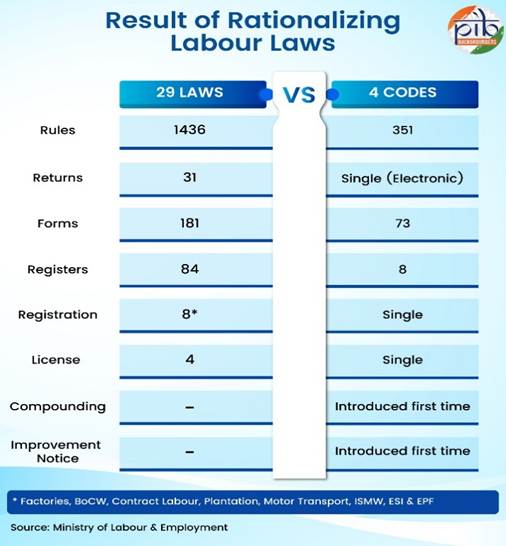
- Multiplicity of Compliance: A single company had to manage numerous registrations, licenses, and periodic returns under various acts. This administrative burden was particularly taxing for small and medium-sized enterprises (MSMEs) and startups.
- The "Inspector Raj": The system of physical inspections under multiple laws often led to inefficiencies and created opportunities for corruption, a phenomenon often termed "Inspector Raj."
These images visually represent the scale of this simplification.

2. Outdated Laws in a Modern Economy
Many of India's key labour laws were drafted either before independence or shortly after, in a completely different economic context.
- The Trade Unions Act (1926), the Payment of Wages Act (1936), and the Industrial Disputes Act (1947) were designed for the industrial economy of the 20th century.
- They were ill-equipped to handle the realities of a post-1991 liberalised economy, and certainly not the digital economy of the 21st century.
- Crucially, these laws offered no recognition or protection for new and emerging forms of work, such as gig workers, platform workers, and fixed-term employment.
This created a legal framework that was out of sync with the modern workforce and business models.
3. Hindrance to Economic Growth and Job Creation
The rigidity and complexity of the old laws had unintended economic consequences.
- Incentive to Stay Small: Many laws, as we saw in the previous lesson, had applicability thresholds (e.g., 10, 20, or 100 employees). This created a perverse incentive for businesses to deliberately stay below these thresholds to avoid the corresponding compliance burden, thus stunting their growth.
- Barriers to Flexibility: Strict rules around hiring and firing, particularly the requirement for government permission for retrenchment in larger establishments, made businesses hesitant to hire formally. This often led to an increased reliance on informal labour and complex contractual arrangements, which offered workers less protection.
The Objectives of the Four Labour Codes
The new Labour Codes are the government's answer to these long-standing problems. The goal was not merely to bundle old laws together, but to rationalise, modernise, and simplify the entire framework.
New Labour Codes Explained: Salary, PF, Leaves, Working Hours—FULL BREAKDOWN
This video from Unacademy IAS provides a concise overview of the problem and the historical recommendation for reform.
Watch the segment from the beginning to the end. It effectively explains how labour being a 'Concurrent List' subject led to a multitude of laws and why the Second National Commission on Labour recommended consolidation.
As the video explained, the reform's core objective is rationalisation. This overarching goal can be broken down into several key aims:
1. To Simplify and Promote Ease of Doing Business:
This is the most cited objective. By consolidating 29 central laws into four codes, the reform aims to create a simpler, more transparent, and less burdensome regulatory environment. Key features contributing to this goal include:
- Single, uniform definitions for critical terms like 'wage' and 'employee'.
- One registration, one license, and one return for establishments, where possible.
- A move towards web-based, randomised inspections and an "Inspector-cum-Facilitator" model to replace the old "Inspector Raj."
India’s New Labour Codes Explained | Advocate S.K Gupta | Supreme Court of India
In this clip, Advocate S.K. Gupta discusses the practical changes in the OSH Code that facilitate ease of doing business.
Watch the part of his explanation from this timestamp where he talks about defining 'core' versus 'non-core' activities. This is a prime example of the codes attempting to provide more clarity and flexibility for businesses regarding contract labour. Then, watch his concluding remarks on inspections from the end, where he explains the shift to the 'Inspector-cum-Facilitator' and its expected impact on foreign investment.
2. To Expand and Universalise Worker Protections:
While simplifying things for employers, the codes also aim to extend the social security net.
- Broader Coverage: The Social Security Code, for the first time, legally recognises gig and platform workers and provides a framework for their social security.
- Minimum Wage Floor: The Code on Wages introduces the concept of a national floor wage, below which no state can set its minimum wage, aiming for more equitable pay across the country.
3. To Modernise and Align with the Current Economy:
The codes introduce provisions that are better suited to contemporary employment relationships.
- Legalising Fixed-Term Employment (FTE): The codes provide a legal framework for hiring employees for a fixed duration, giving employers flexibility for project-based work while ensuring FTEs receive benefits like gratuity on a pro-rata basis. This is a significant change from the ambiguity of the past.
The New Structure: A Map for the Future
So, how did 29 laws become four? The consolidation followed a logical, thematic approach, as recommended by the Second National Commission on Labour. This structure is the new foundation you will need to navigate.
The following table shows which key legacy acts were subsumed into each of the four new codes.
| New Labour Code | Legacy Acts Subsumed (Key Examples) |
|---|---|
| 1. The Code on Wages, 2019 | • The Payment of Wages Act, 1936 • The Minimum Wages Act, 1948 • The Payment of Bonus Act, 1965 • The Equal Remuneration Act, 1976 |
| 2. The Industrial Relations Code, 2020 | • The Trade Unions Act, 1926 • The Industrial Employment (Standing Orders) Act, 1946 • The Industrial Disputes Act, 1947 |
| 3. The Code on Social Security, 2020 | • The Employees’ Provident Funds and Miscellaneous Provisions Act, 1952 • The Employees’ State Insurance Act, 1948 • The Payment of Gratuity Act, 1972 • The Maternity Benefit Act, 1961 • The Employees’ Compensation Act, 1923 |
| 4. The Occupational Safety, Health & Working Conditions (OSH) Code, 2020 | • The Factories Act, 1948 • The Contract Labour (Regulation and Abolition) Act, 1970 • The Inter-State Migrant Workmen Act, 1979 • The Plantations Labour Act, 1951 • Thirteen legacy acts in total, covering specific industries and conditions. |
Overview of Labour Law Reforms - PRS India
For a definitive list, you can refer to the Annexure in the PRS India report.
Please navigate to the end of the document and find the section Table 3. This table officially lists all 29 central acts and how they have been grouped under the four codes.
Conclusion
This lesson has provided the crucial "why" behind the new Labour Codes. We've moved beyond simply knowing the law exists to understanding the historical and economic imperatives that drove its creation.
Key Takeaways:
- The old system of over 29 central labour laws was complex, contradictory, and outdated, leading to a heavy compliance burden and hindering economic growth.
- The primary rationale for the new Labour Codes is to simplify, modernise, and rationalise this framework.
- The key objectives are to improve the ease of doing business, attract investment, and create jobs by offering more flexibility to employers.
- Simultaneously, the codes aim to expand worker protections by creating uniform standards and extending social security to previously uncovered segments like gig and platform workers.
- The consolidation logically groups laws into four thematic codes: Wages, Industrial Relations, Social Security, and OSH.
This marks the end of our first module. You now have a solid foundation: you understand the constitutional basis of labour laws, the roles of central and state governments, how to determine which laws apply to a company, and the rationale behind the new, consolidated structure.
In our next module, we will begin our deep dive into the substance of these laws, starting with the Code on Wages, 2019. Our first lesson will examine the legacy acts that governed pay and set the stage for understanding the significant changes introduced by the new code.