Hello! Welcome back to our course on Polycystic Ovarian Syndrome.
In our previous lessons, we have meticulously built the framework for diagnosing PCOS using the Rotterdam criteria, covering menstrual dysfunction, hyperandrogenism, and polycystic ovarian morphology. A crucial part of the Rotterdam criteria, which we have mentioned but not yet explored, is the statement: "after the exclusion of other etiologies."
Today's lesson focuses entirely on this principle. Our learning outcome is to explain the process of differential diagnosis to exclude conditions such as congenital adrenal hyperplasia and androgen-secreting tumors. We will learn how to distinguish PCOS from other serious conditions that present with similar signs and symptoms. This is a critical step in clinical practice to ensure an accurate diagnosis and appropriate management. We will explore the "red flags" in a patient's history that suggest something other than PCOS and the specific tests used to rule out these mimics.
The Importance of Differential Diagnosis
Diagnosing PCOS is a process of exclusion. Because its symptoms—hirsutism, acne, irregular periods—overlap with several other endocrine disorders, a clinician cannot confidently diagnose PCOS until these other conditions have been ruled out. Some of these conditions, like androgen-secreting tumors, are rare but potentially life-threatening, making this process critically important.
The primary conditions that mimic PCOS and must be considered are:
- Androgen-secreting tumors (ovarian or adrenal)
- Non-classic Congenital Adrenal Hyperplasia (NCAH)
- Cushing's syndrome
- Thyroid dysfunction
- Hyperprolactinemia
We will focus on the first three, as they are the most significant hyperandrogenic mimics. Thyroid and prolactin issues are typically screened for as a standard part of the workup for menstrual irregularities.
Step 1: The Clinical Picture - Spotting the "Red Flags"
The first step in differential diagnosis begins with a thorough history and physical examination. While many symptoms overlap with PCOS, certain features should raise suspicion for a different underlying cause.
Key "red flags" to look for:
- Rapid and Severe Onset: Symptoms of hyperandrogenism (hirsutism, acne) that appear suddenly and progress rapidly over a few months, rather than developing slowly around puberty.
- Virilization: Severe signs of androgen excess, such as a deepening voice, temporal balding, increased muscle mass, and clitoromegaly (enlargement of the clitoris). These are rare in PCOS.
- Late Onset: A woman with a history of regular menstrual cycles who suddenly develops amenorrhea and hirsutism later in life (e.g., in her 30s or 40s).
- Signs of Cortisol Excess: Features like central obesity (with thin arms and legs), a "moon face," a "buffalo hump" on the upper back, wide purple stretch marks (striae), and thin, easily bruised skin.
To see how these clinical clues guide a doctor's thinking, please watch the following video. It presents a case that illustrates why it's important to think beyond a simple PCOS diagnosis.
Hirsutism : Clinical Evaluation : Dr Shonali Chandra
The video 'Hirsutism : Clinical Evaluation' by Dr. Shonali Chandra on the MEDICINE DECODED channel provides an excellent case-based introduction to differential diagnosis. Pay attention to how the patient's age and the rapid progression of her symptoms make the physician consider diagnoses other than typical PCOS.
Please watch the first 2 minutes and 52 seconds (00:07 - 02:52). Note the specific features of the case (age of onset, rapid progression) that lower the probability of PCOS and prompt the consideration of other, more serious conditions.
Step 2: Biochemical Evaluation - Targeting the Diagnosis
After the clinical assessment, specific blood tests are used to investigate the source and severity of the androgen excess. This is where we can truly begin to differentiate between conditions.
Androgen-Secreting Tumors
The most urgent condition to rule out is an androgen-secreting tumor of the ovary or adrenal gland. While rare, they are characterized by the rapid onset of severe hyperandrogenism and virilization.
- Key Test: Serum Total Testosterone
- PCOS: Testosterone is typically normal or mildly to moderately elevated, usually less than 150 ng/dL (5.2 nmol/L).
- Tumor: Testosterone levels are markedly high, often greater than 200 ng/dL (6.9 nmol/L). This level is a major red flag.
- Additional Test: DHEA-S (Dehydroepiandrosterone sulfate)
- DHEA-S is produced almost exclusively by the adrenal glands. A very high level (>700 mcg/dL) strongly suggests an adrenal source, such as an adrenal tumor.
If testosterone or DHEA-S levels are significantly elevated, the next step is imaging (a transvaginal ultrasound to look for an ovarian tumor or a CT/MRI scan to look for an adrenal tumor).
Let's continue with the same video to see how testosterone levels are used in a diagnostic flowchart.
Hirsutism : Clinical Evaluation : Dr Shonali Chandra
This next segment of the video 'Hirsutism : Clinical Evaluation' explains the diagnostic algorithm based on serum testosterone levels.
Please watch from 07:18 to 10:48. Focus on the flowchart presented. Understand the critical cutoff of 150 ng/dL for serum testosterone and how it directs the subsequent investigation toward either PCOS or a workup for a tumor.
Non-Classic Congenital Adrenal Hyperplasia (NCAH)
NCAH is a genetic disorder that is one of the most common mimics of PCOS. It's an autosomal recessive condition caused by a partial deficiency of an enzyme, most commonly 21-hydroxylase, which is essential for cortisol production in the adrenal glands.
To understand the basic mechanism of CAH, this short animated video provides a very clear explanation.
What is Congenital Adrenal Hyperplasia (CAH)?
The video 'What is Congenital Adrenal Hyperplasia (CAH)?' from HealthSketch will give you a solid foundation on what CAH is, its genetic cause, and its effect on hormone production.
Please watch from the beginning to 02:37. This will explain the core concept: a faulty enzyme prevents the adrenal glands from making enough cortisol. The brain then signals the adrenals to work harder, but this overstimulation only results in the overproduction of androgens.
As the video explained, the block in the cortisol pathway causes precursor molecules to accumulate. This precursor, 17-hydroxyprogesterone (17-OHP), is shunted into the androgen synthesis pathway, leading to hyperandrogenism.

Clinically, NCAH can look identical to PCOS, with hirsutism, acne, and irregular periods. Even polycystic ovarian morphology on ultrasound is common in women with NCAH. Therefore, differentiation relies entirely on a specific biochemical test.
- Key Test: Basal 17-hydroxyprogesterone (17-OHP)
- This test must be performed in the morning during the early follicular phase (days 2-5) of the menstrual cycle, as 17-OHP levels fluctuate.
- A level < 200 ng/dL (2 ng/mL or 6 nmol/L) effectively rules out NCAH.
- A level > 200 ng/dL is suspicious and requires confirmation with an ACTH stimulation test. In this test, synthetic ACTH is administered intravenously, and 17-OHP levels are measured 60 minutes later. A very high, exaggerated response confirms the diagnosis of NCAH.
Cushing's Syndrome
Cushing's syndrome is a condition caused by prolonged exposure to high levels of cortisol. While it can cause hyperandrogenism and menstrual irregularity, its most distinct features are related to cortisol excess. As noted in the "red flags," these include central obesity, a "moon face," thin skin, and purple striae. When these signs are present, specific testing is required.
- Key Screening Tests:
- Overnight 1 mg dexamethasone suppression test: The patient takes a 1 mg tablet of dexamethasone (a potent synthetic glucocorticoid) at night, and their morning cortisol is measured. In a healthy person, this should suppress cortisol production (<1.8 mcg/dL). Failure to suppress suggests Cushing's syndrome.
- 24-hour urinary free cortisol: Measures the total amount of cortisol excreted in the urine over a full day. Elevated levels indicate cortisol overproduction.
If these screening tests are abnormal, further complex testing is needed to determine the specific cause of Cushing's syndrome.
A Unified Approach to Differential Diagnosis
To consolidate your understanding, please study the following comprehensive review article and summary table. They provide an in-depth look at how to distinguish PCOS from these adrenal disorders.
Differentiating Polycystic Ovary Syndrome from Adrenal ...
The review article 'Differentiating Polycystic Ovary Syndrome from Adrenal ...' provides a detailed, academic discussion on this topic. It outlines the clinical features and specific diagnostic tests for each condition.
Please read Section 3, 'Differential Diagnosis' (subsections 3.1, 3.2, and 3.3). This is the core of our lesson. Focus on the specific clinical clues and biochemical test cutoffs used to distinguish PCOS from NCAH, Cushing's Syndrome, and Androgen Secreting Adrenal Tumors.
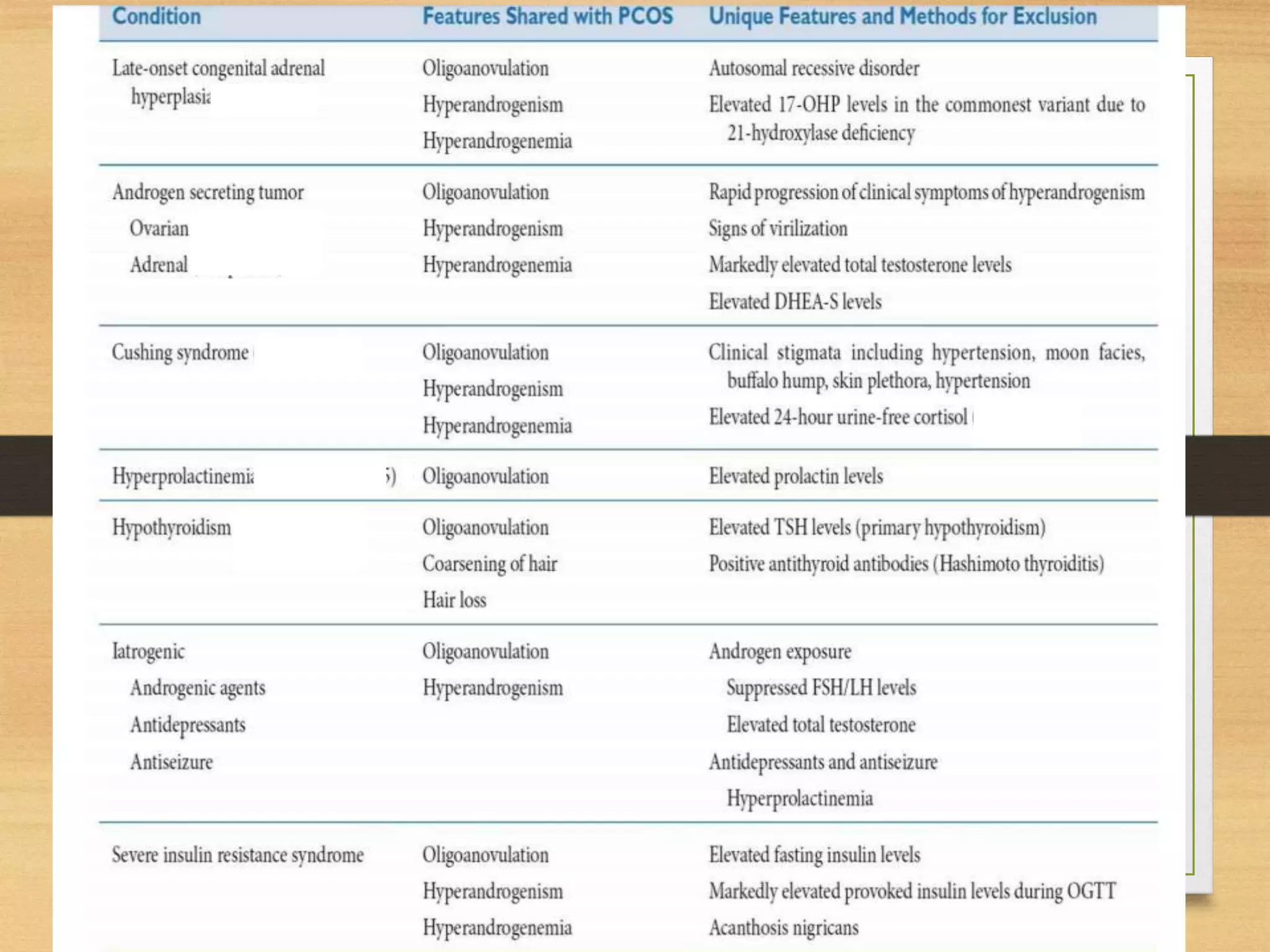
The table below provides an excellent summary of the entire differential diagnosis process, bringing together the key points we've discussed.
Test your understanding!
A 22-year-old woman presents with hirsutism and irregular periods that began around age 14. Her total testosterone level is 90 ng/dL (normal range <60 ng/dL). Her morning, follicular phase 17-OHP level is 150 ng/dL (normal range <200 ng/dL). A thyroid test and prolactin level are normal. Based on this information, what is the most likely diagnosis?
Show answer
The most likely diagnosis is Polycystic Ovary Syndrome (PCOS).
Here's the reasoning:
- Her symptoms (hirsutism, irregular periods) and age of onset are classic for PCOS.
- Her testosterone is mildly elevated, which is consistent with PCOS, but not high enough to strongly suggest a tumor.
- Her 17-OHP level is within the normal range, effectively ruling out NCAH.
- Other common causes (thyroid, prolactin) are excluded.
Assuming she also has oligo/anovulation (indicated by irregular periods) and biochemical hyperandrogenism (elevated testosterone), she meets two of the three Rotterdam criteria, and the major mimics have been excluded.
Conclusion
In this lesson, we have established that PCOS is fundamentally a diagnosis of exclusion. You have learned to identify the clinical "red flags" that should prompt a broader investigation and the specific biochemical tests used to differentiate PCOS from its most important mimics.
Key Takeaways:
- PCOS is a diagnosis of exclusion. Always consider other causes of hyperandrogenism and menstrual dysfunction.
- Clinical clues like rapid onset, severe virilization, or signs of cortisol excess are "red flags" for conditions other than PCOS.
- Androgen-secreting tumors are ruled out by measuring serum testosterone. A level >200 ng/dL is highly suspicious.
- Non-classic Congenital Adrenal Hyperplasia (NCAH) is ruled out by measuring a morning, follicular phase 17-OHP level. A level <200 ng/dL makes NCAH highly unlikely.
- Cushing's syndrome is ruled out with screening tests like the dexamethasone suppression test or a 24-hour urine cortisol measurement.
- Only after excluding these other conditions can a diagnosis of PCOS be confidently made.
Preview of the Next Lesson:
Now that we have firmly established how to diagnose PCOS, we will turn our attention to its long-term health implications. In our next lesson, we will begin to explore these by focusing on the metabolic consequences, where we will describe the long-term metabolic consequences of PCOS, including type 2 diabetes, dyslipidemia, and cardiovascular disease.