Hello! Welcome back to our comprehensive study of Polycystic Ovarian Syndrome.
In our last lesson, we focused on the crucial process of differential diagnosis, establishing that a confident diagnosis of PCOS can only be made after excluding other conditions that mimic its symptoms. Now that we understand how to diagnose PCOS, we shift our focus to its long-term health implications. PCOS is far more than a reproductive issue; it is a systemic, lifelong condition with significant metabolic effects.
Today's lesson addresses the learning outcome: Describe the long-term metabolic consequences of PCOS, including type 2 diabetes, dyslipidemia, and cardiovascular disease. We will explore how the core hormonal imbalances of PCOS, particularly insulin resistance, set the stage for these serious health risks. Understanding these connections is fundamental to appreciating the full scope of PCOS and the importance of long-term management.
The Vicious Cycle: Insulin Resistance and Hyperandrogenism
Before we delve into specific diseases, we must first revisit a concept that is central to the metabolic dysfunction in PCOS: Insulin Resistance (IR). As you may recall from our foundational modules, IR is a state where the body's cells (especially muscle, fat, and liver cells) do not respond effectively to the hormone insulin. To compensate, the pancreas produces more and more insulin, a condition known as compensatory hyperinsulinemia.
In PCOS, this hyperinsulinemia has a profound effect on the ovaries. Insulin acts as a co-gonadotropin, amplifying the effect of Luteinizing Hormone (LH) on theca cells, which drives them to produce excess androgens. Simultaneously, high insulin levels suppress the liver's production of Sex Hormone-Binding Globulin (SHBG), increasing the amount of free, biologically active androgens circulating in the blood.
This creates a self-perpetuating cycle:
- Insulin Resistance leads to...
- Hyperinsulinemia, which promotes...
- Hyperandrogenism, which in turn can worsen...
- Insulin Resistance, particularly by promoting abdominal fat accumulation.
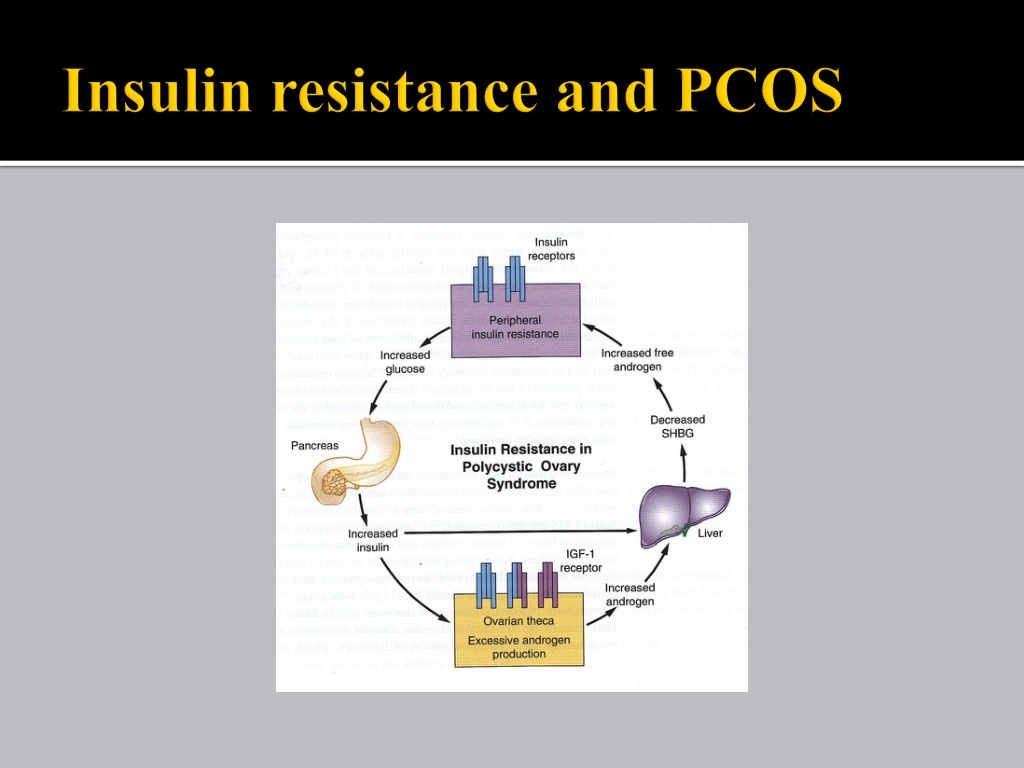
This core dysfunction is the primary driver of the long-term metabolic consequences we will discuss today. It's crucial to note that while IR is more common and severe in women with PCOS who are also obese, it is an intrinsic feature of the syndrome and is often present even in lean women.
To begin, please read the introduction of the following article, which sets the stage by highlighting PCOS as a multisystemic disorder with an increased lifetime risk of metabolic complications.
Insulin resistance, metabolic syndrome and polycystic ...
The review article 'Insulin resistance, metabolic syndrome and polycystic ...' from Frontiers in Endocrinology provides an excellent overview of the metabolic aspects of PCOS. This first section will reinforce the connection between PCOS, IR, and long-term health risks.
Please read the 'Background' section within the 'Introduction'. Focus on how PCOS is now recognized as a syndrome encompassing a spectrum of metabolic abnormalities and the statement that women with PCOS face an increased lifetime risk of type 2 diabetes and cardiovascular complications, regardless of their weight.
Consequence 1: Type 2 Diabetes Mellitus (T2D)
The most well-established long-term metabolic consequence of PCOS is a dramatically increased risk of developing Type 2 Diabetes Mellitus (T2D).
From Insulin Resistance to Diabetes
The progression from the insulin resistance seen in PCOS to overt T2D follows a clear path:
- Insulin Resistance: Target cells become less sensitive to insulin.
- Compensatory Hyperinsulinemia: The pancreas works overtime to produce more insulin to maintain normal blood glucose levels.
- Impaired Glucose Tolerance (Pre-diabetes): Over time, the pancreatic beta cells start to fatigue and cannot keep up with the high demand. Blood glucose levels begin to rise, especially after a meal.
- Type 2 Diabetes: Beta-cell function declines further, leading to a state of relative insulin deficiency. The body can no longer control blood glucose levels, resulting in chronic hyperglycemia (high blood sugar).
To build a solid foundation of how T2D develops, please watch the following video. It provides an excellent visual explanation of insulin's normal function and what goes wrong in diabetes.
Diabetes Complication and Pathophysiology
The video 'Diabetes Complication and Pathophysiology' by Armando Hasudungan clearly explains the basics of T2D. This will help you visualize the concepts of insulin resistance and beta-cell function.
Please watch from the beginning to 05:55. Focus on the definition of T2D, the role of insulin resistance, how insulin is normally secreted by pancreatic beta cells, and how this process becomes dysfunctional.
PCOS as an Independent Risk Factor for T2D
Women with PCOS are at a 4- to 10-fold higher risk of developing T2D compared to women without PCOS. Crucially, this risk is not solely due to obesity. PCOS itself is an independent risk factor. This means that even lean women with PCOS have a higher risk of developing T2D than their weight-matched peers without the syndrome. The progression to T2D also tends to occur at a younger age in women with PCOS.
The article from Frontiers in Endocrinology elaborates on this point, highlighting that the metabolic dysfunction is an intrinsic part of the syndrome.
Insulin resistance, metabolic syndrome and polycystic ...
Let's return to the article 'Insulin resistance, metabolic syndrome and polycystic ...' to explore the evidence for PCOS being an independent risk factor for diabetes.
Please read the last four paragraphs of Section 3, 'The association between PCOS and metabolic syndrome'. Start from the paragraph beginning with 'However, it is important to recognize that metabolic dysfunction is not limited to obese individuals.' Focus on the findings that demonstrate an increased risk of T2D in women with PCOS independently of BMI, especially in lean individuals.
Consequence 2: Dyslipidemia
Another major metabolic consequence of PCOS is dyslipidemia, which refers to an unhealthy profile of lipids (fats) in the blood. This is not just a random finding; it's a specific pattern driven by hyperinsulinemia and hyperandrogenism.
The typical "PCOS lipid profile" is characterized by:
- Elevated Triglycerides (TGs)
- Low High-Density Lipoprotein (HDL) Cholesterol, often called "good" cholesterol.
- Low-Density Lipoprotein (LDL) cholesterol ("bad" cholesterol) levels may be normal or slightly elevated, but there is often a qualitative change towards smaller, denser LDL particles, which are more atherogenic (plaque-forming).
How does PCOS cause this?
- Role of Insulin Resistance: Hyperinsulinemia stimulates the liver to produce more Very-Low-Density Lipoprotein (VLDL), a particle rich in triglycerides. This directly leads to high TG levels.
- Role of Hyperandrogenism: Excess androgens contribute to this abnormal profile, particularly by increasing the activity of an enzyme called hepatic lipase, which breaks down HDL particles, thus lowering HDL levels.
The following short video segment clearly explains the link between the high androgen levels in PCOS and the resulting dyslipidemia.
14. Polycystic Ovarian Syndrome ( PCOS ) : Obstetrics and Gynaecology Lecture
The video 'Polycystic Ovarian Syndrome ( PCOS ) : Obstetrics and Gynaecology Lecture' by MedSchool Simplified offers a concise explanation of how androgens affect cholesterol levels.
Watch the segment from 33:21 to 34:05. The speaker directly explains how increased androgens decrease 'good' cholesterol (HDL) and increase 'bad' cholesterol (LDL) and triglycerides.
This atherogenic lipid profile is a key reason why women with PCOS are considered to be at higher risk for cardiovascular disease.
Test your understanding!
A clinician is reviewing the blood results of a patient with PCOS. Which of the following lipid profiles would be most characteristic of her condition?
A) High HDL, Low LDL, Low Triglycerides
B) Low HDL, High LDL, High Triglycerides
C) Normal HDL, Normal LDL, Normal Triglycerides
D) Low HDL, Normal LDL, High Triglycerides
Show answer
The correct answer is D) Low HDL, Normal LDL, High Triglycerides. While LDL can sometimes be high (making B a possible but less precise answer), the most classic and consistent findings in PCOS are low HDL and high triglycerides. The LDL level is often within the normal range, though the particles may be smaller and denser.
Consequence 3: Cardiovascular Disease (CVD)
Cardiovascular disease is the tragic endpoint of uncontrolled metabolic dysfunction. The hyperglycemia from T2D and the atherogenic lipid profile from dyslipidemia work together to damage blood vessels, leading to atherosclerosis.
Atherosclerosis is the process where plaques, made of cholesterol, fat, calcium, and other substances, build up inside the arteries. This buildup hardens and narrows the arteries, restricting blood flow and increasing the risk of blood clots, which can cause a heart attack or stroke.

The development of atherosclerosis in the context of PCOS and diabetes is a multi-step process:
- Endothelial Dysfunction: High blood glucose and inflammatory factors damage the endothelium (the smooth inner lining of the blood vessels), making it "sticky."
- Lipid Invasion: Small, dense LDL particles penetrate the damaged endothelium and enter the artery wall.
- Inflammatory Response: The body's immune cells (macrophages) are sent to clean up the cholesterol, but they become overwhelmed, ingest the LDL, and transform into "foam cells."
- Plaque Formation: These foam cells accumulate, along with other debris, to form an atherosclerotic plaque.
- Plaque Rupture: If the plaque becomes unstable and ruptures, it can trigger the formation of a blood clot that blocks the artery.
The following video provides a superb visual explanation of how high blood glucose initiates these vascular changes, leading to the microvascular and macrovascular complications seen in diabetes.
Diabetes Complication and Pathophysiology
Let's return to Armando Hasudungan's 'Diabetes Complication and Pathophysiology' video. This section brilliantly illustrates the molecular mechanisms of how hyperglycemia leads to atherosclerosis.
Please watch from 05:55 to 14:50. The first part (until 09:45) introduces the macrovascular complications, including coronary heart disease. The second, more detailed part (from 09:45 onwards) explains the pathophysiology of how high glucose damages blood vessels and leads to plaque formation. Focus on the roles of reactive oxygen species, inflammation, and LDL cholesterol.
The Unifying Concept: Metabolic Syndrome
We have discussed T2D, dyslipidemia, and CVD risk as separate consequences, but in reality, they are deeply interconnected. This cluster of cardiometabolic risk factors is formally known as Metabolic Syndrome.
A person is diagnosed with metabolic syndrome if they have at least three of the following five conditions:
- Central Obesity: Increased waist circumference.
- Elevated Triglycerides: >150 mg/dL.
- Low HDL Cholesterol: <50 mg/dL in women.
- Elevated Blood Pressure (Hypertension): ≥130/85 mmHg or on medication for hypertension.
- Elevated Fasting Glucose: ≥100 mg/dL (indicating pre-diabetes or diabetes).
Given what we've learned, it's no surprise that women with PCOS have a very high prevalence of metabolic syndrome—up to 40% or more. The diagnosis of metabolic syndrome is a powerful indicator of a patient's future risk for both T2D and cardiovascular disease.
The next video segment provides a very clear summary of metabolic syndrome and its diagnostic criteria in the context of PCOS.
14. Polycystic Ovarian Syndrome ( PCOS ) : Obstetrics and Gynaecology Lecture
To tie these concepts together, let's watch one final clip from the MedSchool Simplified lecture on PCOS. It explicitly defines metabolic syndrome and lists the criteria.
Watch the segment from 59:01 to 01:02:20. Pay close attention to the definition of metabolic syndrome and the five criteria used for its diagnosis, and how they relate directly to the pathophysiology of PCOS we've discussed.
Conclusion
In this lesson, we have moved beyond the diagnosis of PCOS to understand its profound and lifelong metabolic impact. It is a condition that places women at a significantly elevated risk for serious chronic diseases.
Key Takeaways:
- PCOS is a systemic metabolic disorder, not just a reproductive one. Its long-term consequences are primarily driven by insulin resistance and hyperandrogenism.
- Women with PCOS have a markedly increased risk of developing Type 2 Diabetes (T2D), a risk that is independent of obesity.
- PCOS is associated with an atherogenic dyslipidemia, characterized by high triglycerides and low HDL cholesterol, which promotes plaque formation in arteries.
- The combination of hyperglycemia, dyslipidemia, inflammation, and hypertension greatly increases the long-term risk of Cardiovascular Disease (CVD) through the process of atherosclerosis.
- The concept of Metabolic Syndrome unifies these risk factors, and its prevalence is very high in the PCOS population.
Preview of the Next Lesson:
Having explored the metabolic consequences, our next lesson will address the other major long-term health dimensions of PCOS. We will discuss the reproductive and psychological consequences of PCOS, including infertility, pregnancy complications, and mood disorders. This will complete our picture of the multifaceted challenges faced by individuals with this syndrome.