Hello! Welcome to your next lesson in our exploration of the genetic and epigenetic basis of PCOS.
In our last lesson, we focused on how variations in the DNA sequence itself—the specific "spelling" of genes like CYP11A and INSR—can create a predisposition to PCOS. We learned that these are like blueprints with slight alterations. Today, we shift our focus from the blueprint itself to the instructions on how to read that blueprint.
Our learning outcome is to explain the concept of epigenetics and describe major mechanisms like DNA methylation and histone modification. Imagine that every cell in your body has the exact same library of genetic books (your DNA). Epigenetics is the librarian that decides which books are open for reading, which are closed and locked away, and which have sticky notes on certain pages. This process allows a muscle cell and a skin cell to perform vastly different functions, despite having identical DNA.
By the end of this lesson, you will understand:
- The definition of epigenetics and its role in cell differentiation.
- How DNA is packaged into a structure called chromatin.
- The mechanism of DNA methylation and its role in gene silencing.
- The mechanism of histone modification and its role in regulating gene accessibility.
Let's begin by defining this fascinating concept more formally.
1. What is Epigenetics?
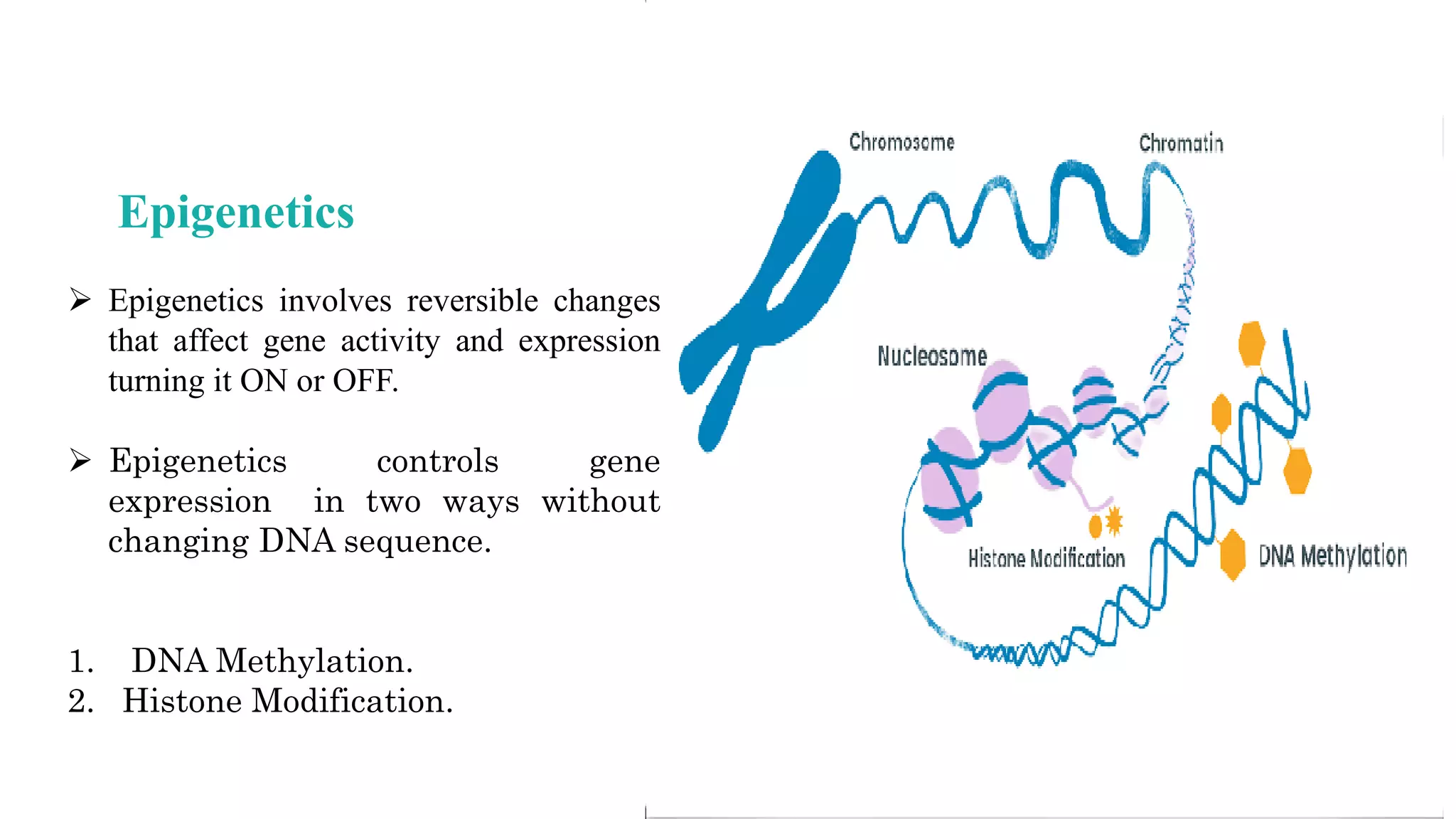
The term "epigenetics" comes from Greek, where the prefix epi- means "above" or "on." So, epigenetics literally means "above genetics." It refers to changes that affect gene activity and expression without altering the underlying DNA sequence. These changes are heritable, meaning they can be passed on from one cell to its descendants during cell division.
To get a dynamic introduction to this idea, please watch the first couple of minutes of the following video.
The video 'Epigenetics - An Introduction' by Armando Hasudungan provides a clear and simple animated explanation of why epigenetics is necessary to explain how different cells in our body have different functions despite containing the same DNA.
Please watch from 01:03 to 02:29. Focus on the core concept: epigenetic modifications are chemical tags that turn genes on or off, leading to specialized cell functions.
For a solid textual summary of this concept, the MedlinePlus Genetics page is an excellent resource.
The article 'What is epigenetics?' from MedlinePlus Genetics provides a clear, concise definition and introduces the two key mechanisms we will be discussing.
Please read the entire short article. Pay close attention to the definition of the 'epigenome' and how it influences protein production. Notice how it introduces DNA methylation and histone modification as the primary examples.
2. The Packaging of DNA: Chromatin and Histones
To understand how epigenetic marks work, we first need to understand how our DNA is organized. A human cell contains about two meters of DNA, which must fit inside a nucleus that is only a few micrometers in diameter. This incredible feat of packaging is achieved by wrapping the DNA around proteins called histones.
- A segment of DNA wrapped around a core of eight histone proteins is called a nucleosome.
- This string of nucleosomes, which looks like "beads on a string," is coiled up further to form a compact fiber called chromatin.
This packaging is not just for storage; it's a key part of gene regulation.
- Euchromatin: When chromatin is loosely packed, the DNA is accessible to the cellular machinery that reads genes and produces proteins. Genes in euchromatin are generally considered "on."
- Heterochromatin: When chromatin is tightly condensed, the DNA is hidden and inaccessible. Genes in heterochromatin are "off" or silenced.
The video below explains this packaging process in detail and introduces how it relates to epigenetics.
EPIGENETICS & CHROMATIN STATES - An introduction to histone modifications & gene transcription roles
The video 'EPIGENETICS & CHROMATIN STATES' from Genomics Guru gives a more academic overview of chromatin structure. It will help you visualize the nucleosome and understand the crucial role of histone 'tails'.
Please watch from 02:24 to 07:22. The first part (until 04:17) covers the levels of DNA packaging. The second part (from 04:17) focuses on the structure of the nucleosome and the unstructured 'histone tails,' which are the primary site of epigenetic modifications.
Now that we understand the structure that is being modified, let's explore the modifications themselves.
3. The Major Epigenetic Mechanisms
There are two primary epigenetic mechanisms that regulate chromatin structure and gene expression.

A. DNA Methylation: The "Off Switch"
DNA methylation is one of the most stable and well-understood epigenetic marks.
- What it is: The addition of a small chemical tag, a methyl group (), directly onto a cytosine (C) base in the DNA sequence. This most often occurs where a cytosine is followed by a guanine (G), known as a "CpG site."
- What it does: When CpG sites in a gene's promoter region (the "start" sequence of a gene) are heavily methylated, it acts like a physical barrier. This blocks the transcription machinery from binding to the DNA, effectively silencing the gene or turning it "off."
- The Machinery: Enzymes called DNA methyltransferases (DNMTs) are the "writers" that add methyl groups. Other enzymes, like the TET family, can initiate the process of removing them, acting as "erasers."
The article below provides a more detailed explanation of this process.
Complete Guide to Understanding Epigenetics
The 'Complete Guide to Understanding Epigenetics' from Active Motif offers a thorough look at DNA methylation, including the different types of methylation and the enzymes involved.
Please start by reading the section 'Types of Epigenetic Modifications' for an overview. Then, read the section 'DNA Methylation & Methylation Variants'. Focus on understanding the role of CpG islands and the general principle that methylation of promoters leads to transcriptional silencing.
B. Histone Modification: The "Dimmer Switch"
While DNA methylation often acts as a simple on/off switch, histone modifications are more nuanced, acting like a dimmer switch that can fine-tune gene expression. These modifications occur on the histone "tails" that we saw in the video.
The next video segment provides a fantastic, in-depth explanation of the two most important histone modifications: acetylation and methylation.
EPIGENETICS & CHROMATIN STATES - An introduction to histone modifications & gene transcription roles
We return to 'EPIGENETICS & CHROMATIN STATES' to learn about histone modifications. This section clearly explains how different chemical marks on histone tails can either open or close the chromatin.
Please watch from 07:22 to 19:10. This is a detailed section, so take your time. First part (07:22 - 11:44): Focus on histone acetylation. Understand that it neutralizes charge, opens up chromatin, and is associated with gene activation. Note the enzymes involved: HATs (writers) and HDACs (erasers). Second part (11:44 - 19:10): Focus on histone methylation. The key takeaway here is its complexity. Unlike acetylation, methylation doesn't change the charge and its effect (activation or repression) depends entirely on which specific site is methylated and how many methyl groups are added. Notice how different methylation marks recruit different proteins to either activate or silence genes.
Let's summarize these crucial points:
-
Histone Acetylation:
- What it is: Addition of an acetyl group to a lysine amino acid on a histone tail.
- What it does: Neutralizes the tail's positive charge, weakening its grip on the negatively charged DNA. This "loosens" the chromatin (creating euchromatin).
- The Effect: Generally leads to gene activation. Think Acetylation = Active.
- The Machinery: "Writers" are Histone Acetyltransferases (HATs); "erasers" are Histone Deacetylases (HDACs).
-
Histone Methylation:
- What it is: Addition of a methyl group to a lysine or arginine amino acid.
- What it does: Does not change the charge but creates a binding site for specific "reader" proteins.
- The Effect: Highly context-dependent. It can be activating or repressive. For example:
- Methylation at histone H3 lysine 4 (H3K4me3) is a strong mark of an active gene promoter.
- Methylation at histone H3 lysine 27 (H3K27me3) is a strong mark of a repressed or silenced gene.
- The Machinery: "Writers" are Histone Methyltransferases (HMTs); "erasers" are Histone Demethylases (HDMs).
Test your understanding!
Imagine scientists are studying a gene that is abnormally silenced in a specific disease. Which of the following epigenetic patterns would they most likely expect to find at that gene's promoter?
- Low DNA methylation and high histone acetylation.
- High DNA methylation and low histone acetylation.
- Low DNA methylation and low histone acetylation.
Show answer
The correct answer is 2. High DNA methylation and low histone acetylation.
- High DNA methylation at a promoter is a strong signal for gene silencing.
- Low histone acetylation (meaning high histone deacetylation) means the chromatin is tightly wound and inaccessible, which also contributes to gene silencing.
This combination represents a repressive epigenetic state.
Conclusion
In this lesson, we have moved beyond the static DNA code to the dynamic world of gene regulation. You've learned how the "software" of the epigenome directs the "hardware" of the genome.
Key Takeaways:
- Epigenetics refers to heritable modifications that regulate gene expression without changing the DNA sequence, explaining how cells with the same genes can have different identities.
- DNA is packaged into chromatin, and the accessibility of this chromatin (euchromatin vs. heterochromatin) dictates whether genes are active or inactive.
- DNA methylation is a major epigenetic mechanism that typically acts as a stable "off switch" by adding methyl groups to gene promoters.
- Histone modification is a more dynamic mechanism. Acetylation generally activates genes by loosening chromatin, while methylation can either activate or repress genes depending on the specific context.
Preview of the Next Lesson:
Now that you have a solid foundation in what epigenetic modifications are, our next lesson will explore their direct relevance to PCOS. We will discuss how epigenetic modifications and gene-environment interactions may contribute to PCOS pathogenesis. You'll see how factors like diet, stress, and the intrauterine environment can leave epigenetic marks that influence the development of PCOS, connecting the dots between genetics, environment, and disease.