Hello! Welcome to the next step in our investigation into the genetic basis of PCOS.
In our last lesson, we established the fundamental mechanisms of epigenetics. We learned that while your DNA is like the hardware of a computer, the epigenome is the software that tells the hardware what to do. You now understand the main "software commands": DNA methylation, which often acts as an "off" switch, and histone modifications (like acetylation and methylation), which act as "dimmer switches" to fine-tune gene activity.
Today, we will connect this foundational knowledge directly to the pathogenesis of PCOS. Our learning outcome is to discuss how epigenetic modifications and gene-environment interactions may contribute to PCOS pathogenesis. We will explore how factors from our environment—such as diet, chemical exposures, and even the conditions in the womb before birth—can leave lasting epigenetic marks that influence whether a person with a genetic predisposition actually develops PCOS.
By the end of this lesson, you will understand:
- The principle of gene-environment interaction, where the epigenome acts as the bridge.
- The "Developmental Origins of Health and Disease" (DOHaD) hypothesis as it applies to PCOS.
- Specific epigenetic alterations (in DNA methylation, histone marks, and microRNAs) found in women with PCOS.
- How factors like diet, obesity, and gut microbiota interact with the epigenome to influence PCOS.
Let's begin by exploring the powerful idea of how our environment "talks" to our genes.
1. The Epigenome: A Bridge Between Genes and Environment
Your genetic code is largely fixed, but your epigenome is dynamic and responsive. It can be modified by the choices you make, the food you eat, and the environment you live in. This interaction is fundamental to understanding complex disorders like PCOS, where genetics alone don't tell the whole story.
To see a classic and compelling illustration of this principle, we'll watch a presentation by Dr. Randy Jirtle, a pioneer in the field of epigenetics. He uses a fascinating mouse model to show how a mother's diet can dramatically change her offspring's health outcomes—all through epigenetic changes.
Epigenetics: How Genes and Environment Interact
In this video from the NIH, 'Epigenetics: How Genes and Environment Interact,' you will see a powerful demonstration of how environmental factors influence the epigenome. First, the speaker introduces the concept of the epigenome as the 'software' controlling the 'hardware' of the genome.
Please watch from 05:32 to 09:31. Focus on the analogy of the genome as hardware and the epigenome as software. Note the key question: why do identical twins, who share the same DNA, have different susceptibility to diseases?
Now, let's watch the core of the experiment. Dr. Jirtle will show how genetically identical mice can look completely different and have vastly different health profiles based solely on their mother's diet during pregnancy.
Epigenetics: How Genes and Environment Interact
This next segment shows the famous agouti mouse experiment. It's a clear visual example of how an environmental input (nutrition) alters the epigenome (DNA methylation) to change the phenotype (coat color and disease risk).
Please watch from 17:04 to 23:56. Pay close attention to: The difference between the yellow, obese mouse and the brown, healthy mouse (they are genetically identical!). The role of maternal diet (methyl donors like folic acid and B12). How the diet changes DNA methylation at the agouti gene, which in turn changes the coat color and risk for obesity, diabetes, and cancer.
This experiment beautifully demonstrates that Nurture shapes Nature through epigenetic mechanisms. The mother's diet directly altered the DNA methylation patterns in her offspring, changing how their genes were expressed and profoundly impacting their adult health. This concept of early-life programming is central to modern theories about the origins of PCOS.
2. Developmental "Programming" of PCOS
The agouti mouse experiment provides a model for a powerful idea in medicine: the Developmental Origins of Health and Disease (DOHaD) hypothesis. This theory proposes that the environment experienced during critical periods of development, particularly in the womb, can "program" a person's lifelong susceptibility to diseases like PCOS.
Let's read a short section from a recent scientific review that introduces this concept in the context of PCOS.
PCOS and the Genome: Is the Genetic Puzzle Still Worth ...
The paper 'PCOS and the Genome' discusses how epigenetic regulation connects the environment to PCOS pathophysiology. This section specifically introduces the DOHaD hypothesis.
Please read the section '3.2. Epigenetic Regulation and Environmental Interactions'. Focus on understanding the DOHaD hypothesis and the idea that the intrauterine environment (e.g., maternal hormones) can induce persistent epigenetic changes in the fetus, predisposing them to PCOS later in life.
As the article mentions, one of the leading theories for the developmental programming of PCOS involves exposure to excess androgens in the womb. Let's delve into this specific mechanism.
Polycystic Ovarian Syndrome Genetics and Epigenetics
This article, 'Polycystic Ovarian Syndrome Genetics and Epigenetics,' details the leading theory of fetal programming in PCOS: exposure to excess androgens in utero.
Please read the section titled 'Epigenetics'. Focus on the proposed '2-hit mechanism': Maternal insulin resistance leads to fetal hyperinsulinemia and excess fetal androgen production. Placental dysfunction prevents the normal breakdown of these excess androgens. This creates a hyperandrogenic fetal environment that can epigenetically reprogram genes.
This theory provides a compelling model for how the metabolic state of the mother can be transmitted to the next generation, not through DNA changes, but through epigenetic programming that sets the stage for PCOS to develop.
3. Specific Epigenetic Signatures in PCOS
So, what are the actual epigenetic changes observed in women with PCOS? Research has identified alterations in all the major mechanisms we've discussed: DNA methylation, histone modification, and even another class of small regulatory molecules called microRNAs.
These changes are found in key tissues involved in PCOS, including ovarian granulosa and theca cells, adipose tissue, and even in the blood. They affect genes crucial for:
- Steroidogenesis (androgen production)
- Insulin signaling and glucose metabolism
- Inflammation
- Follicular development
Let's look at some examples:
A. Altered DNA Methylation and Histone Modification
As we saw in the agouti mice, the methylation of gene promoters is a powerful way to control gene expression. In PCOS, studies have found abnormal methylation patterns (both too much, hypermethylation, and too little, hypomethylation) in numerous genes.
For a concrete example, let's look at a paper that discusses histone modifications.
Polycystic Ovarian Syndrome Genetics and Epigenetics
We return to 'Polycystic Ovarian Syndrome Genetics and Epigenetics' to see a specific example of histone modification in PCOS.
Please read the first two paragraphs of the subsection that starts with 'Histone epigenetic modifications...'. Note how increased histone acetylation and methylation in PCOS patients was linked to reduced expression of the CYP19A1 gene. This gene codes for aromatase, the enzyme that converts androgens to estrogens. Reduced aromatase activity is a direct contributor to the hyperandrogenic state in PCOS.
B. The Role of MicroRNAs (miRNAs)
Beyond modifying DNA and histones, the cell has another layer of epigenetic control: microRNAs (miRNAs). These are tiny, non-coding strands of RNA that don't make proteins themselves. Instead, they act like molecular censors, binding to messenger RNA (mRNA) molecules and either blocking them from being translated into protein or causing them to be degraded.
In PCOS, the levels of many miRNAs are dysregulated, contributing to the disease phenotype. For instance, altered levels of miR-93 and miR-222 have been linked to the insulin resistance seen in PCOS.
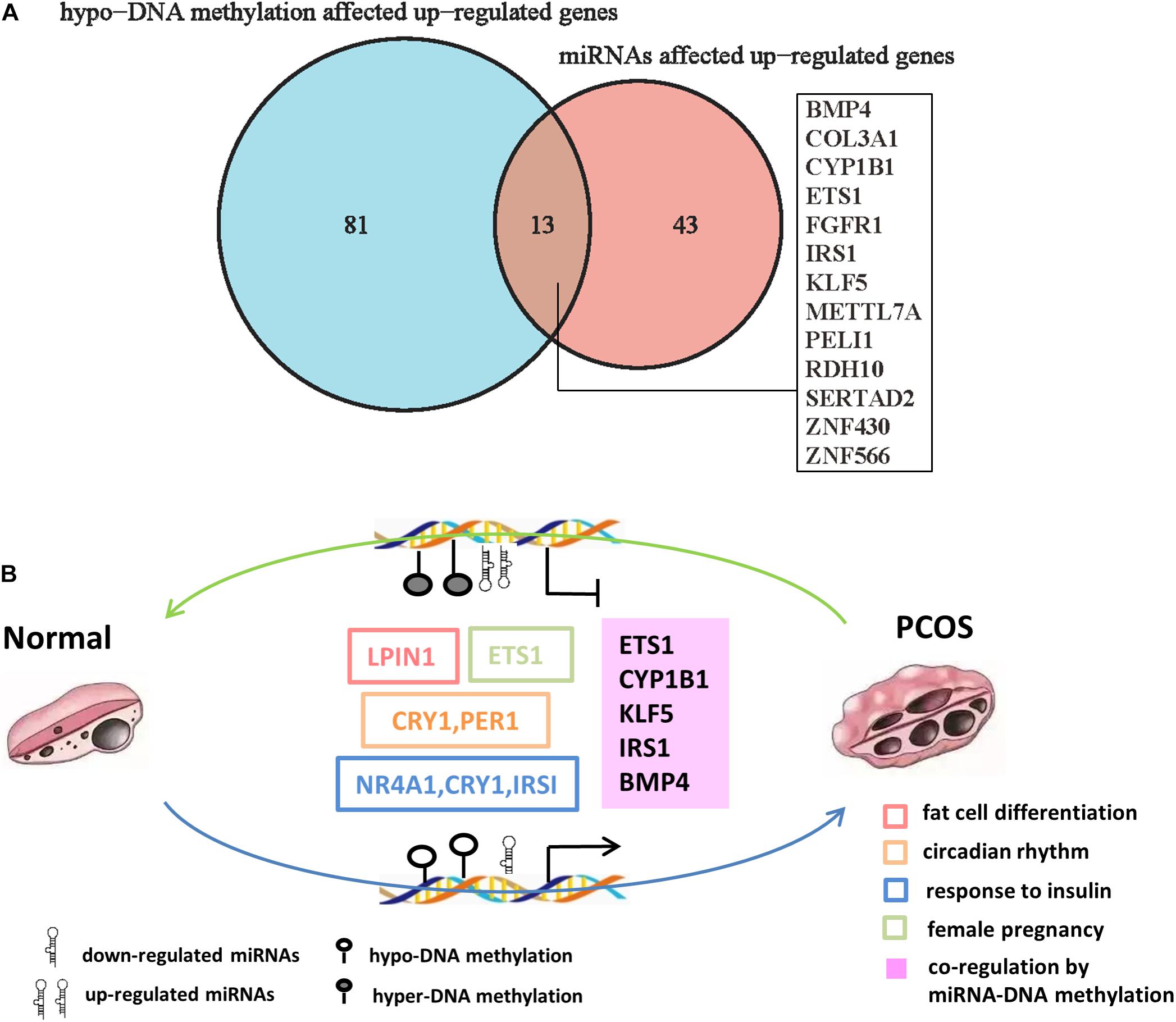
The following image provides an excellent visual summary, showing how both DNA hypomethylation and altered miRNA levels can work together to increase the expression of genes involved in PCOS.
Test your understanding!
A researcher finds that in the ovarian theca cells of women with PCOS, the gene for a key androgen-producing enzyme is over-expressed. Based on what you've learned about epigenetic mechanisms, which of the following findings at that gene's promoter would most likely explain this over-expression?
- Hypermethylation of DNA and low histone acetylation.
- Hypomethylation of DNA and high histone acetylation.
- Hypermethylation of DNA and high histone acetylation.
Show answer
The correct answer is 2. Hypomethylation of DNA and high histone acetylation.
- Hypomethylation (less methylation) removes the repressive marks from the gene promoter, making it accessible to transcription machinery.
- High histone acetylation loosens the chromatin structure (creating euchromatin), further promoting gene accessibility and activation.
This combination creates a highly active or "on" state, leading to the observed over-expression of the gene.
4. The Continuing Influence of the Environment
While developmental programming sets a strong foundation, the environment continues to interact with our epigenome throughout life. Factors like diet, obesity, environmental toxins, and even the bacteria in our gut can influence the PCOS phenotype.
- Obesity: As mentioned in the resource "Polycystic Ovarian Syndrome Genetics and Epigenetics," obesity itself can act as an epigenetic modifier, further exacerbating the metabolic and reproductive features of PCOS.
- Endocrine-Disrupting Chemicals (EDCs): Just as Bisphenol A (BPA) affected the agouti mice in the video, exposure to EDCs in plastics, pesticides, and cosmetics is an area of active research for its potential role in PCOS.
- The Gut Microbiota: Emerging research highlights a "gut-ovary axis." The types of bacteria in your gut can influence your body's metabolism and inflammation. These bacteria produce metabolites (e.g., short-chain fatty acids like butyrate) that can directly inhibit histone deacetylases (HDACs), thereby altering gene expression in your own cells. This provides a direct mechanistic link between diet, gut health, and PCOS pathophysiology.
Conclusion
Today, we have built a critical bridge between the basic science of epigenetics and the complex reality of PCOS. You have seen that PCOS is not simply a matter of having the "wrong" genes, but is profoundly influenced by how those genes are regulated in response to the environment, starting from the moment of conception.
Key Takeaways:
- Epigenetics is the primary mechanism facilitating gene-environment interactions, explaining how factors like nutrition and stress can alter gene expression.
- The DOHaD hypothesis suggests that the intrauterine environment can "program" long-term disease risk. In PCOS, in utero hyperandrogenism is a leading theory for this programming.
- PCOS is associated with specific epigenetic alterations, including aberrant DNA methylation, histone modifications, and miRNA expression in genes critical for hormone production and metabolism.
- Lifelong environmental factors, including diet, obesity, and the gut microbiome, continuously shape the epigenome and influence the severity of the PCOS phenotype.
Preview of the Next Lesson:
We have introduced the powerful DOHaD hypothesis today. In our next lesson, we will dive deeper into this topic. We will describe the theory of intrauterine programming and the developmental origins of health and disease (DOHaD) as it applies to PCOS in much greater detail, examining the animal and human evidence that supports this fascinating and critical aspect of PCOS etiology.