Greetings, Detective. Your work on the rival studios case was exemplary. By dissecting the data and accounting for the "Package Type" confounder, you successfully resolved Simpson's Paradox and revealed that Velvet & Vellum was, in fact, the superior studio within every client tier. It was a textbook case of how failing to stratify data can obscure the truth.
However, as you file the report, a curious addendum from Velvet & Vellum's lead analyst catches your eye. In an effort to court only the most promising talent, they started a premium program, exclusively accepting clients who had been featured in the prestigious "Aphrodite's Choice" annual glamour showcase. When analyzing this elite cohort, they stumbled upon a bizarre finding: among these celebrated individuals, there appeared to be a negative correlation between natural modeling ability and the quality of their personal wardrobe.
This seems nonsensical. Are clients with a great wardrobe so confident they neglect to practice their posing? Do naturally talented models not care about fashion? Or is this another, more subtle, statistical phantom? In our last investigation, the paradox was solved by stratifying the data. Today, we'll explore a paradox that emerges for the opposite reason: by improperly stratifying it.
The Anatomy of a Spurious Correlation
The phenomenon V&V's analyst has stumbled upon is a classic trap known as collider bias, or Berkson's Paradox. It's a sly beast, fundamentally different from the confounding you dealt with in the last case. With confounding, a common cause misleads us. With colliders, it's a common effect.
To understand this, we need to distinguish between two types of variables in a causal path.
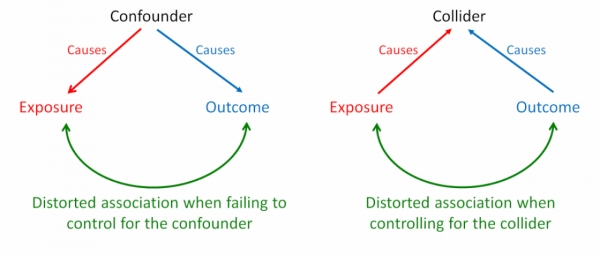
The key insight is this: when two independent causes lead to a single common effect (the "collider"), conditioning your analysis on that effect can create a spurious statistical relationship between the two original causes.
The article "Berkson's Paradox Explained" provides some fantastic, intuitive examples of this.
Berkson's Paradox Explained: Why Selection Bias Creates False ...
This article will be your primary briefing on this new type of statistical illusion. It defines the paradox, distinguishes it from Simpson's Paradox, and provides memorable real-world scenarios.
First, read the introduction to understand the core concept and how it differs from Simpson's Paradox. Then, jump to the section "Berkson's Paradox in Everyday Life" and read the excellent Dating Market Paradox example. It's a perfect analogy for our current puzzle. Finally, review the section on how to spot and avoid this bias.
The Elite University Puzzle
Let's cement this idea with another classic example, which is very similar to the "Aphrodite's Choice" showcase scenario. An article by Adam Kelleher on selection bias presents this puzzle clearly.
How do you correct selection bias? | by adam kelleher
This piece uses causal graphs to provide a crisp explanation of how selection bias occurs when conditioning on a collider.
Read the section the college skills example, which introduces the idea of admittance being conditional on math OR social skills. Then, review the following section that shows the causal graph and explains why conditioning on admittance (A=true) induces a statistical dependency.
As these resources explain, if a university admits students who have either great math skills OR great social skills, and you then survey only the admitted students, you'll find a negative correlation between math and social skills. Why? Because if an admitted student has poor math skills, you know they must have been admitted for their great social skills to clear the admission bar. The two skills become spuriously linked in your selected sample, even if they're unrelated in the general population.
The act of "being admitted" is the collider.
Solving the "Aphrodite's Choice" Mystery
Now let's apply this to the V&V studio case. The two independent variables are:
- Talent (T): A client's natural modeling ability.
- Wardrobe (W): The quality and uniqueness of their lingerie collection.
In the general population of aspiring models, we can assume these are independent. A person's innate talent doesn't determine their shopping budget.
The collider is Being Featured (F) in the "Aphrodite's Choice" showcase. To get featured, a model needs either exceptional Talent OR an exceptional Wardrobe (or both). The causal structure is:
By studying only the clients who were featured, V&V's analyst has conditioned on the collider F. Let's trace the logic numerically.
Imagine a population of 400 potential clients, with Talent and Wardrobe being independent binary variables (High/Low and Great/Standard), each with a 50% chance of being favorable.
| Wardrobe (Great) | Wardrobe (Standard) | Total | |
|---|---|---|---|
| Talent (High) | 100 | 100 | 200 |
| Talent (Low) | 100 | 100 | 200 |
| Total | 200 | 200 | 400 |
In this general population, knowing a client has High Talent tells you nothing about their wardrobe. , which is the same as the overall probability . They are independent.
Now, let's apply the selection filter: you get Featured (F) if your Talent is High OR your Wardrobe is Great. This means only one group is excluded: those with Low Talent AND a Standard Wardrobe.
Our selected sample of featured clients looks like this:
| (Featured Clients Only) | Wardrobe (Great) | Wardrobe (Standard) | Total |
|---|---|---|---|
| Talent (High) | 100 | 100 | 200 |
| Talent (Low) | 100 | 0 (excluded) | 100 |
| Total | 200 | 100 | 300 |
Now, let's re-calculate the probabilities within this selected group.
- What is the probability that a featured client has a Great Wardrobe?
- Now, what is the probability that a featured client has a Great Wardrobe, given we know they have High Talent?
Look at that. Within the selected group, knowing a client has High Talent lowers the probability that they have a Great Wardrobe (from 66.7% down to 50%). We have manufactured a negative correlation out of thin air, simply by choosing whom to include in our study. This is precisely Berkson's Paradox.
The video below gives another clear walkthrough of this "explaining away" effect.
This video from "Econometrics, Causality, and Coding with Dr. HK" offers a formal definition of colliders and some great worked examples.
First, watch the segment that defines a collider on a causal path from this section. Then, see how conditioning on a child's eye color (a collider) can make the parents' eye colors appear related in this example. Finally, watch the excellent analogy about programming vs. social skills at a tech company, which perfectly mirrors our studio scenario.
The scatter plot below illustrates what is happening. In the total population (blue and red dots), there is no correlation between academic and sporting ability. But if you only look at the "selected" observations (red dots) — those who made it into a selective school that requires high ability in at least one area — a spurious negative correlation appears.

Conclusion: The Investigator's Fallacy
The mystery of the negative correlation is solved. The analyst at Velvet & Vellum fell prey to selection bias. There is no real-world negative relationship between a model's talent and their wardrobe. The effect is an illusion created by their own exclusive intake process. The "confounding variable" in this case was the selection criterion itself—the act of being featured in the showcase.
Key Takeaways:
- A collider is a variable that is a common effect of two or more other variables (e.g., ).
- Conditioning on a collider (e.g., by selecting a specific subgroup for study) can open a spurious statistical path between its causes, even if they are independent in the general population. This is known as collider bias or Berkson's Paradox.
- This is the opposite of confounding. With a confounder, you must condition on it to get the right answer. With a collider, you must not condition on it.
Preview of the Next Investigation: The Backdoor Key
You have now successfully navigated two of the most treacherous traps in causal analysis: Simpson's Paradox (confounding) and Berkson's Paradox (collider bias). You've learned when to stratify and when not to.
In our next session, we will move from identifying these problems to formally correcting for them. You'll learn how to use a powerful tool from Judea Pearl's do-calculus—the backdoor adjustment formula. This will allow you to systematically identify and control for confounders to isolate the true causal effect of an intervention, like "choosing a studio," on an outcome, like "client satisfaction." We are moving from diagnosing statistical illusions to performing causal surgery.