Greetings, Detective. Your work on the Studio Paradox has been exemplary. You correctly identified "Package Type" as the confounder poisoning the data and, using the backdoor adjustment, surgically removed its influence to reveal the true, superior performance of Velvet & Vellum.
However, a new wrinkle has appeared in the case. Just as you were preparing your final report, you received an anonymous tip: the records detailing which client chose which package have been... misplaced. Vanished. Without this crucial data on our confounder, the backdoor adjustment is impossible. It seems someone wants to keep the truth hidden.
This is a classic intelligence problem: an unobserved confounder is blocking our path. Are we stumped? Not at all. A good detective always has more than one way to pick a lock. In situations like this, where the "back door" is barred, we look for a "front door." Today's investigation will equip you with the front-door adjustment formula, a remarkably clever method for estimating a causal effect even when the primary confounder is unobservable.
The Hidden Confounder and the New Clue
Let's update our case file. The causal diagram we used previously showed Package Type as a measurable confounder. Now, it's an unobserved variable, which we'll label . This variable creates a spurious backdoor path between our treatment (Studio Choice) and our outcome (Satisfaction).
However, your investigation has turned up a new piece of evidence: data on whether a client received a "Personalized Style Consultation" (). Velvet & Vellum offered these consultations more frequently as part of their standard service, while Satin & Steel reserved them for specific, un-documented circumstances. This consultation is a mediating variable; it lies on the causal pathway between the studio choice and the client's final satisfaction.
This gives us the following causal structure:
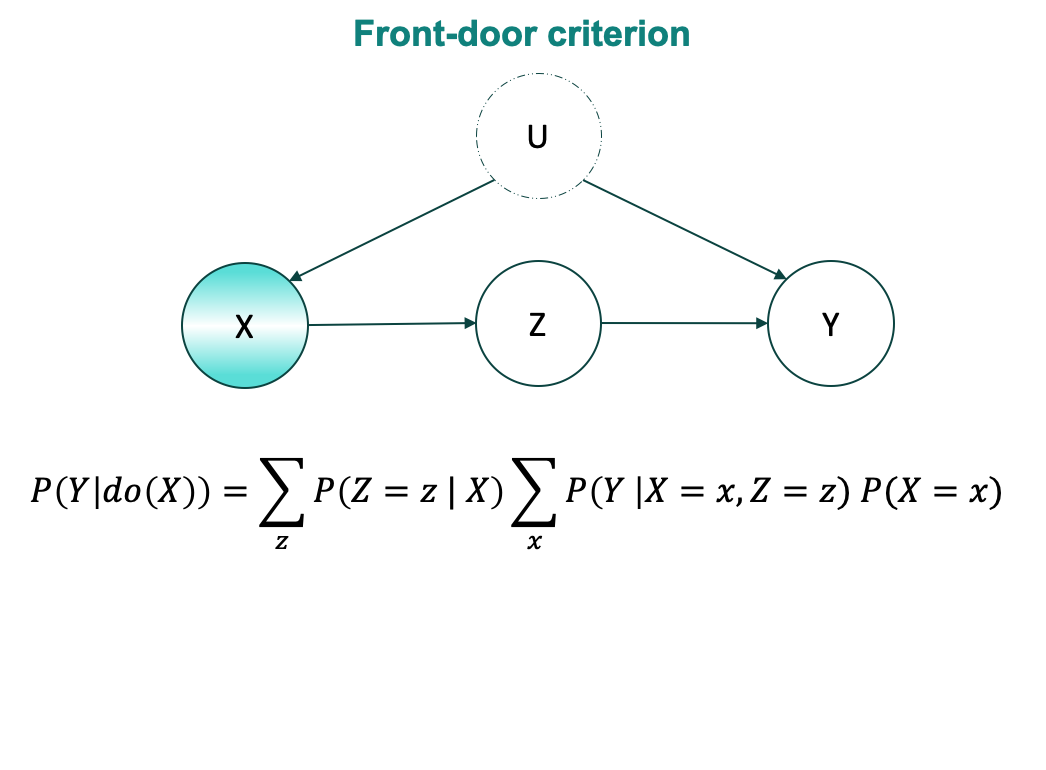
The path is the "front door" — the direct causal mechanism we want to measure. The path is the un-blockable "back door." The front-door adjustment allows us to isolate the flow of causality through the front door, even as spurious association leaks through the back.
The Front-Door Criterion: Conditions for Entry
To use this method, the mediating variable must satisfy three strict conditions, known as the Front-Door Criterion.
A variable (or set of variables) satisfies the front-door criterion relative to and if:
- intercepts all directed paths from to . This means the entire causal effect of on is mediated through . In our case, the studio's influence on satisfaction works entirely through the quality and nature of its services, which we are summarizing with the "Personalized Consultation" variable.
- There is no unblocked backdoor path from to . The confounder must not directly cause . Our unobserved confounder (client's budget/enthusiasm) affects their studio choice and overall satisfaction, but we assume it doesn't independently make them eligible for a consultation except via their choice of studio.
- All backdoor paths from to are blocked by . This is the crucial step. Any confounding path between the mediator and the outcome must pass through . In our diagram, the path is a backdoor path from to , and it is blocked if we condition on .
The following video provides an excellent conceptual breakdown of these conditions and the overall logic of the adjustment.
5.3 - The Frontdoor Adjustment
This video from Brady Neal's Causal Inference series clearly explains the problem of unobserved confounders and how the front-door adjustment provides a solution.
Watch the introduction from the setup to understand the core problem. Then, review the segment defining the Front-door Criterion to solidify the three conditions we just discussed.
Deconstructing the Front-Door Formula
With the conditions met, we can deploy the formula. It looks complex, but it's a logical extension of what you already know. The intuition is that we are chaining together two separate, identifiable causal effects.
The front-door adjustment formula is:
Let's break this down into two parts:
-
Effect of on : The first part, , measures the effect of the treatment on the mediator. Because Condition 2 states there is no confounding between and , the causal effect is simply the observed conditional probability: .
-
Effect of on : The second part, , is the causal effect of the mediator on the outcome. Notice the backdoor path from to is . To block this path, we must adjust for . This expression is the backdoor adjustment formula for the effect of on , where we adjust for !
So, the front-door adjustment cleverly identifies the total effect by first finding the effect of the studio choice on getting a consultation, and then combining it with the (adjusted) effect of the consultation on satisfaction.
This blog post provides a superb intuitive proof of how the formula is derived by chaining two backdoor adjustments.
Causality: The front-door criterion
This article by David Salazar provides a clear, intuitive derivation of the front-door formula.
Read the section Consecutive applications of the back-door criterion. Pay close attention to how the author starts with the goal of chaining two effects, X \rightarrow M and M \rightarrow Y, and uses rules you're already familiar with to arrive at the final formula.
Solving the Case with the Front-Door Adjustment
Your team has managed to salvage the following data from the studio's records, involving 1000 clients. The "Package Type" data is gone, but the "Personalized Consultation" data is intact.
| Studio (X) | Consultation (Z) | Satisfied (Y=1) | Not Satisfied (Y=0) | Total |
|---|---|---|---|---|
| V&V | No | 40 | 60 | 100 |
| Yes | 225 | 105 | 330 | |
| S&S | No | 252 | 228 | 480 |
| Yes | 57 | 33 | 90 |
Let's calculate the true causal effect of choosing Velvet & Vellum () on satisfaction (). The following article walks through an almost identical calculation by hand. We will follow its structure to solve our case.
Unlock the Power of Causal Inference & Front-door ...
This guide provides a thorough, step-by-step numerical example of the front-door adjustment. We will use its methodology here, and you can refer to it for a detailed breakdown of each step.
Focus on the section Working it out by hand. The author meticulously expands the summations and substitutes the conditional probabilities. Use this as a reference as we perform our own calculation.
Our goal is to compute P(Y=1 | do(X=\text{V&V})). The formula is:
\sum_{z \in \{0,1\}} P(Z=z | X=\text{V&V}) \left[ \sum_{x' \in \{V,S\}} P(Y=1 | X=x', Z=z) P(X=x') \right]Where means "Yes" for Consultation, and means "No".
Step 1: Calculate all necessary probabilities from the table.
-
Marginal Probabilities of :
-
Conditional Probabilities :
-
Conditional Probabilities :
Step 2: Calculate the inner sum (the effect of on ).
This is the backdoor adjustment of controlling for .
Let's call this term .
- For (Consultation = Yes):
- For (Consultation = No):
Step 3: Calculate the final outer sum.
This combines the effect of with the effect of .
The true causal effect of choosing Velvet & Vellum is a 61.1% satisfaction rate.
You can repeat the calculation for Satin & Steel as an exercise. The result is . Once again, even with the primary confounder hidden, our advanced techniques reveal that Velvet & Vellum is causally superior. Case closed.
Conclusion
You have now mastered one of the most elegant tools in the causal inference toolkit. While the backdoor adjustment is a frontal assault on confounding, the front-door adjustment is a subtle flanking maneuver. It proves that even with critical information missing, a causal effect can be identified by carefully tracing the mechanism through which it operates.
Key Takeaways:
- When a primary confounder is unobserved, backdoor adjustment is not possible.
- If a mediating variable exists that satisfies the three conditions of the Front-Door Criterion, the causal effect is still identifiable.
- The Front-Door Adjustment Formula estimates the effect of on by chaining two identifiable effects: the unconfounded effect of on , and the backdoor-adjusted effect of on (controlling for ).
Preview of the Next Module: The Coach's Miracle Cure
Your success in the Studio Paradox case has brought you a new client. A relationship coach is making waves with a bold claim: a 100% success rate in improving client satisfaction. This sounds too good to be true. In our next module, we will shift focus from comparing groups to scrutinizing the claims of a single entity. You will need new methods to determine if this coach has a "miracle cure" or if the numbers are merely a statistical illusion. Our first task will be to assess the likelihood of such perfect results occurring by chance alone.