Hello! Welcome back to our module on Advanced Automation & Personalization for Hotels.
In our last lesson, we focused on the crucial moment before a booking is confirmed by designing an abandoned booking recovery sequence. We saw how automated emails can bring high-intent guests back to complete their reservations, directly recovering revenue.
Today, we'll shift our focus to the period after a guest's stay. The guest journey doesn't end at checkout; in many ways, it's just the beginning of a long-term relationship. Our goal for this lesson is to learn how to set up a post-stay automation sequence to solicit reviews and encourage repeat bookings. This is where we transition from securing a single booking to building guest loyalty and lifetime value—a cornerstone of a sustainable and profitable hotel business.
1. The Value of the Post-Stay Conversation
Once a guest has checked out and paid, why continue to invest time and resources in communicating with them? The answer lies in shifting from a purely transactional mindset to a relationship-building one. The post-stay period is your single greatest opportunity to build lifetime value (LTV), a key metric we discussed in the first module.
Effective post-stay communication serves two primary business goals:
- Generating Social Proof: Freshly departed guests are your best source for reviews. Positive reviews on platforms like Google, TripAdvisor, and Booking.com are incredibly powerful assets that influence future guests.
- Driving Repeat Business: Encouraging a past guest to return is often far more cost-effective than acquiring a new one. A well-timed email can plant the seed for their next visit, anniversary trip, or family vacation.
Luxury Hospitality Marketing Guide 2026
Let's begin by understanding where post-stay sequences fit into the broader email marketing strategy. The 'Luxury Hospitality Marketing Guide 2026' provides a clear framework for this.
First, find the subsection titled 'Post-Stay Retention Series' under 'Lifecycle Automation'. Note its two main purposes. Then, navigate down to the section 'POST-STAY JOURNEYS' and review the list of essential components. This will form the blueprint for our sequence.
As the guide emphasizes, this is where "lifetime value is built." It's not just about a single email; it's a journey composed of gratitude, review solicitation, and invitations to return.
2. Designing Your Post-Stay Automation Sequence
Building on what we learned in the last lesson, an effective post-stay strategy isn't a one-off email but a timed sequence. Each email has a specific job to do. We'll design a core three-part sequence that you can expand upon later.
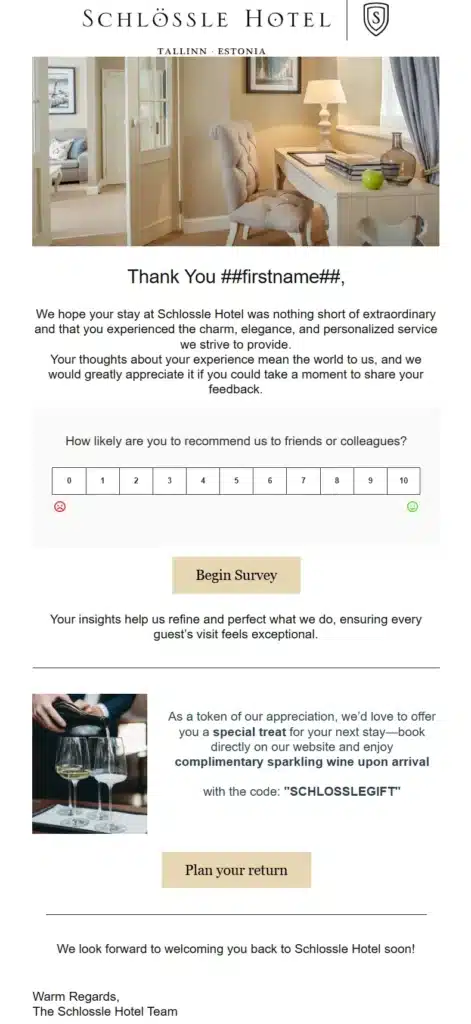
Email 1: The Thank You & Review Request
- When to send: 24 to 48 hours after checkout.
- Goal: To thank the guest sincerely while their experience is fresh in their minds and to guide them toward leaving a review.
- Content Strategy:
- Personalize: Start with a warm, genuine thank you using the guest's first name.
- Frame the Ask: Don't just demand a review. As the Luxury Hospitality Guide suggests, frame it as an invitation to "contribute to the story of the place" and help future travelers make their choice.
- Make it Easy: Provide direct, clear links to 1-2 key review platforms. For most hotels, this would be your Google Business Profile and perhaps TripAdvisor. Too many options can lead to decision paralysis.
- Keep it Focused: The primary goal of this first email is the review. Avoid cluttering it with offers for a future stay; that comes next.
Hotel Email Marketing: The Complete Guide
For a practical example of what this email can look like, let's turn to Cvent's 'Hotel Email Marketing' guide. It provides a simple but effective template.
Scroll to the section with email examples and review template #4, 'Post-visit example'. Pay attention to the subject line, the body copy, and the clear call-to-action for the survey/feedback.
Here is another excellent visual example of this first email in action:
Email 2: The Return Invitation
- When to send: 7-14 days after checkout.
- Goal: To shift the focus from reflecting on the past stay to dreaming about the next one.
- Content Strategy:
- Evoke Emotion: Use nostalgic language. "We hope the memories of your stay are still with you." or "Dreaming of your next getaway?"
- Provide a Value-Add Incentive: This is the perfect time to present a "welcome back" offer. To protect your brand, consider a value-add instead of a direct percentage discount. Examples include:
- "Enjoy complimentary breakfast on us during your next stay."
- "Receive a complimentary upgrade to a premier room."
- "A bottle of champagne will be waiting for you."
- Use a Unique Code: Provide a specific promo code (e.g.,
WELCOMEBACK) to track how effective this email is at driving repeat bookings.
Email 3: The Anniversary Nudge
- When to send: Approximately 11 months after their stay (to get them thinking about their one-year anniversary).
- Goal: To create a powerful, nostalgic trigger for re-booking.
- Content Strategy:
- Reference the Anniversary: "Can you believe it's been almost a year since your stay with us?" This level of personalization shows you remember and value them.
- Show, Don't Just Tell: Include a beautiful, high-quality photo of your property, perhaps reflecting the season they visited in.
- Re-up the Offer: You can present the same (or a slightly enhanced) "welcome back" offer to give them a compelling reason to book their anniversary trip with you.
Test your understanding!
A guest checks out of your hotel. One month later, they receive an automated email with the subject line "Review Us!" The email body says, "Please review your stay from last month on Google, TripAdvisor, Yelp, and Booking.com."
Based on our lesson, identify two major flaws with this approach and explain how you would fix them.
Show answer
-
Flaw 1: Poor Timing. Waiting 30 days is too long. The guest's memory of the stay has faded, significantly reducing their motivation and the potential quality of the review.
- Fix: The review request email should be sent much sooner, within 24-48 hours of checkout, when the experience is still fresh.
-
Flaw 2: Overwhelming and Impersonal Request. The subject line is demanding, and asking for reviews on four different platforms at once creates friction and can lead to the guest not leaving one at all.
- Fix: The subject line should be warmer, like "Thank you for staying with us." The request itself should be framed as an invitation to help future guests and should provide direct links to only one or two primary review sites to make the process as simple as possible.
3. Implementing the Post-Stay Automation
The technical setup for this sequence builds directly on the concepts from our last lesson on abandoned bookings. The logic of triggers, filters, and delays remains the same.
-
The Trigger: The automation should be triggered by an event from your Property Management System (PMS) or booking engine that signifies a guest has completed their stay. This is typically an event like
Guest Checked OutorOrder Fulfilled. This integration between your hotel's core system and your email marketing platform is essential for powerful automation. -
The Automation Path: In your email platform, you will build a workflow that looks like this:
- Trigger:
Guest Checked Out - Time Delay: Wait 1 day.
- Send Email: Email #1 (Thank You & Review Request).
- Time Delay: Wait 10 days.
- Send Email: Email #2 (Return Invitation).
- Time Delay: Wait ~320 days.
- Send Email: Email #3 (Anniversary Nudge).
- Trigger:
-
Essential Filters: Filters are your safety net to ensure you're always sending the right message at the right time.
- Filter out Future Bookers: Before sending Email #2 or #3, add a filter to check if the guest has booked another stay. The condition would be: "Has
Booked Reservationzero times since starting this flow." This prevents you from sending a "come back" offer to someone who has already re-booked. - (Advanced) Filter by Feedback: If your first email links to an internal survey, you can create a more sophisticated flow. If a guest leaves negative feedback (e.g., a score of 1 or 2 out of 5), you can use a filter to automatically exit them from this promotional sequence. Instead, you could trigger a separate, internal task for a manager to follow up personally. This prevents you from asking an unhappy guest for a public review.
- Filter out Future Bookers: Before sending Email #2 or #3, add a filter to check if the guest has booked another stay. The condition would be: "Has
Conclusion
You have now designed a complete post-stay automation sequence. This powerful tool works continuously in the background to transform one-time guests into loyal patrons and brand advocates. By thoughtfully engaging guests after they leave, you tap into two of the most valuable assets for any hotel: authentic social proof and profitable repeat business.
Key Takeaways:
- The post-stay period is where you build guest loyalty and maximize Lifetime Value (LTV).
- A well-designed sequence has distinct phases: first, solicit a review while the experience is fresh, then nurture the relationship for a future booking.
- Timing is critical. The review request must be immediate, while the return invitation can wait a week or two.
- The technical implementation relies on a
Checkouttrigger from your PMS and uses filters to prevent sending irrelevant emails to guests who have already re-booked.
What's Next?
We've talked a lot about using dynamic content like a guest's name. But what if we could take personalization even further? In the next lesson, we will dive deeper and learn how to implement dynamic content in emails to personalize offers based on past stay history. Imagine sending a special spa offer only to guests who used the spa on their last visit. This is the next level of creating truly relevant and effective automated marketing.