Hello! Welcome to the first lesson in our final module, The Future: AI & First-Party Data.
In our last module, we focused on building sophisticated and compliant automation systems. You learned how to capture and manage guest consent, ensuring your marketing is not only effective but also trustworthy. This foundation is crucial because the high-quality, consent-based first-party data you collect is the essential fuel for the next wave of marketing technology: Artificial Intelligence.
Today, we'll dive straight into that future. Our learning outcome is to use AI-powered tools to generate ideas for ad copy and blog posts. You'll learn how to transform tools like ChatGPT from a simple search engine into a creative partner for your hotel's marketing efforts. The goal is not just to get an answer, but to get a great answer—one that reflects your brand, speaks to your ideal guest, and saves you valuable time.
1. Briefing Your New AI Marketing Assistant
Before you ask an AI to write anything, you need to tell it who you are. A generic prompt will get a generic response. To get content that sounds like it comes from your hotel, you must first provide it with context. Think of it as onboarding a new team member.
There are two primary ways to do this in tools like ChatGPT:
- Custom Instructions: A feature where you tell the AI about yourself and how you want it to respond in all future conversations. This is perfect for setting your brand voice, tone, and key information about your hotel.
- Dedicated Projects/Chats: You can start a new "project" or chat thread dedicated to your hotel's marketing. In the very first message, you provide all the necessary brand documents and instructions.
Let's see how this works in practice.
Turn ChatGPT into Your Digital Marketing Team
This first video from digital marketing consultant Grace Leung shows how to set up a dedicated 'Marketing Team' project in ChatGPT. This is a powerful way to keep all your marketing content generation organized and on-brand.
Watch the section from 01:10 to 01:55. Notice how she uploads a 'brand overview' file and sets custom instructions for the AI to act as a 'marketing team lead'.
To define that brand voice, you don't even have to describe it from scratch. You can ask the AI to analyze your existing content to learn your style.
7 ChatGPT Power Prompts That Will Change Your Business
In this next clip, business strategist Wes McDowell demonstrates a powerful technique for teaching ChatGPT your unique tone of voice. This is a crucial step for ensuring your ad copy and blog posts sound authentic.
Watch from 00:40 to 01:19 to understand the value of 'Custom Instructions', and then from 01:38 to 03:29 to see the specific prompt he uses. Pay attention to how he asks the AI to analyze content and break down its stylistic elements. You could use this with your hotel's website copy, past emails, or even brochure text.
By front-loading this information, you ensure every idea the AI generates is already tailored to your hotel's unique identity, location, and target guests.
2. The Art of the Prompt: A Formula for Better Ideas
The single most important skill for using generative AI is prompt engineering. This is simply the practice of writing clear, detailed instructions to get the best possible output. A vague request leads to a vague result. A detailed brief leads to a strategic one.
There are several frameworks for writing good prompts. Let's look at two visual guides that break down the key components.

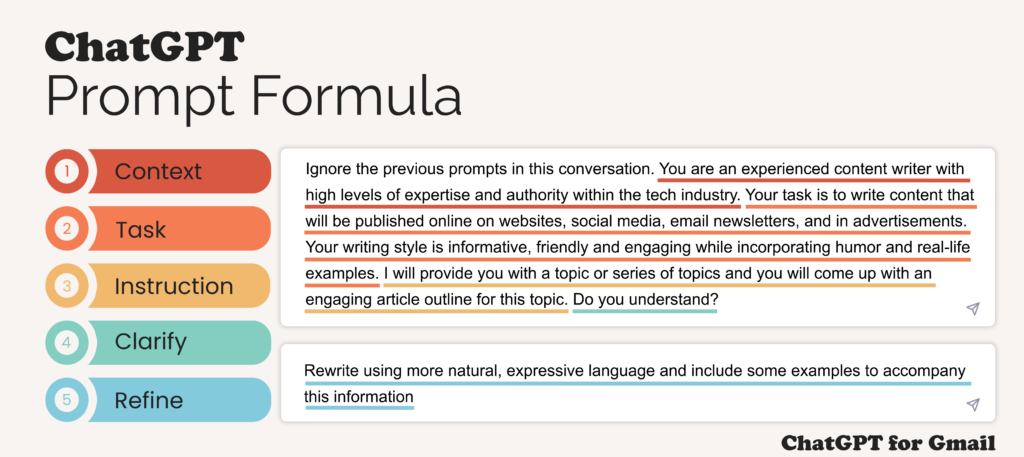
Combining these ideas, a powerful prompt for a hotel marketer should generally include:
- Persona/Role: Tell the AI who to be. Start your prompt with "Act as an expert hotel marketing copywriter specializing in luxury travel."
- Context: Provide the background. "Our hotel is a 50-room boutique hotel in [Your City], targeting couples seeking romantic getaways. We are known for our spa and fine-dining restaurant."
- Task: State exactly what you need. "Generate a list of 10 blog post ideas." or "Write 3 variations of a Facebook ad headline."
- Instructions & Format: Give specific constraints and tell it how to present the information. "The headlines must be under 10 words, create a sense of urgency, and mention our 'Summer Romance' package. Present the output in a table with columns for 'Headline' and 'Key Benefit'."
This structured approach transforms your interaction with AI from a simple Q&A into a proper creative brief.
3. Generating Ideas for Ad Copy and Blog Posts in Practice
Now let's apply these principles to generate content for your hotel. The key is to start broad (brainstorming topics) and then narrow down to specifics (outlines and ad copy).
A. For Blog Posts: Attracting Guests with Valuable Content
Blog posts are excellent for SEO and for showing potential guests the value of staying with you by selling the destination.
Step 1: Brainstorm Topics
First, generate a wide range of potential topics that would appeal to your target audience.
7 ChatGPT Power Prompts That Will Change Your Business
Let's return to Wes McDowell's video to see a prompt that generates a large list of content ideas. This is a great way to fill your content calendar for months.
Watch from 03:29 to 04:46. Notice how he asks for 30 ideas and specifies that the output should be a table including topic descriptions and title ideas. You could adapt this prompt for your hotel by specifying your target audience (e.g., 'families with young children', 'business travelers').
Step 2: Generate a Specific Blog Post Draft
Once you have a topic you like, you can ask the AI to create a draft. Let's use a prompt specifically designed for hotels.
9 ChatGPT Prompts Hotel Marketing Teams Will Wish They ...
This LinkedIn article by Alexander Knoedel provides excellent, hotel-specific prompts. Let's look at the one for creating a blog post.
Read section 7, 'Blog Post Bonanza (Content Marketing)'. This prompt is perfect for creating a list-style post about local attractions, which is highly valuable for guests and great for search engine rankings.
Step 3: Create a Detailed Outline
For longer or more complex posts, it's often better to ask for an outline first. This gives you more control over the structure before the AI starts writing. After getting the outline, you can ask the AI to write each section one by one, which often produces more detailed and higher-quality content.
B. For Ad Copy: Driving Bookings on Social Media
Effective ad copy needs to be concise, engaging, and tailored to the platform and audience.
Using ChatGPT for Hotel Marketing: 31+ Helpful Prompts
The article from TravelBoom Marketing gives several prompts aimed directly at hotel marketers, including specific ones for paid social ads.
First, read the section 'Prompts for Paid Social'. It gives a clear, structured prompt for creating Facebook ads. Then, read the section 'Prompt Success With an ‘Act As’ Statement' to reinforce the importance of giving the AI a role.
To take this a step further, you can generate copy variations for different guest segments. This is where AI can be a massive time-saver.
9 ChatGPT Prompts Hotel Marketing Teams Will Wish They ...
Let's revisit the article from Alexander Knoedel to see a brilliant prompt for personalizing your messaging.
Read section 5, 'Segment & Conquer (Personalized Messaging)'. The prompt here asks the AI to take a single offer and write different versions of the ad copy for distinct audiences (e.g., families vs. business travelers). This directly applies to what you've learned about audience segmentation in Meta Ads.
Test your understanding!
You want to use ChatGPT to create a Facebook ad campaign for your hotel's new "Weekend Spa Retreat" package. The target audience is stressed young professionals aged 25-40.
Which of the following prompts is most likely to give you the best result?
A) "Write a Facebook ad for my hotel's spa package."
B) "Act as an expert social media copywriter. Write a Facebook ad for our 'Weekend Spa Retreat' package. The audience is stressed young professionals. The ad should be exciting and focus on relaxation."
C) "Act as an expert hotel marketing copywriter specializing in wellness travel. Our hotel is a luxury property with an award-winning spa. Generate 3 complete Facebook ad variations for our new 'Weekend Spa Retreat' package. Each variation should include a headline (under 10 words), primary text (2-3 sentences), and a call-to-action. Target stressed professionals aged 25-40 and focus the copy on themes of digital detox, rejuvenation, and escaping the city. Format the output as a table."
Show answer
The best prompt is C. It follows the principles we've discussed: it assigns a specific role, provides rich context about the hotel and package, defines a clear task (3 variations), and specifies the target audience and desired format. Prompt B is good, but C is far more detailed and is therefore much more likely to produce strategic, high-quality ad copy that requires less editing. Prompt A is too vague and will produce a generic result.
4. The Final, Crucial Step: The Human Touch
AI-generated content is a starting point, not a final product. The most effective marketers use AI as a collaborator, not a replacement.
7 ChatGPT Power Prompts That Will Change Your Business
Finally, let's watch one last clip that emphasizes the most critical step in this entire process.
Watch the short segment from 06:36 to 07:10. Wes McDowell calls this the 'human pass'. This step is non-negotiable.
Always review, edit, and refine the AI's output. Check for:
- Factual Accuracy: Does it mention the correct opening times for your restaurant? Are the local attractions it listed real?
- Tone: Does it truly capture your brand's voice?
- Authenticity: Can you inject a personal anecdote, a specific detail, or a unique perspective that only a human can provide?
This final polish is what separates generic, robotic content from compelling marketing that connects with people.
Conclusion
You've now taken your first step into using AI as a creative partner. By moving beyond simple questions and embracing structured prompting, you can unlock a powerful tool for generating a constant flow of on-brand ideas for your hotel.
Key Takeaways:
- Context is King: Always start by briefing the AI on your brand, target audience, and goals using Custom Instructions or a dedicated project chat.
- Structure Your Prompts: Use a formula (Role, Context, Task, Format) to write clear and detailed instructions.
- Ideate & Iterate: Use AI to brainstorm a wide array of ideas for blog posts and ad copy, then drill down to create outlines and specific variations for different segments.
- You Are the Editor-in-Chief: The AI is your junior copywriter. Your job is to review, refine, and add the essential human touch to ensure quality and authenticity.
What's Next?
Now that you have a process for generating compelling words, the next logical step is to think about the visuals that accompany them. In our next lesson, we will continue our journey into generative AI and learn how to use generative AI to create image concepts for ad creatives.